



 Chat with AI
Exam 19: Comparative Advantage, international Trade, and Exchange Rates

Exam 1: Economics: Foundations and Models160 Questions
Exam 2: Trade-Offs, comparative Advantage, and the Market System191 Questions
Exam 3: Where Prices Come From: the Interaction of Demand and Supply241 Questions
Exam 4: Market Efficiency and Market Failure226 Questions
Exam 5: The Economics of Healthcare169 Questions
Exam 6: Firms,the Stock Market,and Corporate Governance255 Questions
Exam 7: Consumer Choice and Elasticity270 Questions
Exam 8: Technology, production, and Costs277 Questions
Exam 9: Firms in Perfectly Competitive Markets351 Questions
Exam 10: Monopoly and Antitrust253 Questions
Exam 11: Monopolistic Competition and Oligopoly304 Questions
Exam 12: GDP: Measuring Total Production and Income200 Questions
Exam 13: Unemployment and Inflation207 Questions
Exam 14: Economic Growth, the Financial System and Business Cycles172 Questions
Exam 15: Aggregate Demand and Aggregate Supply Analysis120 Questions
Exam 16: Money, banks, and the Federal Reserve System139 Questions
Exam 17: Monetary Policy180 Questions
Exam 18: Fiscal Policy131 Questions
Exam 19: Comparative Advantage, international Trade, and Exchange Rates247 Questions
Select questions type


If one United States dollar could be exchanged for one Australian dollar in 1970,and one United States dollar can now be exchanged for 0.94 Australian dollars,which of the following is true?
(Multiple Choice)
4.8/5  (71)
(71) A currency exchange rate system under which the currency is determined by demand and supply,and occasional government intervention is a
(Multiple Choice)
4.9/5 (80)
(80) Suppose the world is currently experiencing a period of strong economic growth.Both the European Union and Australia experience robust increases in income.Illustrate how this will affect the exchange rate using a graph of the demand and supply of dollars for euros.Will the dollar appreciate or depreciate against the euro? Explain why.
(Essay)
5.0/5 (82)
(82) Figure 19.2  -Refer to Figure 19.2.Suppose that Italians reduce their demand for Australian steel by half.Assuming all else remains constant,this would be represented as a movement from
 (Multiple Choice)
4.8/5 (75)
(75) Figure 19.4 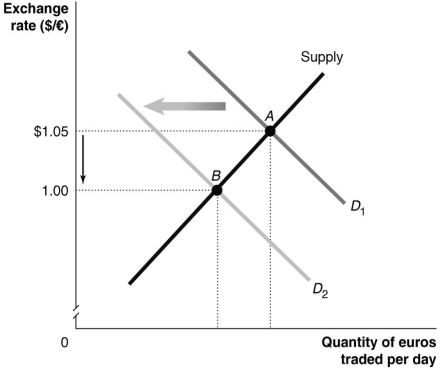 -Which of the following would cause the change depicted in Figure 19.4? Note that the figure depicts the quantity of euros traded.
 (Multiple Choice)
4.9/5 (83)
(83) The real exchange rate of Japanese yen to Australian dollars will increase if Australia's price level ________ and the nominal exchange rate of yen to the dollar ________.
(Multiple Choice)
4.9/5 (73)
(73) If the rate of inflation in Australia exceeds the rate of inflation in Great Britain,we would expect the Australian dollar to depreciate in value against the British pound.
(True/False)
4.8/5 (90)
(90) What effect does an open economy have on the effectiveness of monetary policy and fiscal policy?
(Essay)
4.9/5 (84)
(84) Assume the exchange rate between the dollar and yen is ¥80= $1.Suppose that the exchange rate changes to ¥75 = $1.As a result of the change,there will be
(Multiple Choice)
4.9/5 (88)
(88) The model of purchasing power parity is the only way to determine whether a country's currency is undervalued or overvalued.
(True/False)
4.9/5 (80)
(80) The demand by other countries for Australian dollars will increase when
(Multiple Choice)
4.9/5 (74)
(74) During the 1980s,Australia ________ twin deficits and in the 1990s,Australia ________ twin deficits.
(Multiple Choice)
4.8/5 (82)
(82) Suppose the prices of Australian goods are rising faster than prices of goods in Great Britain.If purchasing power parity holds,then
(Multiple Choice)
4.8/5 (84)
(84) Contractionary fiscal policy lowers the budget deficit.In an open economy this may ________ the foreign exchange value of the dollar,and ________ net exports.
(Multiple Choice)
4.8/5 (79)
(79) Which of the following is a true statement describing expansionary fiscal policy's impact in open and closed economies?
(Multiple Choice)
5.0/5 (82)
(82) The ________ account records flows of funds into and out of a country.
(Multiple Choice)
4.9/5 (79)
(79) A speculative attack is the result of investors' expectations that the future value of a currency will decline.
(True/False)
4.7/5 (76)
(76) 
Filters
- Essay(0)
- Multiple Choice(0)
- Short Answer(0)
- True False(0)
- Matching(0)