



 Chat with AI
Exam 19: Comparative Advantage, international Trade, and Exchange Rates

Exam 1: Economics: Foundations and Models160 Questions
Exam 2: Trade-Offs, comparative Advantage, and the Market System191 Questions
Exam 3: Where Prices Come From: the Interaction of Demand and Supply241 Questions
Exam 4: Market Efficiency and Market Failure226 Questions
Exam 5: The Economics of Healthcare169 Questions
Exam 6: Firms,the Stock Market,and Corporate Governance255 Questions
Exam 7: Consumer Choice and Elasticity270 Questions
Exam 8: Technology, production, and Costs277 Questions
Exam 9: Firms in Perfectly Competitive Markets351 Questions
Exam 10: Monopoly and Antitrust253 Questions
Exam 11: Monopolistic Competition and Oligopoly304 Questions
Exam 12: GDP: Measuring Total Production and Income200 Questions
Exam 13: Unemployment and Inflation207 Questions
Exam 14: Economic Growth, the Financial System and Business Cycles172 Questions
Exam 15: Aggregate Demand and Aggregate Supply Analysis120 Questions
Exam 16: Money, banks, and the Federal Reserve System139 Questions
Exam 17: Monetary Policy180 Questions
Exam 18: Fiscal Policy131 Questions
Exam 19: Comparative Advantage, international Trade, and Exchange Rates247 Questions
Select questions type


Soon after the Australia dollar was floated,it ________ against the United States dollar and ________ against other major currencies.
(Multiple Choice)
4.8/5  (67)
(67) Hypothetically,what would a report that argues that the dollar is 'undervalued' mean? How would foreign exchange markets respond to this information? Support your answer graphically.
(Essay)
4.8/5 (88)
(88) What is the relationship across the current account,the capital account,the financial account and the balance of payments?
(Essay)
4.9/5 (81)
(81) According to the theory of purchasing power parity,the foreign exchange market will
(Multiple Choice)
4.8/5 (83)
(83) How does a decrease in value of a country's currency relative to other currencies affect its balance of trade on goods and services?
(Multiple Choice)
4.8/5 (71)
(71) Figure 19.3 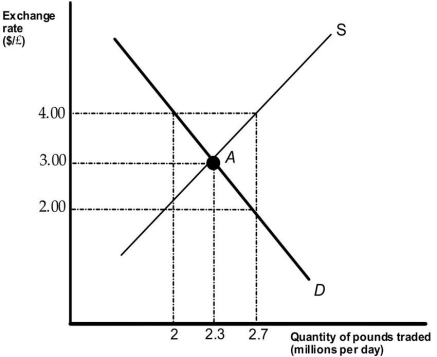 -Suppose the graph in Figure 19.3 represents the market for the British pound under the Bretton Woods System.If the par exchange rate was set at 4 United States dollars
 (Multiple Choice)
4.9/5 (72)
(72) How will the exchange rate (foreign currency per dollar)respond to a decrease in the relative rate of productivity growth in Australia in the long run?
(Multiple Choice)
4.8/5 (78)
(78) Figure 19.2  -Refer to Figure 19.2.Currency speculators believe that the value of the euro will decrease relative to the dollar.Assuming ceteris paribus,how would this be represented?
 (Multiple Choice)
4.8/5 (71)
(71) Show what will happen in the market for yen if Japan's central bank sells yen for dollars,and explain what will happen to Australia's current account,ceteris paribus,because of this action.
(Essay)
4.8/5 (85)
(85) Your friend states that (i)a strong dollar (appreciation of the dollar)is a sign of a healthy economy and that (ii)a weak dollar (depreciation of the dollar)is a sign of a weak economy.Assuming that other factors that could affect the exchange rate do not change,explain that the opposite is true when the following are considered:
a. the effect of rapidly falling incomes in Australia during a recession
b. the effect of rapidly rising incomes in Australia during an economic expansion
(Essay)
4.8/5 (70)
(70) Under the Bretton Woods System,if the par rate per British pound-defined as United States (US)dollars per pound-was below its equilibrium value,then
(Multiple Choice)
4.7/5 (79)
(79) If an Australian company sells insurance to a foreign company,how does this affect Australia's balance of payments?
(Multiple Choice)
4.8/5 (81)
(81) A large federal budget deficit will not lead to a current account deficit if private saving ________ or domestic investment ________.
(Multiple Choice)
4.8/5 (77)
(77) Suppose that Australia's price level is 125,the British price level is 100,and the nominal exchange rate of pounds to the dollar is £0.60 = $1,then the real exchange rate of pounds to the dollar is
(Multiple Choice)
4.9/5 (70)
(70) Assume that the exchange rate between the dollar and the yen is ¥60 = $1.Suppose the exchange rate changes to ¥100 = $1.Because of the change
(Multiple Choice)
4.7/5 (69)
(69) How will the exchange rate (foreign currency per dollar)respond to an increase in the preference for imported goods by Australians in the long run,ceteris paribus?
(Multiple Choice)
4.9/5 (65)
(65) Suppose that average productivity of Chinese firms increases more rapidly than the average productivity of Australian firms,then
(Multiple Choice)
4.8/5 (63)
(63) 
Filters
- Essay(0)
- Multiple Choice(0)
- Short Answer(0)
- True False(0)
- Matching(0)