



 Chat with AI
Exam 13: Money Creation and Deposit Insurance

Exam 1: The Nature of Economics171 Questions
Exam 2: Production Possibilities and Economic Systems137 Questions
Exam 3: Demand and Supply177 Questions
Exam 4: Introduction to Macroeconomics112 Questions
Exam 5: Measuring the Economys Performance106 Questions
Exam 6: Modelling Real Gdp and the Price Level in the Long Run115 Questions
Exam 7: Economic Growth and Development109 Questions
Exam 8: Modelling Real Gdp and the Price Level in the Short Run115 Questions
Exam 9: Consumption, investment, and the Multiplier120 Questions
Exam 10: The Public Sector129 Questions
Exam 11: Fiscal Policy and the Public Debt116 Questions
Exam 12: Money and the Banking System112 Questions
Exam 13: Money Creation and Deposit Insurance115 Questions
Exam 14: The Bank of Canada and Monetary Policy131 Questions
Exam 15: Issues in Stabilization Policy115 Questions
Exam 16: Comparative Advantage and the Open Economy92 Questions
Exam 17: Exchange Rates and the Balance of Payments105 Questions
Select questions type


When all banks have zero excess reserves to start and you write a cheque that is deposited in another bank,it is true that
(Multiple Choice)
4.9/5  (77)
(77) If the desired reserve ratio is 10 percent,the money multiplier is
(Multiple Choice)
4.8/5 (73)
(73) The required ratio is 10 percent of their deposits as reserves.Currently,there are $200 billion in deposits.The Bank of Canada raises the reserve requirement to 20 percent.Consequently,
(Multiple Choice)
5.0/5 (82)
(82) If the desired reserve requirement is raised,the money multiplier
(Multiple Choice)
4.7/5 (81)
(81) Table 13-4
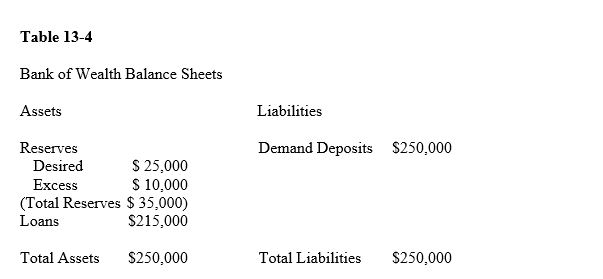 -In Table 13-4,the Bank of Wealth is subject to a desired reserve ratio of
 (Multiple Choice)
4.9/5 (73)
(73) Under a system of fractional reserve banking,the desired reserve ratio is the ratio of
(Multiple Choice)
4.9/5 (92)
(92) The required reserve ratio is 20 percent.All banks have zero excess reserves.A check for $1 million is deposited in Bank A,written on an account from Bank B.What are the new excess reserves at Bank A,and by how much does the money supply change if all banks make loans so that they have zero excess reserves?
(Multiple Choice)
4.7/5 (85)
(85) As far as reserves and deposits are concerned,describe the assets and liabilities of a bank.
(Essay)
4.7/5 (76)
(76) A bank with $200 million in deposits keeps $20 million of cash in the bank vault,$10 million in deposits at the Bank of Canada,and $5 million in government securities in the bank vault.Its actual reserves equal
(Multiple Choice)
4.7/5 (80)
(80) What are the maximum and minimum values the deposit multiplier can potentially take on.
(Essay)
4.7/5 (82)
(82) If a bank holds $20,000 in desired reserves in order to meet a desired reserve ratio of 40 percent,demand deposits must equal
(Multiple Choice)
4.9/5 (80)
(80) A bank currently has $100 million in deposits,$6 million in cash in the vault,deposits with the Bank of Canada of $4 million,and other assets equal to $90 million.The desired reserve ratio is 10 percent.A new deposit is made of $1 million.What is the maximum sized loan the bank can now make?
(Multiple Choice)
4.7/5 (86)
(86) Provide a brief discussion and exposition on the money multiplier;how it works,what its effects are and what the consequences of leakages are on creation of deposits.
(Essay)
4.9/5 (80)
(80) A bank with $500 million in deposits holds $35 million in vault cash,has $40 million on deposit with the Bank of Canada,and owns $50 million in government securities.If a fall in the desired reserve ratio generates excess reserves of $25 million,and prior to the fall the bank had no excess reserves,then the former desired reserve ratio was ________ and the new desired reserve ratio is ________.
(Multiple Choice)
4.8/5 (81)
(81) 
Filters
- Essay(0)
- Multiple Choice(0)
- Short Answer(0)
- True False(0)
- Matching(0)