



 Chat with AI
Exam 13: Money Creation and Deposit Insurance

Exam 1: The Nature of Economics171 Questions
Exam 2: Production Possibilities and Economic Systems137 Questions
Exam 3: Demand and Supply177 Questions
Exam 4: Introduction to Macroeconomics112 Questions
Exam 5: Measuring the Economys Performance106 Questions
Exam 6: Modelling Real Gdp and the Price Level in the Long Run115 Questions
Exam 7: Economic Growth and Development109 Questions
Exam 8: Modelling Real Gdp and the Price Level in the Short Run115 Questions
Exam 9: Consumption, investment, and the Multiplier120 Questions
Exam 10: The Public Sector129 Questions
Exam 11: Fiscal Policy and the Public Debt116 Questions
Exam 12: Money and the Banking System112 Questions
Exam 13: Money Creation and Deposit Insurance115 Questions
Exam 14: The Bank of Canada and Monetary Policy131 Questions
Exam 15: Issues in Stabilization Policy115 Questions
Exam 16: Comparative Advantage and the Open Economy92 Questions
Exam 17: Exchange Rates and the Balance of Payments105 Questions
Select questions type


Following a new deposit of $50 when the desired reserve ratio is 10 percent,the maximum increase in the assets of commercial banks will be
(Multiple Choice)
4.8/5  (81)
(81) A bank with deposits of $200 million keeps $20 million in cash in its vault,$15 million of deposits at the Bank of Canada,and $10 million in government securities.The desired reserve requirement is 15 percent.The bank has excess reserves of
(Multiple Choice)
4.8/5 (75)
(75) Table 13-3
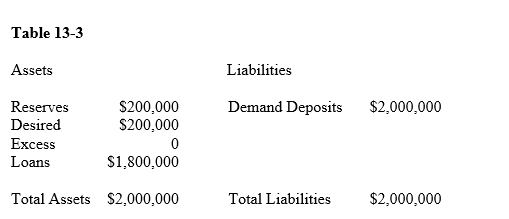 -In Table 13-3,the money multiplier for the banking system is
 (Multiple Choice)
4.9/5 (82)
(82) Following a new deposit of $200,a commercial bank subject to a 15 percent desired reserve ratio will have what eventual change to its balance sheet?
(Multiple Choice)
4.8/5 (72)
(72) Explain how a currency drain affects the size of the money multiplier.In your explanation,suppose that a bank gains $1 million in new deposits and reserves.Further suppose that the desired reserve ratio is 10 percent and the currency drain is 33.33 percent.
(Essay)
5.0/5 (84)
(84) Table 13-1
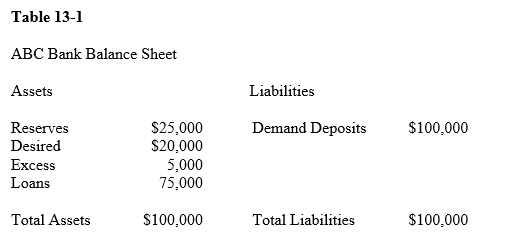 -According to Table 13-1,the desired reserve ratio for the ABC Bank is
 (Multiple Choice)
4.9/5 (88)
(88) Table 13-1
-In Table 13-1,suppose that $20,000 in new deposits is received by the bank.If there were no other changes in the balance sheet,then the bank would be in a position to make new loans in the amount of
-In Table 13-1,suppose that $20,000 in new deposits is received by the bank.If there were no other changes in the balance sheet,then the bank would be in a position to make new loans in the amount of (Multiple Choice)
4.8/5 (69)
(69) Table 13-2
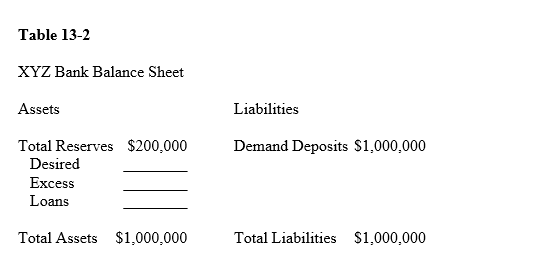 -In Table 13-2,if excess reserves for XYZ Bank are $30,000,the desired reserve ratio
 (Multiple Choice)
5.0/5 (72)
(72) A bank currently has $50 million in deposits,$6 million in cash in the vault,$4 million on deposit with the Bank of Canada,and $5 million in government securities.The required reserve ratio is 20 percent.A new deposit is made of $1 million.What is the maximum size loan the bank can now make?
(Multiple Choice)
4.8/5 (71)
(71) Following a new deposit of $500,the loans of a commercial bank increase by $400.In this situation,the desired reserve ratio is most likely
(Multiple Choice)
4.8/5 (67)
(67) The reason that the commercial banking system can generate a multiple expansion or contraction of the money supply is that
(Multiple Choice)
4.8/5 (82)
(82) If there are zero excess reserves in the Canadian banking system and the Bank of Canada raises the required reserve ratio from 10 percent to 20 percent,then
(Multiple Choice)
4.9/5 (67)
(67) Table 13-4
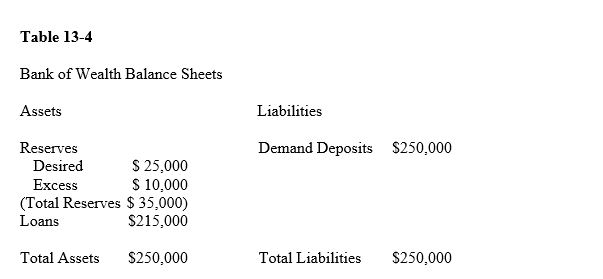 -In Table 13-4,the Bank of Wealth can make additional loans up to
 (Multiple Choice)
4.9/5 (75)
(75) If depository insurance exists,bank managers may make riskier loans than they would have otherwise,which is an example of
(Multiple Choice)
4.8/5 (87)
(87) Table 13-4
-In Table 13-4,if a customer withdrew $10,000 the bank would
-In Table 13-4,if a customer withdrew $10,000 the bank would (Multiple Choice)
4.8/5 (81)
(81) 
Filters
- Essay(0)
- Multiple Choice(0)
- Short Answer(0)
- True False(0)
- Matching(0)