



 Chat with AI
Exam 13: Money Creation and Deposit Insurance

Exam 1: The Nature of Economics171 Questions
Exam 2: Production Possibilities and Economic Systems137 Questions
Exam 3: Demand and Supply177 Questions
Exam 4: Introduction to Macroeconomics112 Questions
Exam 5: Measuring the Economys Performance106 Questions
Exam 6: Modelling Real Gdp and the Price Level in the Long Run115 Questions
Exam 7: Economic Growth and Development109 Questions
Exam 8: Modelling Real Gdp and the Price Level in the Short Run115 Questions
Exam 9: Consumption, investment, and the Multiplier120 Questions
Exam 10: The Public Sector129 Questions
Exam 11: Fiscal Policy and the Public Debt116 Questions
Exam 12: Money and the Banking System112 Questions
Exam 13: Money Creation and Deposit Insurance115 Questions
Exam 14: The Bank of Canada and Monetary Policy131 Questions
Exam 15: Issues in Stabilization Policy115 Questions
Exam 16: Comparative Advantage and the Open Economy92 Questions
Exam 17: Exchange Rates and the Balance of Payments105 Questions
Select questions type


The money multiplier is equal to

Free
(Multiple Choice)
5.0/5  (81)
(81) Correct Answer: Verified
B
Fractional reserve banking refers to a banking system in which
Free
(Multiple Choice)
4.7/5 (72)
(72) Correct Answer:Verified
VerifiedB
Table 13-1
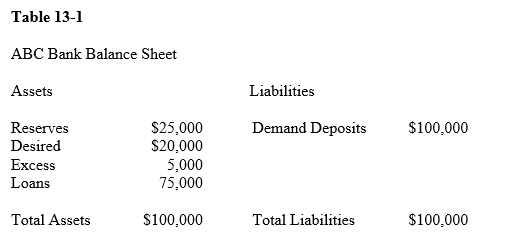 -In Table 13-1,suppose that $10,000 in new deposits is received by the bank.If there were no other changes in the balance sheet,then the bank would be in a position to make new loans in the amount of
Free
(Multiple Choice)
4.8/5 (78)
(78) Correct Answer:Verified
VerifiedA
"An increase in the reserve requirement is a tax increase on banks." Do you agree or disagree with this statement? Why?
(Essay)
4.9/5 (77)
(77) With the fractional banking system in Canada,a commercial bank with $1,000 of deposits generally would
(Multiple Choice)
4.8/5 (94)
(94) The desired reserve ratio is 10 percent.A bank with $10 million in deposits has $700,000 in vault cash and $200,000 on deposit with the Bank of Canada.A person deposits a cheque for $1 million in the bank.The excess reserves of the bank are now
(Multiple Choice)
4.9/5 (84)
(84) Asymmetric information before a transaction takes place generates the problem of
(Multiple Choice)
4.8/5 (77)
(77) Table 13-1
-In Table 13-1,suppose that $15,000 in new deposits is received by the bank.If there were no other changes in the balance sheet,then the bank would be in a position to make new loans in the amount of
-In Table 13-1,suppose that $15,000 in new deposits is received by the bank.If there were no other changes in the balance sheet,then the bank would be in a position to make new loans in the amount of (Multiple Choice)
4.8/5 (83)
(83) Table 13-4
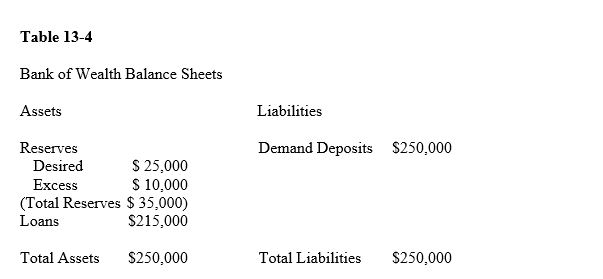 -In Table 13-4,if the Bank of Wealth purchases a $25,000 government security
 (Multiple Choice)
4.8/5 (82)
(82) Describe how desired reserves are used in the banking structure in Canada.More specifically,who sets the desired reserves and how are they used to expand the money supply.
(Essay)
4.8/5 (85)
(85) What forces can make the money multiplier smaller than the reciprocal of the required reserve ratio?
(Essay)
4.7/5 (86)
(86) If the desired reserve ratio is 10 percent and reserves in the commercial banking system increase by $10,000,the maximum possible expansion of demand deposits is
(Multiple Choice)
4.7/5 (78)
(78) There are zero excess reserves at all banks and the required reserve ratio is 20 percent.If a check for $100,000 on Bank ABC is deposited in Bank XYZ,then excess reserves at Bank ABC equal ________ and excess reserves at Bank XYZ equal ________.
(Multiple Choice)
4.8/5 (89)
(89) Most economists would argue that a significant increase in the supply of money will
(Multiple Choice)
4.8/5 (67)
(67) If a bank has $100,000 in demand deposits and $30,000 on reserve with a 20 percent reserve requirement,the bank
(Multiple Choice)
4.9/5 (82)
(82) The desired reserve ratio is 10 percent.All banks have zero excess reserves.A cheque for $500,000 is deposited in Bank A,written on an account at Bank B.By how much does the money supply change if all banks make loans so that they have zero excess reserves?
(Multiple Choice)
5.0/5 (87)
(87) 
Filters
- Essay(0)
- Multiple Choice(0)
- Short Answer(0)
- True False(0)
- Matching(0)