



 Chat with AI
Exam 18: Macroeconomic Policy II: Fiscal Policy

Exam 1: Thinking Like an Economist89 Questions
Exam 2: Applying Graphs to Economics37 Questions
Exam 3: Production Possibilities and Opportunity Cost122 Questions
Exam 4: Market Demand and Supply120 Questions
Exam 5: Markets in Action120 Questions
Exam 6: Elasticity of Demand and Supply118 Questions
Exam 7: Production Costs119 Questions
Exam 8: Perfect Competition124 Questions
Exam 9: Monopoly120 Questions
Exam 10: Monopolistic Competition and Oligopoly124 Questions
Exam 11: Policy Issues: Housing Affordability and Climate Change79 Questions
Exam 12: Measuring the Size of the Economy124 Questions
Exam 13: Business Cycles and Economic Growth120 Questions
Exam 14: Inflation and Unemployment116 Questions
Exam 15: A Simple Model of the Macro Economy134 Questions
Exam 16: The Monetary and Financial System123 Questions
Exam 17: Macroeconomic Policy I: Monetary Policy120 Questions
Exam 18: Macroeconomic Policy II: Fiscal Policy123 Questions
Exam 19: International Trade and Finance132 Questions
Select questions type


A tax multiplier equal to -4.30 would imply that a $100 tax increase would lead to a:
(Multiple Choice)
4.8/5  (81)
(81) Narrbegin Exhibit 17.3  -According to Exhibit 17.3, if we assume the MPC is 0.8, then a shift in the AD curve from AD0 to AD3 would require an increase in government spending of:
 (Multiple Choice)
4.8/5 (76)
(76) Which of the following is not an example of an automatic stabiliser?
(Multiple Choice)
4.9/5 (78)
(78) Narrbegin Exhibit 17.1 Aggregate demand and supply model  -Suppose the economy in Exhibit 17.1 is in equilibrium at point E1 and the marginal propensity to consume (MPC) is 0.8. Following Keynesian economics, to restore full employment, the government should cut taxes by:
 (Multiple Choice)
5.0/5 (88)
(88) Automatic stabilisers are government programs that tend to push the federal budget toward deficit as the real GDP rises and toward surplus as the real GDP falls.
(True/False)
4.8/5 (78)
(78) If the government wants to run an expansionary fiscal policy by increasing consumption, the best alternative is likely to be:
(Multiple Choice)
4.8/5 (76)
(76) The cyclically adjusted budget deficit is the planned deficit for future times.
(True/False)
4.9/5 (76)
(76) Assume Parliament enacts a $10 billion increase in spending and a $10 billion tax increase to finance the additional government spending. The result of this balanced-budget approach is a:
(Multiple Choice)
4.9/5 (63)
(63) When the economy enters a prosperity phase, unemployment benefits:
(Multiple Choice)
4.8/5 (82)
(82) According to supply-side fiscal policy, reducing tax rates on wages and profits will:
(Multiple Choice)
4.8/5 (74)
(74) The presence of automatic stabilisers means an increase in the budget deficit will be automatically experienced during an economic expansion whereas a budget surplus will be automatically experienced during a recession.
(True/False)
5.0/5 (79)
(79) Narrbegin Exhibit 17.2 Aggregate demand and supply model 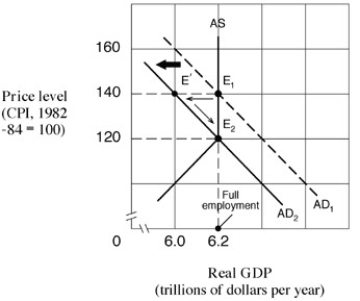 -Suppose the economy in Exhibit 17.2 is in equilibrium at point E1 and the marginal propensity to consume (MPC) is 0.75. Following Keynesian economics, the federal government can move the economy to point E2 and reduce inflation by:
 (Multiple Choice)
4.9/5 (81)
(81) According to supply-side economists, substantial tax cuts will result in:
(Multiple Choice)
4.9/5 (81)
(81) 
Filters
- Essay(0)
- Multiple Choice(0)
- Short Answer(0)
- True False(0)
- Matching(0)