



 Chat with AI
Exam 11: Policy Issues: Housing Affordability and Climate Change

Exam 1: Thinking Like an Economist89 Questions
Exam 2: Applying Graphs to Economics37 Questions
Exam 3: Production Possibilities and Opportunity Cost122 Questions
Exam 4: Market Demand and Supply120 Questions
Exam 5: Markets in Action120 Questions
Exam 6: Elasticity of Demand and Supply118 Questions
Exam 7: Production Costs119 Questions
Exam 8: Perfect Competition124 Questions
Exam 9: Monopoly120 Questions
Exam 10: Monopolistic Competition and Oligopoly124 Questions
Exam 11: Policy Issues: Housing Affordability and Climate Change79 Questions
Exam 12: Measuring the Size of the Economy124 Questions
Exam 13: Business Cycles and Economic Growth120 Questions
Exam 14: Inflation and Unemployment116 Questions
Exam 15: A Simple Model of the Macro Economy134 Questions
Exam 16: The Monetary and Financial System123 Questions
Exam 17: Macroeconomic Policy I: Monetary Policy120 Questions
Exam 18: Macroeconomic Policy II: Fiscal Policy123 Questions
Exam 19: International Trade and Finance132 Questions
Select questions type


Once the carbon trading scheme is in place:

Free
(Multiple Choice)
4.8/5  (87)
(87) Correct Answer: Verified
A
An example of a policy that is not designed to reduce the output of the activity creating the negative externality is a:
Free
(Multiple Choice)
4.8/5 (84)
(84) Correct Answer:Verified
VerifiedC
Narrbegin Exhibit 10.2 Carbon emissions as an externality 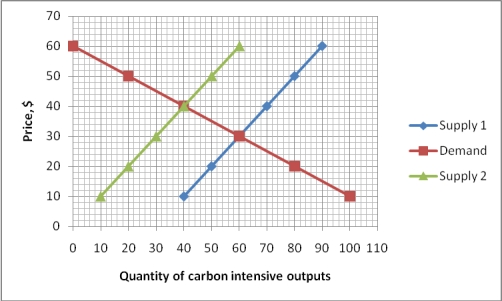 -In Exhibit 10.2, which of the following is likely to be true? Assume that the private supply is 'Supply 1' and the supply including carbon tax is 'Supply 2'.
Free
(Multiple Choice)
4.8/5 (73)
(73) Correct Answer:Verified
VerifiedB
A New South Wales government subsidised the installation of household solar rooftop generators at the cost of:
(Multiple Choice)
4.9/5 (75)
(75) Narrbegin Exhibit 10.4 The market for permits 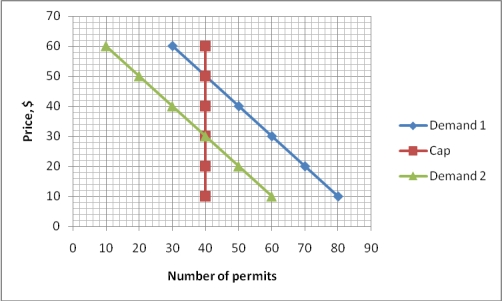 -In Exhibit 10.4, if the demand for permits is 'Demand 1', the price of permits is equal to:
 (Multiple Choice)
4.8/5 (94)
(94) Narrbegin Exhibit 10.2 Carbon emissions as an externality
-In Exhibit 10.2, the market demand curve 'Demand' and market supply curve 'Supply 1' establish a:
-In Exhibit 10.2, the market demand curve 'Demand' and market supply curve 'Supply 1' establish a: (Multiple Choice)
4.9/5 (84)
(84) If the external costs of carbon emissions were included in the industry supply curve:
(Multiple Choice)
5.0/5 (85)
(85) Narrbegin Exhibit 10.4 The market for permits
-In Exhibit 10.4, if the demand for permits is 'Demand 2', the price of permits is equal to:
-In Exhibit 10.4, if the demand for permits is 'Demand 2', the price of permits is equal to: (Multiple Choice)
4.7/5 (77)
(77) Narrbegin Exhibit 10.2 Carbon emissions as an externality
-In Exhibit 10.2, which of the following is likely to be true?
-In Exhibit 10.2, which of the following is likely to be true? (Multiple Choice)
4.8/5 (78)
(78) Narrbegin Exhibit 10.3 Price and demand for permits data
Price Quantity 10 110 20 100 30 90 40 80 50 70 60 60 Narrend
-In Exhibit 10.3, if the 'cap' is set at 80 permits, and the demand for the permits decreased by 20 units at each price level, the resulting price of permits is equal to:
(Multiple Choice)
4.9/5 (83)
(83) Narrbegin Exhibit 10.2 Carbon emissions as an externality
-Suppose that firms are required to purchase equipment to reduce carbon emissions. How is this illustrated in Exhibit 10.2?
-Suppose that firms are required to purchase equipment to reduce carbon emissions. How is this illustrated in Exhibit 10.2? (Multiple Choice)
4.8/5 (99)
(99) 
Filters
- Essay(0)
- Multiple Choice(0)
- Short Answer(0)
- True False(0)
- Matching(0)