



 Chat with AI
Exam 19: International Trade and Finance

Exam 1: Thinking Like an Economist89 Questions
Exam 2: Applying Graphs to Economics37 Questions
Exam 3: Production Possibilities and Opportunity Cost122 Questions
Exam 4: Market Demand and Supply120 Questions
Exam 5: Markets in Action120 Questions
Exam 6: Elasticity of Demand and Supply118 Questions
Exam 7: Production Costs119 Questions
Exam 8: Perfect Competition124 Questions
Exam 9: Monopoly120 Questions
Exam 10: Monopolistic Competition and Oligopoly124 Questions
Exam 11: Policy Issues: Housing Affordability and Climate Change79 Questions
Exam 12: Measuring the Size of the Economy124 Questions
Exam 13: Business Cycles and Economic Growth120 Questions
Exam 14: Inflation and Unemployment116 Questions
Exam 15: A Simple Model of the Macro Economy134 Questions
Exam 16: The Monetary and Financial System123 Questions
Exam 17: Macroeconomic Policy I: Monetary Policy120 Questions
Exam 18: Macroeconomic Policy II: Fiscal Policy123 Questions
Exam 19: International Trade and Finance132 Questions
Select questions type


A favourable balance of trade occurs when:

Free
(Multiple Choice)
5.0/5  (96)
(96) Correct Answer: Verified
D
A tariff has the effect of granting _____ a larger share of the domestic market.
Free
(Multiple Choice)
4.8/5 (93)
(93) Correct Answer:Verified
VerifiedC
If a Japanese stereo priced at 1 000 000 yen can be purchased for A$1000, the exchange rate is:
Free
(Multiple Choice)
4.8/5 (73)
(73) Correct Answer:Verified
VerifiedC
Narrbegin Exhibit 18.2 Production possibilities curves for US and Mexico 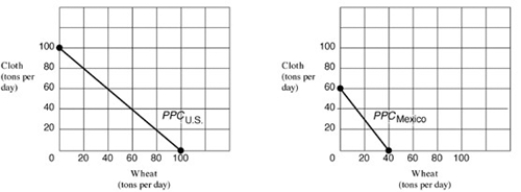 -As shown in Exhibit 18.2, the United States has a comparative advantage over Mexico in:
 (Multiple Choice)
4.8/5 (81)
(81) An increase in inflation in the United States relative to the rate in France would make:
(Multiple Choice)
4.8/5 (71)
(71) Narrbegin Exhibit 18.1 Production possibilities curves  -In Exhibit 18.1, the production possibilities curves of wheat and corn for Nabia and Pada are presented. In Nabia the cost of producing one more unit of wheat is equal to:
 (Multiple Choice)
4.9/5 (79)
(79) A country's imports of goods minus its exports of goods are reported in the goods balance.
(True/False)
4.8/5 (62)
(62) Which of the following would cause the Australian dollar to depreciate against the Japanese yen?
(Multiple Choice)
4.8/5 (67)
(67) Free trade allows countries to specialise in producing goods and services they have an absolute advantage in, without restrictions or taxes and subsidies applied to their flow.
(True/False)
4.9/5 (86)
(86) A limit on the quantity of a good that may be imported in a given time period is called:
(Multiple Choice)
4.9/5 (71)
(71) The main explanation for why the cheap foreign-labour argument is a poor reason for restricting international trade is that:
(Multiple Choice)
5.0/5 (82)
(82) Narrbegin Exhibit 18.3 Potatoes and wheat output (tonnes per day)
Cuuntry Putatoes Wheat Australia 4 2 Ireland 3 1
-In Exhibit 18.3, Australia has a comparative advantage in producing:
(Multiple Choice)
4.9/5 (74)
(74) Which of the following statements is true with respect to a tariff on imported cheese?
(Multiple Choice)
4.9/5 (70)
(70) In a two-good, two-country world, a country has a comparative advantage in any good for which it has a:
(Multiple Choice)
4.9/5 (99)
(99) If a nation follows a policy of being self-sufficient, its:
(Multiple Choice)
4.9/5 (77)
(77) If the Australian dollar appreciates, the effect of this is likely to be:
(Multiple Choice)
4.9/5 (71)
(71) Narrbegin Exhibit 18.3 Potatoes and wheat output (tonnes per day)
Cuuntry Putatoes Wheat Australia 4 2 Ireland 3 1
-In Exhibit 18.3, Australia has an absolute advantage in producing:
(Multiple Choice)
4.9/5 (86)
(86) 
Filters
- Essay(0)
- Multiple Choice(0)
- Short Answer(0)
- True False(0)
- Matching(0)