



 Chat with AI
Exam 9: Monopoly

Exam 1: Thinking Like an Economist89 Questions
Exam 2: Applying Graphs to Economics37 Questions
Exam 3: Production Possibilities and Opportunity Cost122 Questions
Exam 4: Market Demand and Supply120 Questions
Exam 5: Markets in Action120 Questions
Exam 6: Elasticity of Demand and Supply118 Questions
Exam 7: Production Costs119 Questions
Exam 8: Perfect Competition124 Questions
Exam 9: Monopoly120 Questions
Exam 10: Monopolistic Competition and Oligopoly124 Questions
Exam 11: Policy Issues: Housing Affordability and Climate Change79 Questions
Exam 12: Measuring the Size of the Economy124 Questions
Exam 13: Business Cycles and Economic Growth120 Questions
Exam 14: Inflation and Unemployment116 Questions
Exam 15: A Simple Model of the Macro Economy134 Questions
Exam 16: The Monetary and Financial System123 Questions
Exam 17: Macroeconomic Policy I: Monetary Policy120 Questions
Exam 18: Macroeconomic Policy II: Fiscal Policy123 Questions
Exam 19: International Trade and Finance132 Questions
Select questions type


If a monopoly holds a patent over a good, it is often because they paid the most money for it.

Free
(True/False)
4.9/5  (83)
(83) Correct Answer: Verified
False
The physical production of medicinal drugs is often only a very small fraction of the eventual price consumers pay. Which of the following may explain this?
Free
(Multiple Choice)
4.8/5 (80)
(80) Correct Answer:Verified
VerifiedB
If a good has no close substitutes, the market is likely to be:
Free
(Multiple Choice)
4.8/5 (81)
(81) Correct Answer:Verified
VerifiedA
Economies of scale means that competition is unsustainable because:
(Multiple Choice)
4.8/5 (90)
(90) If a big firm is needed to produce at low cost, then natural monopoly can occur.
(True/False)
4.9/5 (75)
(75) In a natural monopoly, the long-run average cost curve declines and therefore average cost is lower when there is only one seller.
(True/False)
4.8/5 (64)
(64) One necessary condition for effective price discrimination is:
(Multiple Choice)
4.9/5 (71)
(71) Narrbegin Exhibit 8.4 Demand and cost curves for a monopolist 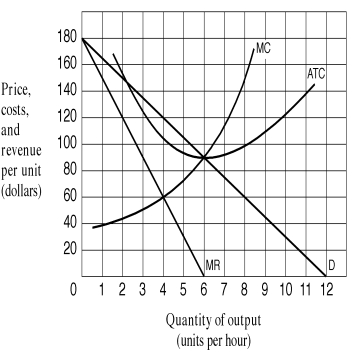 -As shown in Exhibit 8.4, in order to maximise its profit (or minimise its loss), what price should the monopoly charge for its product?
 (Multiple Choice)
4.9/5 (73)
(73) The condition/s required for a monopolist to engage in price discrimination is/are:
(Multiple Choice)
4.9/5 (64)
(64) The efficient allocation of resources is based on the fact that:
(Multiple Choice)
4.9/5 (91)
(91) If the firm owns vital resources, the market is likely to be:
(Multiple Choice)
4.7/5 (75)
(75) When marginal revenue is zero for a monopolist facing a downward-sloping, straight-line demand curve, the price elasticity of demand is:
(Multiple Choice)
4.8/5 (82)
(82) Compared to a perfectly competitive firm with the same cost structure, a monopoly firm will charge a:
(Multiple Choice)
4.7/5 (77)
(77) A price-discriminating monopoly charges the lowest price to the group that:
(Multiple Choice)
4.8/5 (69)
(69) Mobile phone companies offer alternative pricing plans to consumers, who can then choose the one that suits them best. This is an example of:
(Multiple Choice)
4.7/5 (77)
(77) 
Filters
- Essay(0)
- Multiple Choice(0)
- Short Answer(0)
- True False(0)
- Matching(0)