



 Chat with AI
Exam 9: Monopoly

Exam 1: Thinking Like an Economist89 Questions
Exam 2: Applying Graphs to Economics37 Questions
Exam 3: Production Possibilities and Opportunity Cost122 Questions
Exam 4: Market Demand and Supply120 Questions
Exam 5: Markets in Action120 Questions
Exam 6: Elasticity of Demand and Supply118 Questions
Exam 7: Production Costs119 Questions
Exam 8: Perfect Competition124 Questions
Exam 9: Monopoly120 Questions
Exam 10: Monopolistic Competition and Oligopoly124 Questions
Exam 11: Policy Issues: Housing Affordability and Climate Change79 Questions
Exam 12: Measuring the Size of the Economy124 Questions
Exam 13: Business Cycles and Economic Growth120 Questions
Exam 14: Inflation and Unemployment116 Questions
Exam 15: A Simple Model of the Macro Economy134 Questions
Exam 16: The Monetary and Financial System123 Questions
Exam 17: Macroeconomic Policy I: Monetary Policy120 Questions
Exam 18: Macroeconomic Policy II: Fiscal Policy123 Questions
Exam 19: International Trade and Finance132 Questions
Select questions type


A common criticism of price discrimination is that it seems to:
(Multiple Choice)
4.8/5  (78)
(78) A monopolist is always earning economic profits but a perfectly competitive firm is not.
(True/False)
4.8/5 (81)
(81) Narrbegin Exhibit 8.5 Demand and cost data for a monopolist
Price Quantity TR MR Profi \ 10 1 10 10 4 9 2 8 8 3 12 7 4 16 6 5 20 5 6 24 4 7 28 3 8 32 2 9 36 1 10 40
-Refer to Exhibit 8.5. The demand schedule and cost schedule for a monopolist are provided. Which output level maximises profit?
(Multiple Choice)
4.8/5 (65)
(65) Suppose there is only one airline that travels from one island to another. Assume that business travellers have a low elasticity of demand for air travel. Holiday travellers on the other hand are flexible and are sensitive to price. Price discrimination can occur because:
(Multiple Choice)
4.8/5 (77)
(77) At any point where a monopolist's marginal revenue is positive, the downward-sloping, straight-line demand curve is:
(Multiple Choice)
4.8/5 (71)
(71) Perfect competition is considered more efficient than monopoly because, in perfect competition:
(Multiple Choice)
4.9/5 (82)
(82) A monopoly sets a market price that is higher than the marginal cost of production. This fact implies that a monopoly's allocation of resources is:
(Multiple Choice)
4.8/5 (82)
(82) There is only one hairdressing salon on campus. That means it is possibly a/an:
(Multiple Choice)
4.8/5 (90)
(90) Suppose a monopolist's demand curve lies below its average variable cost curve. The firm will:
(Multiple Choice)
4.8/5 (81)
(81) Under both perfect competition and a single priced monopoly case, a firm:
(Multiple Choice)
4.8/5 (76)
(76) Narrbegin Exhibit 8.3 Demand and cost curves for GeneTech, a monopolist with a patented vaccine 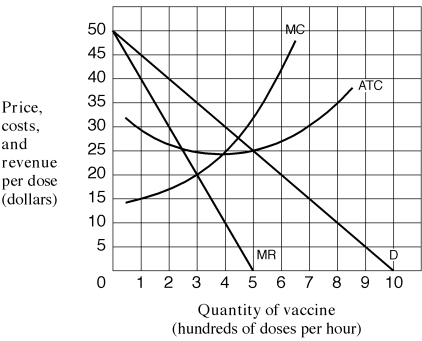 -As shown in Exhibit 8.3, in order to maximise its profit, what price should GeneTech charge for its vaccine?
 (Multiple Choice)
4.8/5 (68)
(68) What is the major difference between perfect competition and monopoly?
(Multiple Choice)
4.9/5 (67)
(67) 
Filters
- Essay(0)
- Multiple Choice(0)
- Short Answer(0)
- True False(0)
- Matching(0)