



 Chat with AI
Exam 19: International Trade and Finance

Exam 1: Thinking Like an Economist89 Questions
Exam 2: Applying Graphs to Economics37 Questions
Exam 3: Production Possibilities and Opportunity Cost122 Questions
Exam 4: Market Demand and Supply120 Questions
Exam 5: Markets in Action120 Questions
Exam 6: Elasticity of Demand and Supply118 Questions
Exam 7: Production Costs119 Questions
Exam 8: Perfect Competition124 Questions
Exam 9: Monopoly120 Questions
Exam 10: Monopolistic Competition and Oligopoly124 Questions
Exam 11: Policy Issues: Housing Affordability and Climate Change79 Questions
Exam 12: Measuring the Size of the Economy124 Questions
Exam 13: Business Cycles and Economic Growth120 Questions
Exam 14: Inflation and Unemployment116 Questions
Exam 15: A Simple Model of the Macro Economy134 Questions
Exam 16: The Monetary and Financial System123 Questions
Exam 17: Macroeconomic Policy I: Monetary Policy120 Questions
Exam 18: Macroeconomic Policy II: Fiscal Policy123 Questions
Exam 19: International Trade and Finance132 Questions
Select questions type


The account which records a nation's foreign economic transactions is called:
(Multiple Choice)
4.7/5  (78)
(78) Narrbegin Exhibit 18.1 Production possibilities curves  -In Exhibit 18.1, the production possibilities curves of wheat and corn for Nabia and Pada are presented. If these two nations trade, Nabia should specialise in the production of:
 (Multiple Choice)
4.9/5 (79)
(79) Assume Australia can use a given amount of its resources to produce either 20 airplanes or eight automobiles and Japan can employ the same amount of its resources to produce either 20 airplanes or 10 automobiles. Australia should specialise in:
(Multiple Choice)
4.9/5 (81)
(81) Narrbegin Exhibit 18.2 Production possibilities curves for US and Mexico 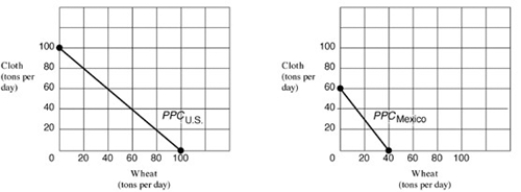 -As shown in Exhibit 18.2, in Mexico, producing one additional ton of wheat costs:
 (Multiple Choice)
4.9/5 (83)
(83) The Japanese demand curve for dollars is downward-sloping because a:
(Multiple Choice)
4.8/5 (85)
(85) Assume that the opportunity cost of producing wheat is lower in Australia compared with Malaysia. Further assume that the opportunity cost of producing cars is higher in Australia compared with Malaysia. Which country has a comparative advantage in producing cars?
(Multiple Choice)
4.8/5 (81)
(81) The current account deficit represents the extent to which a nation's:
(Multiple Choice)
4.9/5 (68)
(68) If a country's goods exports are less than its goods imports, then it experiences a:
(Multiple Choice)
5.0/5 (75)
(75) Shifts in supply and demand for foreign exchange result from changes in relative price levels.
(True/False)
4.7/5 (88)
(88) If a small country is protecting its industry that might mean that:
(Multiple Choice)
4.7/5 (83)
(83) If Australia has a capital account surplus, this indicates:
(Multiple Choice)
4.9/5 (71)
(71) If country A lowers its tariffs even if country B doesn't, then:
(Multiple Choice)
4.7/5 (71)
(71) Assume that the opportunity cost of producing wheat is lower in Australia compared with Malaysia. Further assume that the opportunity cost of producing cars is higher in Australia compared with Malaysia. Which country should specialise in producing cars?
(Multiple Choice)
4.9/5 (74)
(74) If it costs the DuPont Chemical Company more to make the chemical flaxinate in the United States than it does to make it in Taiwan, the Taiwanese must have:
(Multiple Choice)
4.8/5 (76)
(76) Assume that the opportunity cost of producing wheat is lower in Australia compared with Malaysia. Further assume that the opportunity cost of producing cars is higher in Australia compared with Malaysia. Which country has a comparative advantage in producing wheat?
(Multiple Choice)
4.7/5 (84)
(84) By continually running current account deficits, Australia:
(Multiple Choice)
4.8/5 (81)
(81) 
Filters
- Essay(0)
- Multiple Choice(0)
- Short Answer(0)
- True False(0)
- Matching(0)