



 Chat with AI
Exam 18: Macroeconomic Policy II: Fiscal Policy

Exam 1: Thinking Like an Economist89 Questions
Exam 2: Applying Graphs to Economics37 Questions
Exam 3: Production Possibilities and Opportunity Cost122 Questions
Exam 4: Market Demand and Supply120 Questions
Exam 5: Markets in Action120 Questions
Exam 6: Elasticity of Demand and Supply118 Questions
Exam 7: Production Costs119 Questions
Exam 8: Perfect Competition124 Questions
Exam 9: Monopoly120 Questions
Exam 10: Monopolistic Competition and Oligopoly124 Questions
Exam 11: Policy Issues: Housing Affordability and Climate Change79 Questions
Exam 12: Measuring the Size of the Economy124 Questions
Exam 13: Business Cycles and Economic Growth120 Questions
Exam 14: Inflation and Unemployment116 Questions
Exam 15: A Simple Model of the Macro Economy134 Questions
Exam 16: The Monetary and Financial System123 Questions
Exam 17: Macroeconomic Policy I: Monetary Policy120 Questions
Exam 18: Macroeconomic Policy II: Fiscal Policy123 Questions
Exam 19: International Trade and Finance132 Questions
Select questions type


Narrbegin Exhibit 17.4 Aggregate demand and supply curves 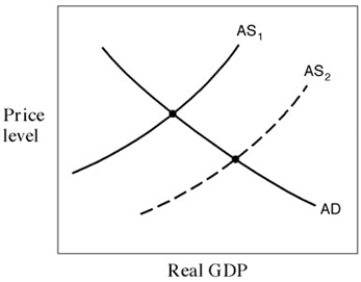 -In Exhibit 17.4, supply-siders claimed that the shift from AS1 to AS2 would occur if the government:
 (Multiple Choice)
4.9/5  (83)
(83) Which of the following is not an example of a supply-side fiscal policy used in Australia?
(Multiple Choice)
4.9/5 (92)
(92) The introduction of the GST in Australia in 2000 was designed to:
(Multiple Choice)
4.8/5 (83)
(83) Assume Parliament enacts a $500 billion increase in spending and a $500 billion tax increase to finance the additional government spending. The result of this balanced-budget approach is a:
(Multiple Choice)
4.9/5 (76)
(76) 'Crowding out' refers to a side-effect of fiscal rather than monetary policy because:
(Multiple Choice)
4.8/5 (88)
(88) A Keynesian approach to fiscal policy would be for government budgets to consistently have a _____ role in the economy.
(Multiple Choice)
4.9/5 (67)
(67) An advocate of supply-side fiscal policy would advocate which of the following?
(Multiple Choice)
5.0/5 (74)
(74) The issuing of government securities to the general public is considered _____ to the government.
(Multiple Choice)
4.9/5 (96)
(96) According to Keynesian economics, fiscal policy should be coordinated to create a deficit during economic contractions and a surplus during economic expansions.
(True/False)
4.9/5 (92)
(92) An expansionary fiscal policy is likely to be more effective if:
(Multiple Choice)
4.8/5 (98)
(98) Assume that we want to drive our economy out of recession by generating a $400 billion change in real GDP. The MPC is 0.8. Which of the following policy prescriptions would generate the targeted $400 billion change in income?
(Multiple Choice)
4.9/5 (78)
(78) The overall goal of microeconomic reform in Australia has been to:
(Multiple Choice)
4.8/5 (95)
(95) Countercyclical fiscal policy advocates running a balanced budget over the course of the business cycle.
(True/False)
4.7/5 (76)
(76) Between 1975-6 and 1986-7, the federal budget was consistently:
(Multiple Choice)
4.8/5 (74)
(74) If the economy is experiencing unemployment, then the most appropriate government policy would be to shift the aggregate:
(Multiple Choice)
4.8/5 (90)
(90) As a proportion of GDP, if estimated revenues equal 30 per cent and estimated outlays equal 27 per cent, the cash balance of the budget is estimated to be:
(Multiple Choice)
4.9/5 (87)
(87) According to supply-side economists, substantial tax cuts will result in:
(Multiple Choice)
4.7/5 (79)
(79) 
Filters
- Essay(0)
- Multiple Choice(0)
- Short Answer(0)
- True False(0)
- Matching(0)