



 Chat with AI
Exam 15: Nuclear Magnetic Resonance Spectroscopy

Exam 1: A Review of General Chemistry: Electrons, Bonds, and Molecular Properties191 Questions
Exam 2: Molecular Representations168 Questions
Exam 3: Acids and Bases127 Questions
Exam 4: Alkanes and Cycloalkanes116 Questions
Exam 5: Stereoisomerism141 Questions
Exam 6: Chemical Reactivity and Mechanisms96 Questions
Exam 7: Alkyl Halides: Nucleophilic Substitution and Elimination Reactions224 Questions
Exam 8: Addition Reactions of Alkenes153 Questions
Exam 9: Alkynes177 Questions
Exam 10: Radical Reactions102 Questions
Exam 11: Synthesis106 Questions
Exam 12: Alcohols and Phenols147 Questions
Exam 13: Ethers and Epoxides; Thiols and Sulfides139 Questions
Exam 14: Infrared Spectroscopy and Mass Spectrometry135 Questions
Exam 15: Nuclear Magnetic Resonance Spectroscopy140 Questions
Exam 16: Conjugated Pi Systems and Pericyclic Reactions140 Questions
Exam 17: Aromatic Compounds118 Questions
Exam 18: Aromatic Substitution Reactions122 Questions
Exam 19: Aldehydes and Ketones169 Questions
Exam 20: Carboxylic Acids and Their Derivatives144 Questions
Exam 21: Alpha Carbon Chemistry: Enols and Enolates147 Questions
Exam 22: Amines112 Questions
Exam 23: Introduction to Organometallic Compounds118 Questions
Exam 24: Carbohydrates144 Questions
Exam 25: Amino Acids, Peptides, and Proteins133 Questions
Exam 26: Lipids123 Questions
Exam 27: Synthetic Polymers119 Questions
Select questions type


The ADVANCE \u 21 ADVANCE \d 2H NMR spectrum of 1-propanol displays a singlet for the OH proton instead of a triplet. Explain why.
(Essay)
4.9/5  (81)
(81) A compound with molecular formula C7H14O2 displays the following IR, 1H NMR, 13C NMR spectra. Propose a structure for this compound. 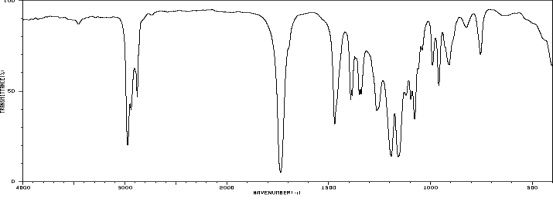
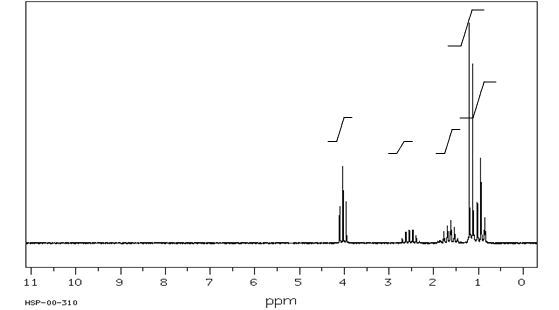 SDBS
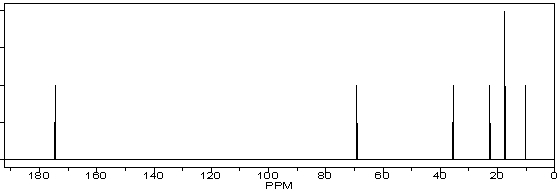
SDBS (Essay)
4.7/5 (80)
(80) Which of the indicated protons in the following compound would appear most downfield in the 1H NMR spectrum? 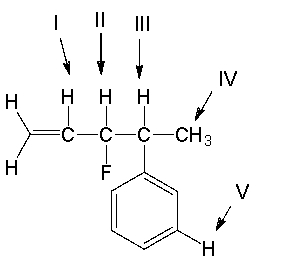
(Multiple Choice)
4.9/5 (73)
(73) A compound with molecular formula C6H11N has the following 1H NMR spectrum. Which of the following is the correct number of protons giving rise to each signal? SHAPE \* MERGEFORMAT 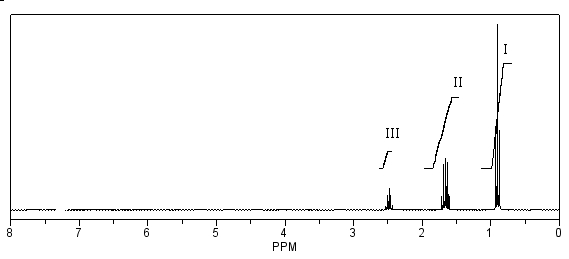

(Multiple Choice)
4.8/5 (84)
(84) 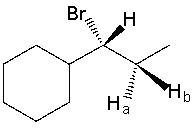
Which of the following is the maximum multiplicity observed for Hb protons in the following compound? Assume that Jab and Jbc values are different. 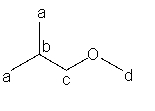
(Multiple Choice)
4.7/5 (86)
(86) 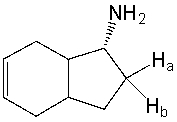
Which of the following compounds displays two triplets and a singlet in its 1H NMR spectrum?
(Multiple Choice)
4.8/5 (67)
(67) How many signals would you expect to find in the 13C NMR spectrum of the following compound? 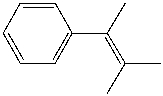
(Multiple Choice)
4.7/5 (56)
(56) How many signals would you expect to find in the 13C NMR spectrum of the following compound? 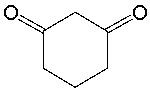
(Multiple Choice)
4.9/5 (80)
(80) Propose a structure for a compound, with molecular formula C8H15ClO3, that fits the following spectroscopic data:
IR: 1780 cm-1, 1150 cm-1
1H NMR: 1.1 (triplet, 6H), 1.9 (quartet, 2H), 2.8 (triplet, 2H), 3.4 (quartet, 4H), 4.2 (triplet, 1H)
13C NMR: 15, 31, 38, 57, 100, 173
(Essay)
4.9/5 (79)
(79) How many signals would you expect in the 1H NMR spectrum of the following compound? 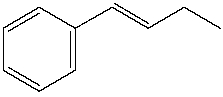
(Multiple Choice)
4.8/5 (79)
(79) How many signals would you expect in the 1H NMR spectrum of the following compound? 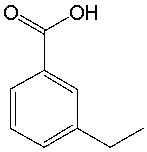
(Multiple Choice)
4.8/5 (82)
(82) A compound with molecular formula C8H14 has the following 1H NMR spectrum. Which of the following is the correct number of protons giving rise to each signal? SHAPE \* MERGEFORMAT 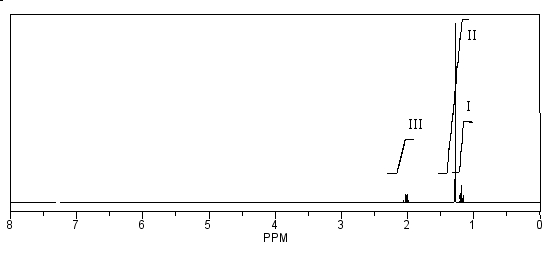

(Multiple Choice)
5.0/5 (69)
(69) How would you use 1H NMR spectroscopy to distinguish between the following compounds? 
(Essay)
4.8/5 (69)
(69) Determine the multiplicity of each signal in the expected 1H NMR spectrum of the following compound. 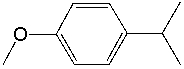
(Essay)
4.9/5 (78)
(78) Which of the following 13C NMR chemical shifts corresponds to Ca in the following compound? 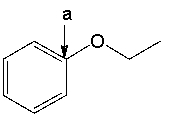
(Multiple Choice)
4.8/5 (71)
(71) 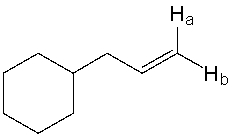
How many nuclear spin states are possible for the 1H nucleus?
(Multiple Choice)
4.8/5 (77)
(77) Determine the multiplicity of each signal in the expected 1H NMR spectrum of the following compound. 
(Essay)
4.9/5 (79)
(79) 
Filters
- Essay(0)
- Multiple Choice(0)
- Short Answer(0)
- True False(0)
- Matching(0)