



 Chat with AI
Exam 14: Infrared Spectroscopy and Mass Spectrometry

Exam 1: A Review of General Chemistry: Electrons, Bonds, and Molecular Properties191 Questions
Exam 2: Molecular Representations168 Questions
Exam 3: Acids and Bases127 Questions
Exam 4: Alkanes and Cycloalkanes116 Questions
Exam 5: Stereoisomerism141 Questions
Exam 6: Chemical Reactivity and Mechanisms96 Questions
Exam 7: Alkyl Halides: Nucleophilic Substitution and Elimination Reactions224 Questions
Exam 8: Addition Reactions of Alkenes153 Questions
Exam 9: Alkynes177 Questions
Exam 10: Radical Reactions102 Questions
Exam 11: Synthesis106 Questions
Exam 12: Alcohols and Phenols147 Questions
Exam 13: Ethers and Epoxides; Thiols and Sulfides139 Questions
Exam 14: Infrared Spectroscopy and Mass Spectrometry135 Questions
Exam 15: Nuclear Magnetic Resonance Spectroscopy140 Questions
Exam 16: Conjugated Pi Systems and Pericyclic Reactions140 Questions
Exam 17: Aromatic Compounds118 Questions
Exam 18: Aromatic Substitution Reactions122 Questions
Exam 19: Aldehydes and Ketones169 Questions
Exam 20: Carboxylic Acids and Their Derivatives144 Questions
Exam 21: Alpha Carbon Chemistry: Enols and Enolates147 Questions
Exam 22: Amines112 Questions
Exam 23: Introduction to Organometallic Compounds118 Questions
Exam 24: Carbohydrates144 Questions
Exam 25: Amino Acids, Peptides, and Proteins133 Questions
Exam 26: Lipids123 Questions
Exam 27: Synthetic Polymers119 Questions
Select questions type


Carboxylic acids show a very broad absorption for the OH group compared to alcohols, because they can form a ______.
(Multiple Choice)
4.9/5  (76)
(76) Which of the following compounds will show a broad absorption near 3300 cm-1 and a sharp absorption at 1650 cm-1? 
(Multiple Choice)
4.8/5 (74)
(74) Why does bromine produces M+• and (M+2)+• peaks of equal intensity on a mass spectrum?
(Multiple Choice)
4.8/5 (72)
(72) Which of the following mass spectra shows the presence of bromine in a compound? I 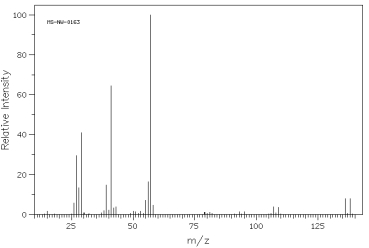 II
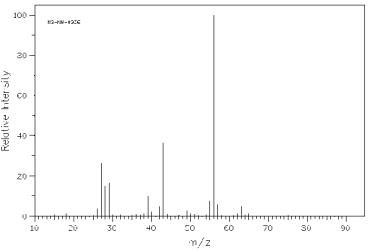 III
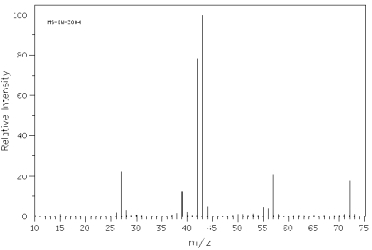 IV
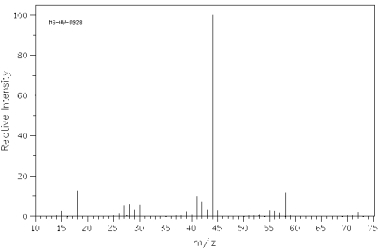 Four spectra above: courtesy of SDBS: National Institute of Advanced Industrial Science and Technology
II III IV Four spectra above: courtesy of SDBS: National Institute of Advanced Industrial Science and Technology (Multiple Choice)
4.8/5 (92)
(92) Which of the following information is primarily obtained from infrared spectroscopy?
(Multiple Choice)
4.9/5 (79)
(79) For each of the following IR spectra determine if it is consistent with the structure of an alcohol, a ketone, an aldehyde, a carboxylic acid, a primary amine, a secondary amine, a primary amide, or a secondary amide.  I.
SDBS: National Institute of Advanced Industrial Science and Technology
II.

I.
SDBS: National Institute of Advanced Industrial Science and Technology
II. (Short Answer)
4.7/5 (75)
(75) Predict the product for the following reaction and explain how you can use IR spectroscopy to monitor the progress of the reaction. 
(Essay)
4.9/5 (70)
(70) Which of the following is initially produced when a compound is bombarded with high energy electrons?
(Multiple Choice)
4.8/5 (75)
(75) Rank absorption of the indicated bonds in decreasing (highest to lowest) order of wavenumber. 
(Multiple Choice)
4.7/5 (81)
(81) Which of the following is not true about the molecular ion in mass spectrometry?
(Multiple Choice)
4.9/5 (68)
(68) Which of the following is true about the molecular weight and the M+•-m/z value for the following compound? 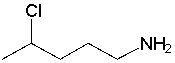
(Multiple Choice)
4.9/5 (82)
(82) Which one of the following compounds is consistent with the mass spectrum below? 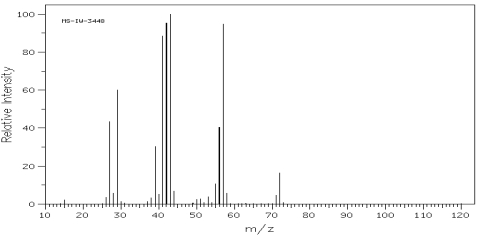 SDBS: National Institute of Advanced Industrial Science and Technology
 (Multiple Choice)
4.9/5 (65)
(65) Provide a molecular formula that is consistent with the following mass spectral data.
M+• at m/z = 73, relative height = 86.1%
(M+1)+• at m/z = 74, relative height = 3.2%
(Short Answer)
4.7/5 (77)
(77) Which of the following is not a prominent peak in the mass spectrum of 2-methyl-2-pentanol?
(Multiple Choice)
4.9/5 (71)
(71) Which of the following is true about the IR spectrum of the compound shown below? 
(Multiple Choice)
4.9/5 (87)
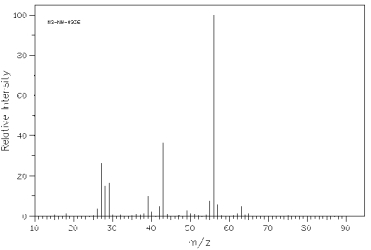
(87) Which of the following mass spectra shows the presence of chlorine in a compound? I 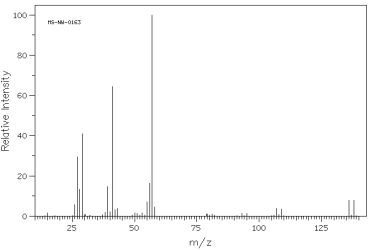 II
 III
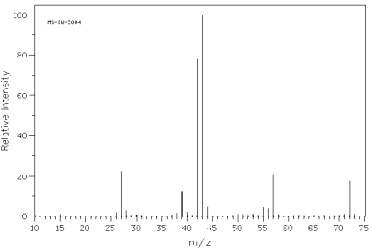 IV
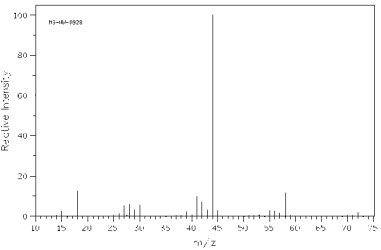 Four spectra above: courtesy of SDBS: National Institute of Advanced Industrial Science and Technology
II III IV Four spectra above: courtesy of SDBS: National Institute of Advanced Industrial Science and Technology (Multiple Choice)
4.8/5 (77)
(77) Which molecular formula is consistent with the following mass spectral data? M+• at m/z = 78, relative height = 23.5%
(M+1)+• at m/z = 79, relative height = 0.78%
(M+2)+• at m/z = 80, relative height = 7.5%
(Multiple Choice)
5.0/5 (96)
(96) Identify the medical application that does not use mass spectrometry.
(Multiple Choice)
4.8/5 (70)
(70) For the following reaction, which of the following change(s) in the IR spectrum is consistent with conversion of the reactant to the product? 
(Multiple Choice)
4.9/5 (64)
(64) 
Filters
- Essay(0)
- Multiple Choice(0)
- Short Answer(0)
- True False(0)
- Matching(0)