



 Chat with AI
Exam 11: Synthesis

Exam 1: A Review of General Chemistry: Electrons, Bonds, and Molecular Properties191 Questions
Exam 2: Molecular Representations168 Questions
Exam 3: Acids and Bases127 Questions
Exam 4: Alkanes and Cycloalkanes116 Questions
Exam 5: Stereoisomerism141 Questions
Exam 6: Chemical Reactivity and Mechanisms96 Questions
Exam 7: Alkyl Halides: Nucleophilic Substitution and Elimination Reactions224 Questions
Exam 8: Addition Reactions of Alkenes153 Questions
Exam 9: Alkynes177 Questions
Exam 10: Radical Reactions102 Questions
Exam 11: Synthesis106 Questions
Exam 12: Alcohols and Phenols147 Questions
Exam 13: Ethers and Epoxides; Thiols and Sulfides139 Questions
Exam 14: Infrared Spectroscopy and Mass Spectrometry135 Questions
Exam 15: Nuclear Magnetic Resonance Spectroscopy140 Questions
Exam 16: Conjugated Pi Systems and Pericyclic Reactions140 Questions
Exam 17: Aromatic Compounds118 Questions
Exam 18: Aromatic Substitution Reactions122 Questions
Exam 19: Aldehydes and Ketones169 Questions
Exam 20: Carboxylic Acids and Their Derivatives144 Questions
Exam 21: Alpha Carbon Chemistry: Enols and Enolates147 Questions
Exam 22: Amines112 Questions
Exam 23: Introduction to Organometallic Compounds118 Questions
Exam 24: Carbohydrates144 Questions
Exam 25: Amino Acids, Peptides, and Proteins133 Questions
Exam 26: Lipids123 Questions
Exam 27: Synthetic Polymers119 Questions
Select questions type


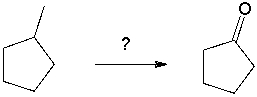

Which of the following alkenes cannot be converted into an alkyne by reacting it with bromine followed by an excess of sodium amide and then with water? 
(Multiple Choice)
4.8/5  (74)
(74) Identify the statement that is not part of Green Chemistry.
(Multiple Choice)
4.7/5 (77)
(77) Propose a multi-step synthetic sequence to accomplish the transformation below. 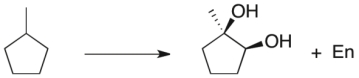
(Essay)
4.9/5 (79)
(79) Which sequence of reagents will accomplish the following synthesis? 
(Multiple Choice)
4.9/5 (76)
(76) Provide the major product(s) obtained from the following reaction. 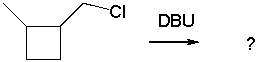
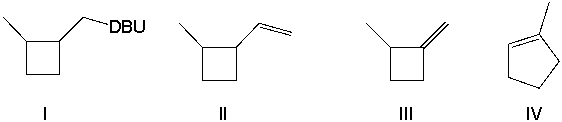
(Multiple Choice)
4.8/5 (64)
(64) Using retrosynthetic synthesis, determine which compound(s) could lead to the alkene shown below in a single step. 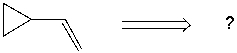
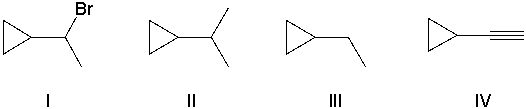
(Multiple Choice)
4.7/5 (91)
(91) Using retrosynthetic synthesis, determine which compound(s) could lead to the alcohol shown below in a single step. 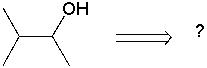

(Multiple Choice)
4.7/5 (78)
(78) 

Compound X has molecular formula C8H10. Reaction of Compound X with excess ozone, followed by reaction with dimethyl sulfide and then washing with water produces only the compounds shown below. Draw a possibility for Compound X that is consistent with these results. 
(Essay)
4.9/5 (87)
(87) 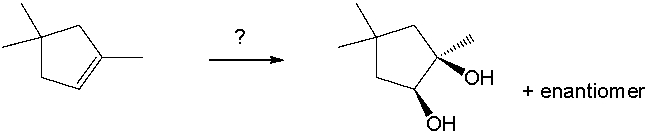
Propose a three-step synthetic sequence to accomplish the transformation below. 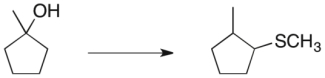
(Essay)
4.8/5 (68)
(68) Devise a synthetic route to convert ethylene into PVC (polyvinyl chloride).
(Essay)
4.8/5 (68)
(68) Perform a retrosynthetic analysis by working backwards two steps in the synthesis below. Identify possible combinations of A and B that could lead to the alkyl halide (C). 

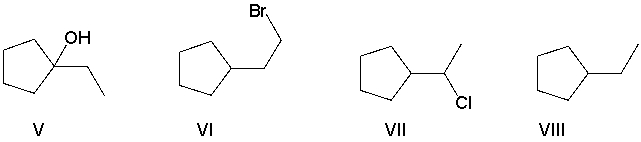
(Multiple Choice)
4.8/5 (77)
(77) 


Propose a three-step synthetic sequence to accomplish the transformation below. 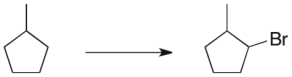
(Essay)
4.9/5 (73)
(73) 
Filters
- Essay(0)
- Multiple Choice(0)
- Short Answer(0)
- True False(0)
- Matching(0)