



 Chat with AI
Exam 9: Alkynes

Exam 1: A Review of General Chemistry: Electrons, Bonds, and Molecular Properties191 Questions
Exam 2: Molecular Representations168 Questions
Exam 3: Acids and Bases127 Questions
Exam 4: Alkanes and Cycloalkanes116 Questions
Exam 5: Stereoisomerism141 Questions
Exam 6: Chemical Reactivity and Mechanisms96 Questions
Exam 7: Alkyl Halides: Nucleophilic Substitution and Elimination Reactions224 Questions
Exam 8: Addition Reactions of Alkenes153 Questions
Exam 9: Alkynes177 Questions
Exam 10: Radical Reactions102 Questions
Exam 11: Synthesis106 Questions
Exam 12: Alcohols and Phenols147 Questions
Exam 13: Ethers and Epoxides; Thiols and Sulfides139 Questions
Exam 14: Infrared Spectroscopy and Mass Spectrometry135 Questions
Exam 15: Nuclear Magnetic Resonance Spectroscopy140 Questions
Exam 16: Conjugated Pi Systems and Pericyclic Reactions140 Questions
Exam 17: Aromatic Compounds118 Questions
Exam 18: Aromatic Substitution Reactions122 Questions
Exam 19: Aldehydes and Ketones169 Questions
Exam 20: Carboxylic Acids and Their Derivatives144 Questions
Exam 21: Alpha Carbon Chemistry: Enols and Enolates147 Questions
Exam 22: Amines112 Questions
Exam 23: Introduction to Organometallic Compounds118 Questions
Exam 24: Carbohydrates144 Questions
Exam 25: Amino Acids, Peptides, and Proteins133 Questions
Exam 26: Lipids123 Questions
Exam 27: Synthetic Polymers119 Questions
Select questions type


Which of the alkynes below, after undergoing an acid-catalyzed hydration, would be expected to produce two different ketones in nearly equivalent yields?
(Multiple Choice)
4.9/5  (86)
(86) For the reaction shown, which of the compounds below would be the expected enol intermediate? 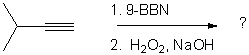

(Multiple Choice)
4.9/5 (87)
(87) Which of the reagents below, when reacting with a terminal alkyne, would be expected to produce a ketone as the final major organic product? 
(Multiple Choice)
4.9/5 (74)
(74) When preparing terminal alkynes by an elimination reaction, sodium amide (NaNH2) dissolved in liquid ammonia (NH3) is used most frequently. Which of the following statements offers the best explanation for the above statement?
(Multiple Choice)
5.0/5 (92)
(92) 
Give the major product from the careful addition of 1 equivalent of Br2 to the alkyne shown below. 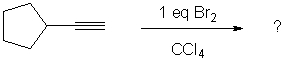
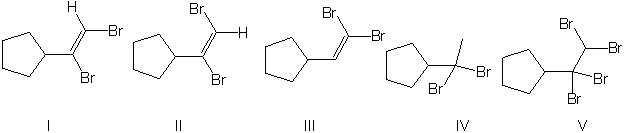
(Multiple Choice)
4.9/5 (74)
(74) What is the IUPAC name for the expected product of the reaction below? 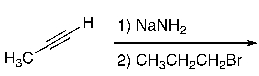
(Multiple Choice)
4.9/5 (82)
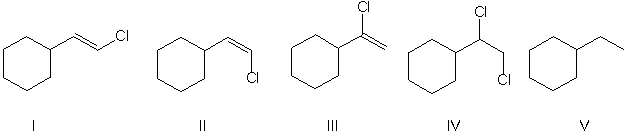
(82) For the reaction below, select the structure of the expected major organic product. 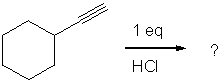
(Multiple Choice)
4.9/5 (71)
(71) 
Select the best reagent to convert 3-heptyne to trans-3-heptene?
(Multiple Choice)
4.8/5 (84)
(84) What is the expected functional group produced when cyclodecyne is reacted with disiamylborane, followed with treatment of basic hydrogen peroxide?
(Multiple Choice)
4.9/5 (89)
(89) 
The major result of treating 1-butyne with 6M aqueous NaOH would be:
(Multiple Choice)
4.9/5 (94)
(94) What is the IUPAC name for the expected final product of the reaction below? 
(Multiple Choice)
4.9/5 (77)
(77) Which of the compounds shown below would be the most likely product expected from the reaction scheme shown? 

(Multiple Choice)
4.9/5 (91)
(91) Which of the ketones below could not be prepared by an acid-catalyzed hydration of an alkyne? 
(Multiple Choice)
4.9/5 (74)
(74) 

What is the final major product expected for the following reaction sequence? 
(Multiple Choice)
4.8/5 (92)
(92) 

Filters
- Essay(0)
- Multiple Choice(0)
- Short Answer(0)
- True False(0)
- Matching(0)