



 Chat with AI
Exam 8: Addition Reactions of Alkenes

Exam 1: A Review of General Chemistry: Electrons, Bonds, and Molecular Properties191 Questions
Exam 2: Molecular Representations168 Questions
Exam 3: Acids and Bases127 Questions
Exam 4: Alkanes and Cycloalkanes116 Questions
Exam 5: Stereoisomerism141 Questions
Exam 6: Chemical Reactivity and Mechanisms96 Questions
Exam 7: Alkyl Halides: Nucleophilic Substitution and Elimination Reactions224 Questions
Exam 8: Addition Reactions of Alkenes153 Questions
Exam 9: Alkynes177 Questions
Exam 10: Radical Reactions102 Questions
Exam 11: Synthesis106 Questions
Exam 12: Alcohols and Phenols147 Questions
Exam 13: Ethers and Epoxides; Thiols and Sulfides139 Questions
Exam 14: Infrared Spectroscopy and Mass Spectrometry135 Questions
Exam 15: Nuclear Magnetic Resonance Spectroscopy140 Questions
Exam 16: Conjugated Pi Systems and Pericyclic Reactions140 Questions
Exam 17: Aromatic Compounds118 Questions
Exam 18: Aromatic Substitution Reactions122 Questions
Exam 19: Aldehydes and Ketones169 Questions
Exam 20: Carboxylic Acids and Their Derivatives144 Questions
Exam 21: Alpha Carbon Chemistry: Enols and Enolates147 Questions
Exam 22: Amines112 Questions
Exam 23: Introduction to Organometallic Compounds118 Questions
Exam 24: Carbohydrates144 Questions
Exam 25: Amino Acids, Peptides, and Proteins133 Questions
Exam 26: Lipids123 Questions
Exam 27: Synthetic Polymers119 Questions
Select questions type


Consider the information given below and identify the structure of the unknown compound A, with a molecular formula of C8H14. Compound A reacts with Br2/CCl4. Upon reaction of A with excess H2/Ni, 1-ethyl-2-methylcyclopentane is produced. Subjecting A to ozonolysis, the product shown below is produced as the major organic product. Draw the correct structure of compound A, and provide a brief and clear explanation relating the data provided with the structure selected. 
(Essay)
4.8/5  (69)
(69) Which of the molecules below would be the expected product for the hydrohalogenation of the following alkene with HBr? 
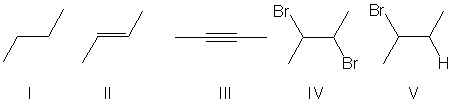
(Multiple Choice)
4.8/5 (85)
(85) How many distinct resonances would appear in the (proton-decoupled) 13C NMR spectrum for the product of the following reaction? 
(Multiple Choice)
4.7/5 (84)
(84) Identify the expected major organic product generated from the reaction sequence shown. 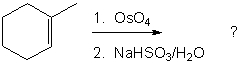

(Multiple Choice)
5.0/5 (78)
(78) Predict the structure(s) of the expected major organic product(s) of the following reaction. Include regiochemical and/or stereochemical details as needed.
SHAPE \* MERGEFORMAT 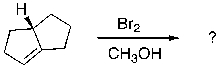

(Essay)
4.9/5 (81)
(81) What is the expected major product of the following reaction? 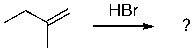
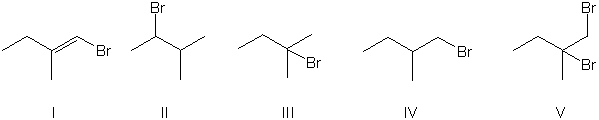
(Multiple Choice)
4.9/5 (88)
(88) Identify the major product from the treatment of 1-methylcyclohexene with H3O+. 
(Multiple Choice)
4.9/5 (76)
(76) What is the expected Markovnikov addition product from the addition of HI to 2-methyl-2-butene?
(Multiple Choice)
4.8/5 (72)
(72) What compound is the expected product upon Markovnikov hydrohalogenation with HBr of the alkene shown below? 
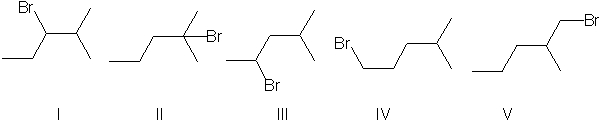
(Multiple Choice)
4.7/5 (79)
(79) Which of the alkenes shown below would produce a chirality center upon Markovnikov hydrohalogenation? 
(Multiple Choice)
4.9/5 (78)
(78) Identify the description of the regioselectivity and stereospecificity in the acid-catalyzed hydration of an alkene.
(Multiple Choice)
4.9/5 (90)
(90) What reagents are needed to accomplish the following synthesis? 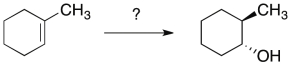
(Multiple Choice)
4.9/5 (71)
(71) 
Filters
- Essay(0)
- Multiple Choice(0)
- Short Answer(0)
- True False(0)
- Matching(0)