



 Chat with AI
Exam 13: Monopolistic Competition: the Competitive Model in a More Realistic Setting

Exam 1: Economics: Foundations and Models444 Questions
Exam 2: Trade-Offs, Comparative Advantage, and the Market System498 Questions
Exam 3: Where Prices Come From: the Interaction of Demand and Supply475 Questions
Exam 4: Economic Efficiency, Government Price Setting, and Taxes419 Questions
Exam 5: Externalities, Environmental Policy, and Public Goods266 Questions
Exam 6: Elasticity: the Responsiveness of Demand and Supply295 Questions
Exam 7: The Economics of Health Care334 Questions
Exam 8: Firms, the Stock Market, and Corporate Governance278 Questions
Exam 9: Comparative Advantage and the Gains From International Trade379 Questions
Exam 10: Consumer Choice and Behavioral Economics302 Questions
Exam 11: Technology, Production, and Costs330 Questions
Exam 12: Firms in Perfectly Competitive Markets298 Questions
Exam 13: Monopolistic Competition: the Competitive Model in a More Realistic Setting276 Questions
Exam 14: Oligopoly: Firms in Less Competitive Markets262 Questions
Exam 15: Monopoly and Antitrust Policy271 Questions
Exam 16: Pricing Strategy263 Questions
Exam 17: The Markets for Labor and Other Factors of Production286 Questions
Exam 18: Public Choice, Taxes, and the Distribution of Income258 Questions
Exam 19: GDP: Measuring Total Production and Income266 Questions
Exam 20: Unemployment and Inflation292 Questions
Exam 21: Economic Growth, the Financial System, and Business Cycles257 Questions
Exam 22: Long-Run Economic Growth: Sources and Policies268 Questions
Exam 23: Aggregate Expenditure and Output in the Short Run306 Questions
Exam 24: Aggregate Demand and Aggregate Supply Analysis284 Questions
Exam 25: Money, Banks, and the Federal Reserve System280 Questions
Exam 26: Monetary Policy277 Questions
Exam 27: Fiscal Policy303 Questions
Exam 28: Inflation, Unemployment, and Federal Reserve Policy257 Questions
Exam 29: Macroeconomics in an Open Economy278 Questions
Exam 30: The International Financial System262 Questions
Select questions type


In monopolistic competition, if a firm produces a highly desirable product relative to its competitors, the firm will be able to raise its price without losing any customers.
(True/False)
4.8/5  (77)
(77) Productive efficiency does not hold for a profit-maximizing, monopolistically competitive firm in the long-run equilibrium because the firm operates along the diseconomies-of-scale region of its average total cost curve.
(True/False)
4.7/5 (94)
(94) Which of the following characteristics is not common to monopolistic competition and perfect competition?
(Multiple Choice)
4.8/5 (73)
(73) Long-run equilibrium under monopolistic competition and perfect competition is similar in that
(Multiple Choice)
4.9/5 (85)
(85) Some factors that allow firms to make economic profits are beyond its control. All but one of the following is an uncontrollable factor. Which factor is controllable?
(Multiple Choice)
4.9/5 (85)
(85) Figure 13-18  -Refer to Figure 13-18. The diagram demonstrates that
 (Multiple Choice)
4.9/5 (80)
(80) When a firm has been granted a trademark, which grants legal protection against other firms using the name of the product that has been granted the trademark, the firm
(Multiple Choice)
4.9/5 (70)
(70) There are many cattle ranchers in the world, and there are also many McDonald's restaurants in the world. Why, then, does a McDonald's restaurant face a downward-sloping demand curve while a cattle rancher faces a horizontal demand curve?
(Essay)
4.9/5 (85)
(85) In both monopolistically competitive and perfectly competitive industries,
(Multiple Choice)
4.9/5 (69)
(69) If price exceeds average variable cost but is less than average total cost, a firm
(Multiple Choice)
4.9/5 (78)
(78) Table 13-1
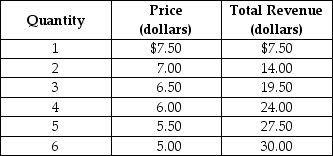 -Refer to Table 13-1. What portion of the marginal revenue of the 4th unit is due to the output effect and what portion is due to the price effect?
 (Multiple Choice)
4.8/5 (63)
(63) Figure 13-11 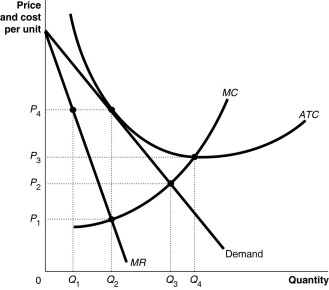 -Refer to Figure 13-11. What is the monopolistic competitor's profit-maximizing price?
 (Multiple Choice)
4.8/5 (87)
(87) Table 13-3
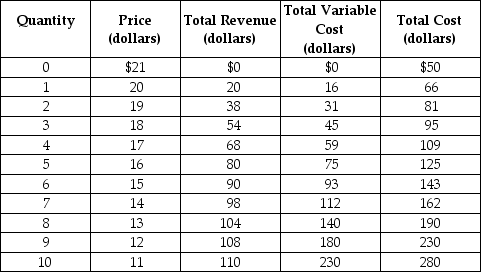 Table 13-3 shows the demand and cost schedules for a monopolistically competitive firm.
-Refer to Table 13-3. What is the amount of the firm's loss at its optimal output level?
Table 13-3 shows the demand and cost schedules for a monopolistically competitive firm.
-Refer to Table 13-3. What is the amount of the firm's loss at its optimal output level? (Multiple Choice)
4.9/5 (87)
(87) Which of the following is the best example of a firm that competes in a monopolistically competitive market?
(Multiple Choice)
4.9/5 (71)
(71) Both the perfectly competitive firm and the monopolistically competitive firm produce at the output where marginal revenue equals marginal cost (MR = MC) but only the perfectly competitive firm achieves allocative efficiency. Explain why this is the case.
(Essay)
4.8/5 (72)
(72) Economists believe that consumers would be better off if markets were perfectly competitive rather than monopolistically competitive.
(True/False)
4.8/5 (74)
(74) If buyers of a monopolistically competitive product feel the products of different sellers have little differences between them, then the demand for each seller's product is relatively elastic.
(True/False)
4.7/5 (80)
(80) Which of the following is not a characteristic of a monopolistically competitive firm in long-run equilibrium?
(Multiple Choice)
4.9/5 (85)
(85) How might a monopolistically competitive firm continually earn economic profit greater than zero?
(Essay)
4.8/5 (85)
(85) 
Filters
- Essay(0)
- Multiple Choice(0)
- Short Answer(0)
- True False(0)
- Matching(0)