



 Chat with AI
Exam 14: Oligopoly: Firms in Less Competitive Markets

Exam 1: Economics: Foundations and Models444 Questions
Exam 2: Trade-Offs, Comparative Advantage, and the Market System498 Questions
Exam 3: Where Prices Come From: the Interaction of Demand and Supply475 Questions
Exam 4: Economic Efficiency, Government Price Setting, and Taxes419 Questions
Exam 5: Externalities, Environmental Policy, and Public Goods266 Questions
Exam 6: Elasticity: the Responsiveness of Demand and Supply295 Questions
Exam 7: The Economics of Health Care334 Questions
Exam 8: Firms, the Stock Market, and Corporate Governance278 Questions
Exam 9: Comparative Advantage and the Gains From International Trade379 Questions
Exam 10: Consumer Choice and Behavioral Economics302 Questions
Exam 11: Technology, Production, and Costs330 Questions
Exam 12: Firms in Perfectly Competitive Markets298 Questions
Exam 13: Monopolistic Competition: the Competitive Model in a More Realistic Setting276 Questions
Exam 14: Oligopoly: Firms in Less Competitive Markets262 Questions
Exam 15: Monopoly and Antitrust Policy271 Questions
Exam 16: Pricing Strategy263 Questions
Exam 17: The Markets for Labor and Other Factors of Production286 Questions
Exam 18: Public Choice, Taxes, and the Distribution of Income258 Questions
Exam 19: GDP: Measuring Total Production and Income266 Questions
Exam 20: Unemployment and Inflation292 Questions
Exam 21: Economic Growth, the Financial System, and Business Cycles257 Questions
Exam 22: Long-Run Economic Growth: Sources and Policies268 Questions
Exam 23: Aggregate Expenditure and Output in the Short Run306 Questions
Exam 24: Aggregate Demand and Aggregate Supply Analysis284 Questions
Exam 25: Money, Banks, and the Federal Reserve System280 Questions
Exam 26: Monetary Policy277 Questions
Exam 27: Fiscal Policy303 Questions
Exam 28: Inflation, Unemployment, and Federal Reserve Policy257 Questions
Exam 29: Macroeconomics in an Open Economy278 Questions
Exam 30: The International Financial System262 Questions
Select questions type


Table 14-5  Ming and Henri each run one of the two dry cleaning facilities in the town of Scaraby. Both consider offering free pickup and delivery services. Table 14-5 shows the payoff matrix containing the expected quarterly profits for each firm.
-Refer to Table 14-5. Does Henri have a dominant strategy? If yes, what is it?
Ming and Henri each run one of the two dry cleaning facilities in the town of Scaraby. Both consider offering free pickup and delivery services. Table 14-5 shows the payoff matrix containing the expected quarterly profits for each firm.
-Refer to Table 14-5. Does Henri have a dominant strategy? If yes, what is it? (Multiple Choice)
4.7/5  (72)
(72) The profit-maximizing level of output and the profit-maximizing price for an oligopolist cannot be calculated when we don't know
(Multiple Choice)
4.8/5 (88)
(88) Table 14-1  Godrickporter and Star Connections are the only two airport shuttle and limousine rental service companies in the mid-sized town of Godrick Hollow. Each firm must decide on whether to increase its advertising spending to compete for customers. Table 14-1 shows the payoff matrix for this advertising game.
-Refer to Table 14-1. Is there a dominant strategy for Star Connections and if so, what is it?
Godrickporter and Star Connections are the only two airport shuttle and limousine rental service companies in the mid-sized town of Godrick Hollow. Each firm must decide on whether to increase its advertising spending to compete for customers. Table 14-1 shows the payoff matrix for this advertising game.
-Refer to Table 14-1. Is there a dominant strategy for Star Connections and if so, what is it? (Multiple Choice)
4.8/5 (85)
(85) Collusion would be common in an oligopoly and a monopolistically competitive industry.
(True/False)
4.9/5 (81)
(81) What is an oligopoly? Give two examples of oligopolistic industries in the United States.
(Essay)
4.8/5 (75)
(75) As word processing on personal computers expanded, sales of typewriters began to disappear. Which of Porter's competitive forces does this event demonstrate?
(Multiple Choice)
4.8/5 (79)
(79) Table 14-2  Table 14-2 shows the payoff matrix for Wal-Mart and Target from every combination of pricing strategies for the popular PlayStation 3. At the start of the game each firm charges a low price and each earns a profit of $7,000.
-Refer to Table 14-2. Is the current strategy in which each firm charges the low price and earns a profit of $7,000 a Nash equilibrium? If not, why and what is the Nash equilibrium?
Table 14-2 shows the payoff matrix for Wal-Mart and Target from every combination of pricing strategies for the popular PlayStation 3. At the start of the game each firm charges a low price and each earns a profit of $7,000.
-Refer to Table 14-2. Is the current strategy in which each firm charges the low price and earns a profit of $7,000 a Nash equilibrium? If not, why and what is the Nash equilibrium? (Multiple Choice)
4.8/5 (91)
(91) Figure 14-7 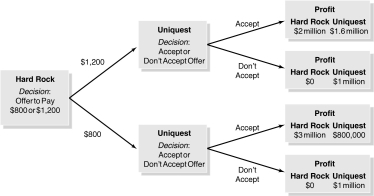 -Refer to Figure 14-7. Uniguest, Inc. is a company that provides PCs with internet access and touch-sensitive screens to hotels. Suppose the Hard Rock Hotel and Casino in Las Vegas informs Uniguest that it is considering installing these systems in its hotel rooms. The Hard Rock expects to be able to charge higher prices for these rooms if it installs Uniguest's systems in its rooms. The two companies begin bargaining over what price the Hard Rock will pay Uniguest for its systems, and the decision tree shown above illustrates this bargaining game. Note that the profit figures listed in the decision tree are additional profits for the Hard Rock and total profits for Uniguest.
a. Suppose the Hard Rock offers Uniguest $1,200 per system. Will Uniguest accept or reject this offer? Why?
b. Suppose the Hard Rock offers Uniguest $800 per system. Will Uniguest accept or reject this offer? Why?
c. Suppose Uniguest attempts to obtain a favorable outcome from the bargaining by telling the Hard Rock it will reject an $800-per-system offer. If the Hard Rock does not believe the threat is credible, what will it do? Why? What will Uniguest do? Why?
d. Is there a sub-game perfect equilibrium in this situation? Explain.
-Refer to Figure 14-7. Uniguest, Inc. is a company that provides PCs with internet access and touch-sensitive screens to hotels. Suppose the Hard Rock Hotel and Casino in Las Vegas informs Uniguest that it is considering installing these systems in its hotel rooms. The Hard Rock expects to be able to charge higher prices for these rooms if it installs Uniguest's systems in its rooms. The two companies begin bargaining over what price the Hard Rock will pay Uniguest for its systems, and the decision tree shown above illustrates this bargaining game. Note that the profit figures listed in the decision tree are additional profits for the Hard Rock and total profits for Uniguest.
a. Suppose the Hard Rock offers Uniguest $1,200 per system. Will Uniguest accept or reject this offer? Why?
b. Suppose the Hard Rock offers Uniguest $800 per system. Will Uniguest accept or reject this offer? Why?
c. Suppose Uniguest attempts to obtain a favorable outcome from the bargaining by telling the Hard Rock it will reject an $800-per-system offer. If the Hard Rock does not believe the threat is credible, what will it do? Why? What will Uniguest do? Why?
d. Is there a sub-game perfect equilibrium in this situation? Explain. (Essay)
4.8/5 (84)
(84) Which of the following is the best example of an oligopolistic industry?
(Multiple Choice)
4.9/5 (66)
(66) Prices of PlayStation 4 game systems are similar at almost every large retailer and little price competition occurs among these retailers. An explanation for this is
(Multiple Choice)
4.7/5 (79)
(79) A study conducted by economists at the University of Chicago found that when Southwest Airlines begins flying a new route, ticket prices on other airlines for that route ________, indicating that airlines ________.
(Multiple Choice)
4.8/5 (81)
(81) In a decision tree, the difference between a decision node and a terminal node is that
(Multiple Choice)
4.8/5 (56)
(56) What is the difference between explicit collusion and implicit collusion?
(Essay)
4.7/5 (71)
(71) Price leadership is a form of explicit collusion where one firm in an oligopoly announces a price change and expects all other firms to follow suit.
(True/False)
4.8/5 (70)
(70) Economies of scale will create a barrier to entry in an oligopoly industry when
(Multiple Choice)
4.9/5 (92)
(92) The study of how people make decisions in situations in which attaining their goals depends on their interactions with others is called
(Multiple Choice)
4.9/5 (78)
(78) For many years the Aluminum Company of America (Alcoa) controlled most of the world's supply of high quality bauxite, the ore needed to produce aluminum. What type of entry barrier was responsible for Alcoa's position in the aluminum industry?
(Multiple Choice)
4.8/5 (82)
(82) 
Filters
- Essay(0)
- Multiple Choice(0)
- Short Answer(0)
- True False(0)
- Matching(0)