



 Chat with AI
Exam 14: Oligopoly: Firms in Less Competitive Markets

Exam 1: Economics: Foundations and Models444 Questions
Exam 2: Trade-Offs, Comparative Advantage, and the Market System498 Questions
Exam 3: Where Prices Come From: the Interaction of Demand and Supply475 Questions
Exam 4: Economic Efficiency, Government Price Setting, and Taxes419 Questions
Exam 5: Externalities, Environmental Policy, and Public Goods266 Questions
Exam 6: Elasticity: the Responsiveness of Demand and Supply295 Questions
Exam 7: The Economics of Health Care334 Questions
Exam 8: Firms, the Stock Market, and Corporate Governance278 Questions
Exam 9: Comparative Advantage and the Gains From International Trade379 Questions
Exam 10: Consumer Choice and Behavioral Economics302 Questions
Exam 11: Technology, Production, and Costs330 Questions
Exam 12: Firms in Perfectly Competitive Markets298 Questions
Exam 13: Monopolistic Competition: the Competitive Model in a More Realistic Setting276 Questions
Exam 14: Oligopoly: Firms in Less Competitive Markets262 Questions
Exam 15: Monopoly and Antitrust Policy271 Questions
Exam 16: Pricing Strategy263 Questions
Exam 17: The Markets for Labor and Other Factors of Production286 Questions
Exam 18: Public Choice, Taxes, and the Distribution of Income258 Questions
Exam 19: GDP: Measuring Total Production and Income266 Questions
Exam 20: Unemployment and Inflation292 Questions
Exam 21: Economic Growth, the Financial System, and Business Cycles257 Questions
Exam 22: Long-Run Economic Growth: Sources and Policies268 Questions
Exam 23: Aggregate Expenditure and Output in the Short Run306 Questions
Exam 24: Aggregate Demand and Aggregate Supply Analysis284 Questions
Exam 25: Money, Banks, and the Federal Reserve System280 Questions
Exam 26: Monetary Policy277 Questions
Exam 27: Fiscal Policy303 Questions
Exam 28: Inflation, Unemployment, and Federal Reserve Policy257 Questions
Exam 29: Macroeconomics in an Open Economy278 Questions
Exam 30: The International Financial System262 Questions
Select questions type


According to an article the Wall Street Journal, "The big car makers are pushing a wide array of new technology into production, responding to relentless competitive pressure, rising energy prices and consumer demand for better safety. Source: Joseph B. White, "Ford, GM Eye Shift in Buying Habits," Wall Street Journal, May 22, 2006.
Which of Porter's competitive forces does this statement allude to?
(Multiple Choice)
4.9/5  (79)
(79) Firms are more likely to find themselves in a prisoner's dilemma in sequential games as opposed to simultaneous games.
(True/False)
4.8/5 (81)
(81) Which industry has the highest four-firm concentration ratio?
(Multiple Choice)
5.0/5 (70)
(70) Figure 14-1  Assume that Lexus (L) is the first automobile company to produce a luxury class hybrid automobile and is the only such company for the past four years. BMW is now considering producing its own luxury hybrid automobile and Lexus must decide whether or not to lower the price of its luxury hybrid to counter BMW's entry into the luxury hybrid niche.
-In a subgame perfect equilibrium,
Assume that Lexus (L) is the first automobile company to produce a luxury class hybrid automobile and is the only such company for the past four years. BMW is now considering producing its own luxury hybrid automobile and Lexus must decide whether or not to lower the price of its luxury hybrid to counter BMW's entry into the luxury hybrid niche.
-In a subgame perfect equilibrium, (Multiple Choice)
4.9/5 (77)
(77) The fraction of an industry's sales that are accounted for by the largest firms is called
(Multiple Choice)
4.8/5 (73)
(73) One reason why, in the last four decades, the number of new auto makers in the world has been very small compared to the past is that
(Multiple Choice)
4.8/5 (69)
(69) Table 14-1  Godrickporter and Star Connections are the only two airport shuttle and limousine rental service companies in the mid-sized town of Godrick Hollow. Each firm must decide on whether to increase its advertising spending to compete for customers. Table 14-1 shows the payoff matrix for this advertising game.
-Refer to Table 14-1. Is there a dominant strategy for Godrickporter and if so, what is it?
Godrickporter and Star Connections are the only two airport shuttle and limousine rental service companies in the mid-sized town of Godrick Hollow. Each firm must decide on whether to increase its advertising spending to compete for customers. Table 14-1 shows the payoff matrix for this advertising game.
-Refer to Table 14-1. Is there a dominant strategy for Godrickporter and if so, what is it? (Multiple Choice)
4.9/5 (70)
(70) Hewlett-Packard will not raise the prices of its personal computers without first considering how Dell might respond. This is evidence of
(Multiple Choice)
4.7/5 (77)
(77) Figure 14-4  Rainbow Writer (RW) is a small online company selling a highly rated software package for printing color labels directly onto CDs. The firm currently earns a profit of $2 million per year selling its package exclusively on its Web site. Odeon, the producer of the most popular software package for editing and burning CDs and DVDs, has expressed interest in bundling Rainbow Writer's product into its own package. Odeon expects that bundling would further boost its sales and allow it to sell the new bundled product at a higher price, thus raising its profits beyond its current profit of $12 million. Figure 14-4 shows the decision tree for the Rainbow Writer-Odeon bargaining game.
-Refer to Figure 14-4. What is the equilibrium outcome in this game and is this a subgame-perfect equilibrium?
Rainbow Writer (RW) is a small online company selling a highly rated software package for printing color labels directly onto CDs. The firm currently earns a profit of $2 million per year selling its package exclusively on its Web site. Odeon, the producer of the most popular software package for editing and burning CDs and DVDs, has expressed interest in bundling Rainbow Writer's product into its own package. Odeon expects that bundling would further boost its sales and allow it to sell the new bundled product at a higher price, thus raising its profits beyond its current profit of $12 million. Figure 14-4 shows the decision tree for the Rainbow Writer-Odeon bargaining game.
-Refer to Figure 14-4. What is the equilibrium outcome in this game and is this a subgame-perfect equilibrium? (Multiple Choice)
4.7/5 (80)
(80) Table 14-4  Alistair Luggage and Baine Baggage are the only firms selling luggage in the upscale town of Montecito. Each firm must decide on whether to increase its advertising spending to compete for customers. If one firm increases its advertising budget but the other does not, then the firm with the higher advertising budget will increase its profit. Table 14-4 shows the payoff matrix for this advertising game.
-Refer to Table 14-4. What is the Nash equilibrium in this game?
Alistair Luggage and Baine Baggage are the only firms selling luggage in the upscale town of Montecito. Each firm must decide on whether to increase its advertising spending to compete for customers. If one firm increases its advertising budget but the other does not, then the firm with the higher advertising budget will increase its profit. Table 14-4 shows the payoff matrix for this advertising game.
-Refer to Table 14-4. What is the Nash equilibrium in this game? (Multiple Choice)
4.9/5 (81)
(81) Does the strength of each of the five competitive forces from Michael Porter's model remain constant over time? Briefly explain.
(Essay)
4.9/5 (74)
(74) The Brooks Appliance Store and the Lefingwell Appliance Store (both are located in the same city) each sell an identical washer-dryer. The owner of each store considered offering the washer-dryer for $700, but decided on a price of $500. If this is a Nash equilibrium we can conclude that
(Multiple Choice)
4.8/5 (74)
(74) Table 14-10 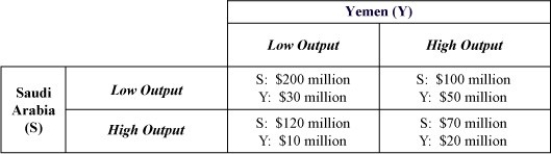 -Refer to Table 14-10. Suppose the payoff matrix in the above figure represents the payoffs to Saudi Arabia and Yemen for the production of oil. Saudi Arabia and Yemen must decide how much oil to produce. Since the demand for oil is inelastic, relatively low production rates drive up prices and profits. Saudi Arabia, the world's largest and lowest cost producer, is able to influence market price; it has an incentive to keep output low. Yemen, on the other hand, is a relatively high cost producer with much smaller reserves. Assume Saudi Arabia now decides to try to further influence the oil market by offering to pay Yemen $25 million to produce a low output.
a. Create a new payoff matrix that reflects Saudi Arabia's willingness to pay Yemen $25 million to produce a low output.
b. What is the dominant strategy for each country in this new game?
c. What is the new Nash equilibrium?
-Refer to Table 14-10. Suppose the payoff matrix in the above figure represents the payoffs to Saudi Arabia and Yemen for the production of oil. Saudi Arabia and Yemen must decide how much oil to produce. Since the demand for oil is inelastic, relatively low production rates drive up prices and profits. Saudi Arabia, the world's largest and lowest cost producer, is able to influence market price; it has an incentive to keep output low. Yemen, on the other hand, is a relatively high cost producer with much smaller reserves. Assume Saudi Arabia now decides to try to further influence the oil market by offering to pay Yemen $25 million to produce a low output.
a. Create a new payoff matrix that reflects Saudi Arabia's willingness to pay Yemen $25 million to produce a low output.
b. What is the dominant strategy for each country in this new game?
c. What is the new Nash equilibrium? (Essay)
4.9/5 (78)
(78) Figure 14-5  A few years ago Netflix (N) pioneered an online DVD rental service. Blockbuster (B), a brick and mortar DVD/video rental company, waited until Netflix had been in business for over a year before deciding whether to establish its own online rental service. At this point, Netflix had to decide whether or not to lower its subscription price in order to deter Blockbuster's entry into the market. Figure 14-5 shows the decision tree for the Netflix-Blockbuster entry game.
-In a sequential game, one firm will act first and then other firms will respond.
A few years ago Netflix (N) pioneered an online DVD rental service. Blockbuster (B), a brick and mortar DVD/video rental company, waited until Netflix had been in business for over a year before deciding whether to establish its own online rental service. At this point, Netflix had to decide whether or not to lower its subscription price in order to deter Blockbuster's entry into the market. Figure 14-5 shows the decision tree for the Netflix-Blockbuster entry game.
-In a sequential game, one firm will act first and then other firms will respond. (True/False)
4.8/5 (95)
(95) Most economists are concerned about entry barriers. Why is this so important to them?
(Essay)
4.7/5 (87)
(87) 
Filters
- Essay(0)
- Multiple Choice(0)
- Short Answer(0)
- True False(0)
- Matching(0)