



 Chat with AI
Exam 14: Oligopoly: Firms in Less Competitive Markets

Exam 1: Economics: Foundations and Models444 Questions
Exam 2: Trade-Offs, Comparative Advantage, and the Market System498 Questions
Exam 3: Where Prices Come From: the Interaction of Demand and Supply475 Questions
Exam 4: Economic Efficiency, Government Price Setting, and Taxes419 Questions
Exam 5: Externalities, Environmental Policy, and Public Goods266 Questions
Exam 6: Elasticity: the Responsiveness of Demand and Supply295 Questions
Exam 7: The Economics of Health Care334 Questions
Exam 8: Firms, the Stock Market, and Corporate Governance278 Questions
Exam 9: Comparative Advantage and the Gains From International Trade379 Questions
Exam 10: Consumer Choice and Behavioral Economics302 Questions
Exam 11: Technology, Production, and Costs330 Questions
Exam 12: Firms in Perfectly Competitive Markets298 Questions
Exam 13: Monopolistic Competition: the Competitive Model in a More Realistic Setting276 Questions
Exam 14: Oligopoly: Firms in Less Competitive Markets262 Questions
Exam 15: Monopoly and Antitrust Policy271 Questions
Exam 16: Pricing Strategy263 Questions
Exam 17: The Markets for Labor and Other Factors of Production286 Questions
Exam 18: Public Choice, Taxes, and the Distribution of Income258 Questions
Exam 19: GDP: Measuring Total Production and Income266 Questions
Exam 20: Unemployment and Inflation292 Questions
Exam 21: Economic Growth, the Financial System, and Business Cycles257 Questions
Exam 22: Long-Run Economic Growth: Sources and Policies268 Questions
Exam 23: Aggregate Expenditure and Output in the Short Run306 Questions
Exam 24: Aggregate Demand and Aggregate Supply Analysis284 Questions
Exam 25: Money, Banks, and the Federal Reserve System280 Questions
Exam 26: Monetary Policy277 Questions
Exam 27: Fiscal Policy303 Questions
Exam 28: Inflation, Unemployment, and Federal Reserve Policy257 Questions
Exam 29: Macroeconomics in an Open Economy278 Questions
Exam 30: The International Financial System262 Questions
Select questions type


Figure 14-9 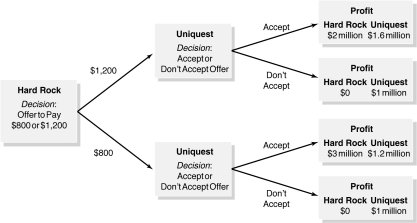 -Refer to Figure 14-9. Uniguest, Inc. is a company that provides PCs with internet access and touch-sensitive screens to hotels. Suppose the Hard Rock Hotel and Casino in Las Vegas informs Uniguest that it is considering installing these systems in its hotel rooms. The Hard Rock expects to be able to charge higher prices for these rooms if it installs Uniguest's systems in its rooms. The two companies begin bargaining over what price the Hard Rock will pay Uniguest for its systems, and the decision tree shown above illustrates this bargaining game. Note that the profit figures listed in the decision tree are additional profits for the Hard Rock and total profits for Uniguest.
a. Suppose the Hard Rock offers Uniguest $1,200 per system. Will Uniguest accept or reject this offer? Why?
b. Suppose the Hard Rock offers Uniguest $800 per system. Will Uniguest accept or reject this offer? Why?
c. Suppose Uniguest attempts to obtain a favorable outcome from the bargaining by telling the Hard Rock it will reject an $800-per-system offer. If the Hard Rock does not believe the threat is credible, what will it do? Why? What will Uniguest do? Why?
d. Is there a sub-game perfect equilibrium in this situation? Explain.
-Refer to Figure 14-9. Uniguest, Inc. is a company that provides PCs with internet access and touch-sensitive screens to hotels. Suppose the Hard Rock Hotel and Casino in Las Vegas informs Uniguest that it is considering installing these systems in its hotel rooms. The Hard Rock expects to be able to charge higher prices for these rooms if it installs Uniguest's systems in its rooms. The two companies begin bargaining over what price the Hard Rock will pay Uniguest for its systems, and the decision tree shown above illustrates this bargaining game. Note that the profit figures listed in the decision tree are additional profits for the Hard Rock and total profits for Uniguest.
a. Suppose the Hard Rock offers Uniguest $1,200 per system. Will Uniguest accept or reject this offer? Why?
b. Suppose the Hard Rock offers Uniguest $800 per system. Will Uniguest accept or reject this offer? Why?
c. Suppose Uniguest attempts to obtain a favorable outcome from the bargaining by telling the Hard Rock it will reject an $800-per-system offer. If the Hard Rock does not believe the threat is credible, what will it do? Why? What will Uniguest do? Why?
d. Is there a sub-game perfect equilibrium in this situation? Explain. (Essay)
4.8/5  (75)
(75) Which of the following is not one of the five competitive forces?
(Multiple Choice)
4.9/5 (86)
(86) Competition in the form of advertising, better customer service, or longer warranties can also reduce profits by raising costs.
(True/False)
4.8/5 (69)
(69) A reason why there is more competition among restaurants than among large discount department stores is that restaurants
(Multiple Choice)
4.9/5 (78)
(78) Article Summary
According to Edmunds.com, incentives for the purchase of automobiles rose to an average of $2,500 per vehicle in the United States in May 2013, or about 8 percent of market value. The incentives offered by the big 3 U.S. auto companies were higher than the average, with Chrysler at 10.3 percent of market value, General Motors at 10 percent, and Ford at 9 percent. Despite the increase in incentives, there was little change in sales volume for the first half of 2013.
Source: Kyle Stock, "Lauderdale CVB ramps up LGBT summer marketing," Bloomberg Businessweek, June 11, 2013.
-Refer to the Article Summary. What happens to the profit a car company makes on each car sold if it offers incentives such as cash rebates to customers? What happens to the company's profit per car if it offers zero percent financing as an incentive? How might a car company decide which of these strategies to use?
(Essay)
4.9/5 (67)
(67) Table 14-5  Ming and Henri each run one of the two dry cleaning facilities in the town of Scaraby. Both consider offering free pickup and delivery services. Table 14-5 shows the payoff matrix containing the expected quarterly profits for each firm.
-Refer to Table 14-5. Does Ming have a dominant strategy? If yes, what is it?
Ming and Henri each run one of the two dry cleaning facilities in the town of Scaraby. Both consider offering free pickup and delivery services. Table 14-5 shows the payoff matrix containing the expected quarterly profits for each firm.
-Refer to Table 14-5. Does Ming have a dominant strategy? If yes, what is it? (Multiple Choice)
4.7/5 (81)
(81) Which of the following is an example of implicit collusion?
(Multiple Choice)
4.8/5 (86)
(86) According to Porter's Five Competitive Forces Model, similar products produced by different firms within the industry affects a firm's ability to raise prices far more than substitutable products produced outside the industry.
(True/False)
4.8/5 (72)
(72) Assume that two interior design companies, Alistair and Baine, are competing for customers and if they both advertise, they would each earn $30 million in profits. If neither advertises, they each earn $50 million in profits. If one advertises and the other doesn't, the firm that advertises earns $40 million in profit while the other earns $20 million in profit.
a. Present the information above in the form of a payoff matrix. Let Baine be the row player and Alistair the column player.
b. Does each firm have a dominant strategy and if so what is it?
c. What is the Nash equilibrium?
(Essay)
4.9/5 (79)
(79) Table 14-5 Ming and Henri each run one of the two dry cleaning facilities in the town of Scaraby. Both consider offering free pickup and delivery services. Table 14-5 shows the payoff matrix containing the expected quarterly profits for each firm.
-Refer to Table 14-5. What is the Nash equilibrium in this game?
Ming and Henri each run one of the two dry cleaning facilities in the town of Scaraby. Both consider offering free pickup and delivery services. Table 14-5 shows the payoff matrix containing the expected quarterly profits for each firm.
-Refer to Table 14-5. What is the Nash equilibrium in this game? (Multiple Choice)
5.0/5 (83)
(83) Prisoner's dilemma games imply that cooperative behavior between two people or two firms always breaks down. But reality teaches us that people and firms often cooperate successfully to achieve their goals. Why do the results from prisoner's dilemma games fail to predict real world results?
(Multiple Choice)
4.8/5 (85)
(85) Figure 15-18  -An oligopolistic industry is characterized by all of the following except
 (Multiple Choice)
4.9/5 (84)
(84) The barrier to entry that allowed Alcoa to make persistent economic profits was ownership of an essential input.
(True/False)
4.8/5 (75)
(75) As a measure of competition in an industry, concentration ratios have several flaws. One of these flaws is that concentration ratios
(Multiple Choice)
4.9/5 (75)
(75) All of the following are ways by which existing firms can deter the entry of new firms into an industry except
(Multiple Choice)
4.8/5 (79)
(79) 
Filters
- Essay(0)
- Multiple Choice(0)
- Short Answer(0)
- True False(0)
- Matching(0)