



 Chat with AI
Exam 21: Economic Growth, the Financial System, and Business Cycles

Exam 1: Economics: Foundations and Models444 Questions
Exam 2: Trade-Offs, Comparative Advantage, and the Market System498 Questions
Exam 3: Where Prices Come From: the Interaction of Demand and Supply475 Questions
Exam 4: Economic Efficiency, Government Price Setting, and Taxes419 Questions
Exam 5: Externalities, Environmental Policy, and Public Goods266 Questions
Exam 6: Elasticity: the Responsiveness of Demand and Supply295 Questions
Exam 7: The Economics of Health Care334 Questions
Exam 8: Firms, the Stock Market, and Corporate Governance278 Questions
Exam 9: Comparative Advantage and the Gains From International Trade379 Questions
Exam 10: Consumer Choice and Behavioral Economics302 Questions
Exam 11: Technology, Production, and Costs330 Questions
Exam 12: Firms in Perfectly Competitive Markets298 Questions
Exam 13: Monopolistic Competition: the Competitive Model in a More Realistic Setting276 Questions
Exam 14: Oligopoly: Firms in Less Competitive Markets262 Questions
Exam 15: Monopoly and Antitrust Policy271 Questions
Exam 16: Pricing Strategy263 Questions
Exam 17: The Markets for Labor and Other Factors of Production286 Questions
Exam 18: Public Choice, Taxes, and the Distribution of Income258 Questions
Exam 19: GDP: Measuring Total Production and Income266 Questions
Exam 20: Unemployment and Inflation292 Questions
Exam 21: Economic Growth, the Financial System, and Business Cycles257 Questions
Exam 22: Long-Run Economic Growth: Sources and Policies268 Questions
Exam 23: Aggregate Expenditure and Output in the Short Run306 Questions
Exam 24: Aggregate Demand and Aggregate Supply Analysis284 Questions
Exam 25: Money, Banks, and the Federal Reserve System280 Questions
Exam 26: Monetary Policy277 Questions
Exam 27: Fiscal Policy303 Questions
Exam 28: Inflation, Unemployment, and Federal Reserve Policy257 Questions
Exam 29: Macroeconomics in an Open Economy278 Questions
Exam 30: The International Financial System262 Questions
Select questions type


Because Whirlpool produces durable goods, the demand for their goods
(Multiple Choice)
4.8/5  (87)
(87) An increase in the government budget surplus will shift the ________ curve for loanable funds to the ________ and the equilibrium real interest rate will ________.
(Multiple Choice)
4.8/5 (72)
(72) What two factors are the keys to determining labor productivity?
(Multiple Choice)
4.8/5 (63)
(63) According to the National Bureau of Economic Research, the United States has experienced ________ recessions since 1950.
(Multiple Choice)
4.8/5 (76)
(76) Centrally-planned economies tend to grow more quickly than market economies.
(True/False)
4.8/5 (83)
(83) Figure 21-6  -Refer to Figure 21-6. The market is in equilibrium. If the government budget deficit rises, which of the following would you expect to see?
 (Multiple Choice)
4.8/5 (79)
(79) If there is public dissaving, investment spending in the economy will decline, holding everything else constant.
(True/False)
4.8/5 (70)
(70) Market economies tend to grow more quickly than centrally-planned economies.
(True/False)
4.8/5 (70)
(70) Consider the following data for a closed economy:
a. Y = $12 trillion
b. C = $8 trillion
c. I= $3 trillion
d. TR = $2 trillion
e. T = $3 trillion
Use the data provided to calculate the level of private saving and the level of public saving and demonstrate their relationship to investment.
(Essay)
4.7/5 (80)
(80) Labor productivity will increase if the ________ increases and ________.
(Multiple Choice)
4.9/5 (84)
(84) Under which of the following circumstances would the government be running a deficit?
(Multiple Choice)
4.9/5 (92)
(92) If you spend more of your income on consumption goods, which of the following will occur?
(Multiple Choice)
4.9/5 (80)
(80) Scenario 21-1
Consider the following data for a closed economy:
Y = $12 trillion
C = $8 trillion
I= $2 trillion
G = $2 trillion
TR = $2 trillion
T = $3 trillion
-Refer to Scenario 21-1. Based on the information above, what is the level of private saving in the economy?
(Multiple Choice)
4.8/5 (78)
(78) Figure 21-3 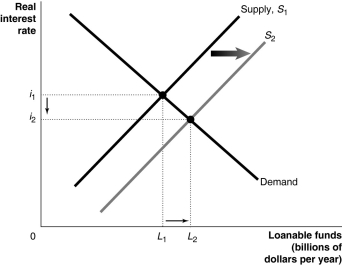 -Refer to Figure 21-3. Which of the following is consistent with the graph depicted above?
 (Multiple Choice)
4.8/5 (84)
(84) Suppose you are a famous international economic advisor. You have been asked to asses the possibilities for growth in an African country. It is a country abundant in labor and some natural resources. The capital to labor ratio is low. It has a free market economy. You have found that this country does not have a very strong and healthy banking system, however the political system is stable and the government does a good job protecting property rights. Assess this country's prospects for growth. Recommend two things that would enhance the country's growth.
(Essay)
4.9/5 (89)
(89) What factors increase potential GDP? Include a definition of potential GDP in your answer.
(Essay)
4.8/5 (72)
(72) ________ are financial securities that represent partial ownership of a firm.
(Multiple Choice)
4.9/5 (84)
(84) When the government runs a deficit, which of the following is true?
(Multiple Choice)
4.9/5 (94)
(94) A financial intermediary's main function is to match ________ with excess funds to ________ with a shortage of funds.
(Multiple Choice)
4.8/5 (83)
(83) 
Filters
- Essay(0)
- Multiple Choice(0)
- Short Answer(0)
- True False(0)
- Matching(0)