



 Chat with AI
Exam 21: Economic Growth, the Financial System, and Business Cycles

Exam 1: Economics: Foundations and Models444 Questions
Exam 2: Trade-Offs, Comparative Advantage, and the Market System498 Questions
Exam 3: Where Prices Come From: the Interaction of Demand and Supply475 Questions
Exam 4: Economic Efficiency, Government Price Setting, and Taxes419 Questions
Exam 5: Externalities, Environmental Policy, and Public Goods266 Questions
Exam 6: Elasticity: the Responsiveness of Demand and Supply295 Questions
Exam 7: The Economics of Health Care334 Questions
Exam 8: Firms, the Stock Market, and Corporate Governance278 Questions
Exam 9: Comparative Advantage and the Gains From International Trade379 Questions
Exam 10: Consumer Choice and Behavioral Economics302 Questions
Exam 11: Technology, Production, and Costs330 Questions
Exam 12: Firms in Perfectly Competitive Markets298 Questions
Exam 13: Monopolistic Competition: the Competitive Model in a More Realistic Setting276 Questions
Exam 14: Oligopoly: Firms in Less Competitive Markets262 Questions
Exam 15: Monopoly and Antitrust Policy271 Questions
Exam 16: Pricing Strategy263 Questions
Exam 17: The Markets for Labor and Other Factors of Production286 Questions
Exam 18: Public Choice, Taxes, and the Distribution of Income258 Questions
Exam 19: GDP: Measuring Total Production and Income266 Questions
Exam 20: Unemployment and Inflation292 Questions
Exam 21: Economic Growth, the Financial System, and Business Cycles257 Questions
Exam 22: Long-Run Economic Growth: Sources and Policies268 Questions
Exam 23: Aggregate Expenditure and Output in the Short Run306 Questions
Exam 24: Aggregate Demand and Aggregate Supply Analysis284 Questions
Exam 25: Money, Banks, and the Federal Reserve System280 Questions
Exam 26: Monetary Policy277 Questions
Exam 27: Fiscal Policy303 Questions
Exam 28: Inflation, Unemployment, and Federal Reserve Policy257 Questions
Exam 29: Macroeconomics in an Open Economy278 Questions
Exam 30: The International Financial System262 Questions
Select questions type


Since 1950, expansions in the United States have become ________, while recessions have become ________.
(Multiple Choice)
4.9/5  (89)
(89) Economists have not found a way to predict when recessions will begin and end.
(True/False)
5.0/5 (72)
(72) In comparison to a government that runs a balanced budget, when the government runs a budget deficit,
(Multiple Choice)
4.9/5 (82)
(82) If Ebenezer Scrooge spends rather than saves his vast wealth, he will
(Multiple Choice)
4.8/5 (82)
(82) Suppose that real GDP for 2012 was $10,000 billion and real GDP for 2013 was $11,000 billion. What is the rate of growth of real GDP between 2012 and 2013?
(Multiple Choice)
4.9/5 (79)
(79) If real GDP grows by 3% in 2011, 3.2% in 2012, and 2.5% in 2013, what is the average annual growth rate of real GDP?
(Multiple Choice)
4.8/5 (68)
(68) Inflation usually increases during a recession and decreases during an expansion.
(True/False)
4.8/5 (90)
(90) Which of the following financial securities is most liquid?
(Multiple Choice)
4.9/5 (75)
(75) Explain and show graphically how a decrease in government spending affects the equilibrium interest rate and equilibrium quantity of loanable funds in the market for loanable funds.
(Essay)
4.9/5 (76)
(76) What type of consumer goods are most affected by the business cycle: durable goods or nondurable goods? Why?
(Essay)
4.8/5 (93)
(93) If real GDP in a closed economy is $40 billion, consumption is $20 billion, and government purchases are $10 billion, what is investment?
(Multiple Choice)
4.8/5 (80)
(80) At the end of World War II in 1945, many economists and business managers expected that the U.S. economy would enter a severe recession. At that time, Sears and Montgomery Ward were the two largest department store chains in the country. Sears CEO Robert Wood expected continuing prosperity and opened new stores. Montgomery Ward CEO Sewell Avery expected falling incomes and rising unemployment and closed a number of existing stores. The results of their actions were seen during the late 1940s, when
(Multiple Choice)
4.9/5 (78)
(78) Following the September 11, 2001, terrorist attacks, the managers of many hotels expected a prolonged period of reduced travel and responded by laying off workers and postponing or canceling new construction. Isadore Sharp, the chairman and CEO of Four Seasons Hotels, decided to
(Multiple Choice)
4.8/5 (75)
(75) Which of the following would encourage economic growth through increases in the capital stock?
(Multiple Choice)
4.7/5 (79)
(79) ________ is the ease with which a financial security can be exchanged for money.
(Multiple Choice)
4.8/5 (92)
(92) Figure 21-5 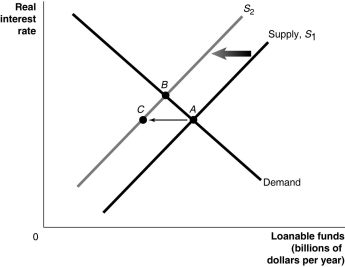 -Refer to Figure 21-5. "Crowding out" of firm investment as a result of a budget deficit is illustrated by the movement from ________ in the graph above.
 (Multiple Choice)
4.9/5 (89)
(89) Which of the following statements describes the experiences of the Whirlpool Corporation since it was established in 1911?
(Multiple Choice)
4.9/5 (79)
(79) 
Filters
- Essay(0)
- Multiple Choice(0)
- Short Answer(0)
- True False(0)
- Matching(0)