



 Chat with AI
Exam 21: Economic Growth, the Financial System, and Business Cycles

Exam 1: Economics: Foundations and Models444 Questions
Exam 2: Trade-Offs, Comparative Advantage, and the Market System498 Questions
Exam 3: Where Prices Come From: the Interaction of Demand and Supply475 Questions
Exam 4: Economic Efficiency, Government Price Setting, and Taxes419 Questions
Exam 5: Externalities, Environmental Policy, and Public Goods266 Questions
Exam 6: Elasticity: the Responsiveness of Demand and Supply295 Questions
Exam 7: The Economics of Health Care334 Questions
Exam 8: Firms, the Stock Market, and Corporate Governance278 Questions
Exam 9: Comparative Advantage and the Gains From International Trade379 Questions
Exam 10: Consumer Choice and Behavioral Economics302 Questions
Exam 11: Technology, Production, and Costs330 Questions
Exam 12: Firms in Perfectly Competitive Markets298 Questions
Exam 13: Monopolistic Competition: the Competitive Model in a More Realistic Setting276 Questions
Exam 14: Oligopoly: Firms in Less Competitive Markets262 Questions
Exam 15: Monopoly and Antitrust Policy271 Questions
Exam 16: Pricing Strategy263 Questions
Exam 17: The Markets for Labor and Other Factors of Production286 Questions
Exam 18: Public Choice, Taxes, and the Distribution of Income258 Questions
Exam 19: GDP: Measuring Total Production and Income266 Questions
Exam 20: Unemployment and Inflation292 Questions
Exam 21: Economic Growth, the Financial System, and Business Cycles257 Questions
Exam 22: Long-Run Economic Growth: Sources and Policies268 Questions
Exam 23: Aggregate Expenditure and Output in the Short Run306 Questions
Exam 24: Aggregate Demand and Aggregate Supply Analysis284 Questions
Exam 25: Money, Banks, and the Federal Reserve System280 Questions
Exam 26: Monetary Policy277 Questions
Exam 27: Fiscal Policy303 Questions
Exam 28: Inflation, Unemployment, and Federal Reserve Policy257 Questions
Exam 29: Macroeconomics in an Open Economy278 Questions
Exam 30: The International Financial System262 Questions
Select questions type


If taxes are less than transfers plus government spending, then
(Multiple Choice)
4.7/5  (79)
(79) A(n) ________ comes to an end with a business cycle ________.
(Multiple Choice)
4.9/5 (86)
(86) Which of the following would contribute to a sustained high rate of economic growth in the long run in an economy?
(Multiple Choice)
4.8/5 (73)
(73) During a recession, spending on ________ tends to fall more dramatically than spending on ________.
(Multiple Choice)
4.7/5 (93)
(93) When the economy reaches a trough in a business cycle, which of the following will occur?
(Multiple Choice)
4.9/5 (79)
(79) As the economy nears the end of an expansion, interest rates usually ________ and wages raise more ________ than prices.
(Multiple Choice)
4.8/5 (75)
(75) Figure 21-2 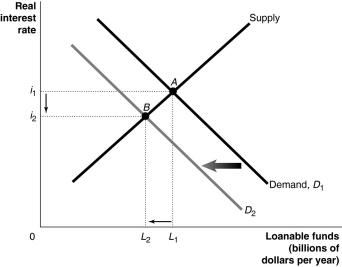 -Refer to Figure 21-2. Which of the following is consistent with the graph depicted above?
 (Multiple Choice)
4.8/5 (89)
(89) In an open economy, there is interaction with other economies in terms of both trading of goods and services and borrowing and lending.
(True/False)
4.8/5 (64)
(64) The Business Cycle Dating Committee defines a recession as
(Multiple Choice)
4.8/5 (70)
(70) Which of the following is not one of the key services provided by the financial system?
(Multiple Choice)
4.8/5 (77)
(77) Recessions cause the unemployment rate to ________ and the inflation rate to ________.
(Multiple Choice)
5.0/5 (90)
(90) Use the equations for public and private saving to demonstrate how total saving in the economy equals investment.
(Essay)
4.9/5 (72)
(72) Table 21-1
 -Refer to Table 21-1. Using the table above, what is the approximate growth rate of real GDP from 2012 to 2013?
 (Multiple Choice)
4.9/5 (90)
(90) Which one of the following is not considered a financial intermediary?
(Multiple Choice)
5.0/5 (86)
(86) Long-run economic growth requires all of the following except
(Multiple Choice)
4.9/5 (80)
(80) Which of the following is most likely to be able to sustain economic growth in an economy?
(Multiple Choice)
4.8/5 (78)
(78) 
Filters
- Essay(0)
- Multiple Choice(0)
- Short Answer(0)
- True False(0)
- Matching(0)