



 Chat with AI
Exam 28: Inflation, Unemployment, and Federal Reserve Policy

Exam 1: Economics: Foundations and Models444 Questions
Exam 2: Trade-Offs, Comparative Advantage, and the Market System498 Questions
Exam 3: Where Prices Come From: the Interaction of Demand and Supply475 Questions
Exam 4: Economic Efficiency, Government Price Setting, and Taxes419 Questions
Exam 5: Externalities, Environmental Policy, and Public Goods266 Questions
Exam 6: Elasticity: the Responsiveness of Demand and Supply295 Questions
Exam 7: The Economics of Health Care334 Questions
Exam 8: Firms, the Stock Market, and Corporate Governance278 Questions
Exam 9: Comparative Advantage and the Gains From International Trade379 Questions
Exam 10: Consumer Choice and Behavioral Economics302 Questions
Exam 11: Technology, Production, and Costs330 Questions
Exam 12: Firms in Perfectly Competitive Markets298 Questions
Exam 13: Monopolistic Competition: the Competitive Model in a More Realistic Setting276 Questions
Exam 14: Oligopoly: Firms in Less Competitive Markets262 Questions
Exam 15: Monopoly and Antitrust Policy271 Questions
Exam 16: Pricing Strategy263 Questions
Exam 17: The Markets for Labor and Other Factors of Production286 Questions
Exam 18: Public Choice, Taxes, and the Distribution of Income258 Questions
Exam 19: GDP: Measuring Total Production and Income266 Questions
Exam 20: Unemployment and Inflation292 Questions
Exam 21: Economic Growth, the Financial System, and Business Cycles257 Questions
Exam 22: Long-Run Economic Growth: Sources and Policies268 Questions
Exam 23: Aggregate Expenditure and Output in the Short Run306 Questions
Exam 24: Aggregate Demand and Aggregate Supply Analysis284 Questions
Exam 25: Money, Banks, and the Federal Reserve System280 Questions
Exam 26: Monetary Policy277 Questions
Exam 27: Fiscal Policy303 Questions
Exam 28: Inflation, Unemployment, and Federal Reserve Policy257 Questions
Exam 29: Macroeconomics in an Open Economy278 Questions
Exam 30: The International Financial System262 Questions
Select questions type


Even if expectations of inflation are rational, sluggish adjustment of wages and prices will still create a short-run trade-off between inflation and unemployment.
(True/False)
4.7/5  (93)
(93) If expected inflation falls, the long-run Phillips curve will
(Multiple Choice)
4.8/5 (73)
(73) According to ________, the economy is normally at potential GDP.
(Multiple Choice)
4.8/5 (72)
(72) In August 1979, President Jimmy Carter appointed ________ as chairman of the Board of Governors of the Federal Reserve System.
(Multiple Choice)
4.9/5 (77)
(77) Figure 28-2  -Refer to Figure 28-2. At which point are inflation expectations equal to the actual inflation rate?
 (Multiple Choice)
4.8/5 (80)
(80) Article Summary
In a September 2013 speech to the Independent Bankers Association of Texas, Federal Reserve Bank of Dallas president Richard Fisher stated that the Fed's credibility was harmed when it announced the previous week that it would continue its large bond purchasing program. In June, Fed Chairman Ben Bernanke had stated that that the program could begin to be cut back later in the year, and several other Fed officials expressed being open to the announced timing of this policy. Bernanke's change in his announced timeline of the Fed's intentions regarding the bond purchasing program brought criticism that the Fed had misled investors. In his speech, Fisher stated "I disagreed with the decision of the committee and argued against it. Doing nothing at this meeting would increase uncertainty about the future conduct of policy and call the credibility of our communications into question. I believe that is exactly what has occurred, though I take no pleasure in saying so." Fisher has been a long-time opponent of the Fed's bond purchasing program, claiming it is ineffective and may well lead to future inflation, and had been calling for the Fed to begin phasing out this program in September.
Source: "Fisher: Standing pat on policy hurt Fed's credibility," Reuters, September 23, 2013.
-Refer to the Article Summary. Richard Fisher brought the Fed's credibility into question when it decided to continue with its bond purchasing program despite leading many to believe that the program would begin to be phased out. Prior to this, over the past two decades whenever a change in Fed policy had been announced, the change has ________ taken place, leading to ________ credibility.
(Multiple Choice)
5.0/5 (65)
(65) Figure 28-1  -Refer to Figure 28-1. Suppose that the economy is currently at point A. If the Federal Reserve engaged in expansionary monetary policy, where would the economy end up in the short run?
 (Multiple Choice)
4.9/5 (75)
(75) If the actual rate of inflation exceeds the expected rate of inflation, the actual real wage is greater than the expected real wage and unemployment falls.
(True/False)
4.8/5 (82)
(82) A study conducted by Alberto Alesina and Lawrence Summers concluded that countries with ________ had lower inflation rates than countries with ________.
(Multiple Choice)
4.7/5 (89)
(89) During a time when the inflation rate is increasing each year for a number of years, are adaptive expectations or rational expectations likely to give the more accurate forecasts? Briefly explain.
(Essay)
4.8/5 (84)
(84) An increase in expected inflation will shift the short-run Phillips Curve.
(True/False)
4.9/5 (75)
(75) Figure 28-8 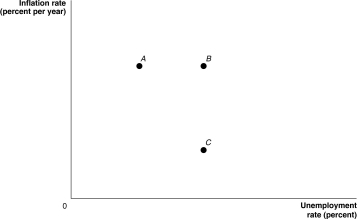 -Refer to Figure 28-8. A typical long-run Phillips curve would have the appearance of a curve running through points
 (Multiple Choice)
4.9/5 (78)
(78) If the Federal Reserve announces that its target for the federal funds rate is rising from 4 percent to 4.25 percent, how do you expect workers and firms to react?
(Multiple Choice)
4.9/5 (68)
(68) Models that focus on factors such as technology shocks rather than "monetary" explanations of fluctuations in real GDP are called
(Multiple Choice)
4.8/5 (84)
(84) If workers and firms expect that inflation will be 5 percent next year, and real wages are not changing over time, by how much will nominal wages increase?
(Multiple Choice)
4.8/5 (71)
(71) The FOMC no longer sets targets for M1 and M2 to meet its goals of price stability and high employment.
(True/False)
4.8/5 (83)
(83) Ceteris paribus, in the short run following a decrease in the rate of growth in Aggregate Demand, we would expect to see an increase in the rate of unemployment and a decrease in the rate of inflation.
(True/False)
4.9/5 (91)
(91) 
Filters
- Essay(0)
- Multiple Choice(0)
- Short Answer(0)
- True False(0)
- Matching(0)