



 Chat with AI
Exam 28: Inflation, Unemployment, and Federal Reserve Policy

Exam 1: Economics: Foundations and Models444 Questions
Exam 2: Trade-Offs, Comparative Advantage, and the Market System498 Questions
Exam 3: Where Prices Come From: the Interaction of Demand and Supply475 Questions
Exam 4: Economic Efficiency, Government Price Setting, and Taxes419 Questions
Exam 5: Externalities, Environmental Policy, and Public Goods266 Questions
Exam 6: Elasticity: the Responsiveness of Demand and Supply295 Questions
Exam 7: The Economics of Health Care334 Questions
Exam 8: Firms, the Stock Market, and Corporate Governance278 Questions
Exam 9: Comparative Advantage and the Gains From International Trade379 Questions
Exam 10: Consumer Choice and Behavioral Economics302 Questions
Exam 11: Technology, Production, and Costs330 Questions
Exam 12: Firms in Perfectly Competitive Markets298 Questions
Exam 13: Monopolistic Competition: the Competitive Model in a More Realistic Setting276 Questions
Exam 14: Oligopoly: Firms in Less Competitive Markets262 Questions
Exam 15: Monopoly and Antitrust Policy271 Questions
Exam 16: Pricing Strategy263 Questions
Exam 17: The Markets for Labor and Other Factors of Production286 Questions
Exam 18: Public Choice, Taxes, and the Distribution of Income258 Questions
Exam 19: GDP: Measuring Total Production and Income266 Questions
Exam 20: Unemployment and Inflation292 Questions
Exam 21: Economic Growth, the Financial System, and Business Cycles257 Questions
Exam 22: Long-Run Economic Growth: Sources and Policies268 Questions
Exam 23: Aggregate Expenditure and Output in the Short Run306 Questions
Exam 24: Aggregate Demand and Aggregate Supply Analysis284 Questions
Exam 25: Money, Banks, and the Federal Reserve System280 Questions
Exam 26: Monetary Policy277 Questions
Exam 27: Fiscal Policy303 Questions
Exam 28: Inflation, Unemployment, and Federal Reserve Policy257 Questions
Exam 29: Macroeconomics in an Open Economy278 Questions
Exam 30: The International Financial System262 Questions
Select questions type


Workers at a local construction company are paid $32.50 per hour, and they have incorporated a 4 percent annual raise in their contracts to account for expected inflation. Explain how unexpected inflation of 2 percent will affect the real wages earned by these workers and the unemployment rate of these workers.
(Essay)
4.7/5  (66)
(66) The experience of Paul Volcker's fight against inflation during the late 1970s and early 1980s indicates that firms and workers may have
(Multiple Choice)
4.8/5 (91)
(91) Shondra's real wage in 2014 is $18.50. If the price level is 106, what is Shondra's nominal wage?
(Multiple Choice)
4.9/5 (80)
(80) If firms and workers have rational expectations, including knowledge of the policy being used by the Federal Reserve, the short-run Phillips curve will be
(Multiple Choice)
4.9/5 (68)
(68) Which of the following best explains the negative slope of the short-run Phillips curve?
(Multiple Choice)
5.0/5 (78)
(78) If wages and prices adjust slowly, we would expect expansionary monetary policy to be
(Multiple Choice)
4.9/5 (77)
(77) According to the short-run Phillips curve, the unemployment rate and the inflation rate are
(Multiple Choice)
4.8/5 (89)
(89) Employees at the university have negotiated a 5 percent increase in wages for the next year, based on their inflation expectations. If inflation is actually 4 percent over the next year, which of the following will occur?
(Multiple Choice)
4.9/5 (76)
(76) Which of the following would be the source of a "real" business cycle?
(Multiple Choice)
5.0/5 (82)
(82) Monetary policy has ________ impact on the long-run Phillips curve.
(Multiple Choice)
4.9/5 (79)
(79) Some economists and lawmakers believe the Fed lost some of its independence when it
(Multiple Choice)
4.7/5 (72)
(72) Figure 28-2 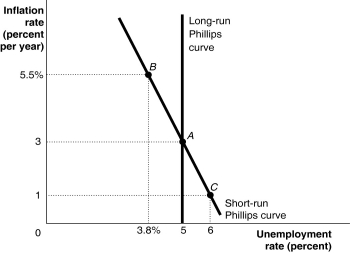 -Refer to Figure 28-2. Suppose the economy is at point C in the figure above. If workers adjust their expectations of inflation, which of the following will be true?
 (Multiple Choice)
4.8/5 (73)
(73) If the Federal Reserve chooses to fight high inflation with contractionary monetary policy and firms and consumers expect this policy to reduce inflation, which of the following would you expect to see?
(Multiple Choice)
4.9/5 (87)
(87) If the Federal Reserve attempts to continue reducing unemployment by manipulating monetary policy, which of the following would you expect to see?
(Multiple Choice)
4.9/5 (89)
(89) The actual real wage is lower than the expected real wage if
(Multiple Choice)
4.7/5 (78)
(78) Where does the short-run Phillips curve intersect the long-run Phillips curve?
(Multiple Choice)
4.9/5 (73)
(73) If rational workers and firms know that the Federal Reserve is following a contractionary monetary policy, they will expect inflation to ________ and will adjust wages so that the real wage ________.
(Multiple Choice)
4.7/5 (73)
(73) If workers accurately predict the rate of inflation, is there a short-run trade-off between inflation and unemployment, as predicted by the Phillips curve? Why or why not?
(Essay)
4.8/5 (91)
(91) What can the Federal Reserve do to reduce the natural rate of unemployment?
(Multiple Choice)
4.9/5 (89)
(89) 
Filters
- Essay(0)
- Multiple Choice(0)
- Short Answer(0)
- True False(0)
- Matching(0)