



 Chat with AI
Exam 28: Inflation, Unemployment, and Federal Reserve Policy

Exam 1: Economics: Foundations and Models444 Questions
Exam 2: Trade-Offs, Comparative Advantage, and the Market System498 Questions
Exam 3: Where Prices Come From: the Interaction of Demand and Supply475 Questions
Exam 4: Economic Efficiency, Government Price Setting, and Taxes419 Questions
Exam 5: Externalities, Environmental Policy, and Public Goods266 Questions
Exam 6: Elasticity: the Responsiveness of Demand and Supply295 Questions
Exam 7: The Economics of Health Care334 Questions
Exam 8: Firms, the Stock Market, and Corporate Governance278 Questions
Exam 9: Comparative Advantage and the Gains From International Trade379 Questions
Exam 10: Consumer Choice and Behavioral Economics302 Questions
Exam 11: Technology, Production, and Costs330 Questions
Exam 12: Firms in Perfectly Competitive Markets298 Questions
Exam 13: Monopolistic Competition: the Competitive Model in a More Realistic Setting276 Questions
Exam 14: Oligopoly: Firms in Less Competitive Markets262 Questions
Exam 15: Monopoly and Antitrust Policy271 Questions
Exam 16: Pricing Strategy263 Questions
Exam 17: The Markets for Labor and Other Factors of Production286 Questions
Exam 18: Public Choice, Taxes, and the Distribution of Income258 Questions
Exam 19: GDP: Measuring Total Production and Income266 Questions
Exam 20: Unemployment and Inflation292 Questions
Exam 21: Economic Growth, the Financial System, and Business Cycles257 Questions
Exam 22: Long-Run Economic Growth: Sources and Policies268 Questions
Exam 23: Aggregate Expenditure and Output in the Short Run306 Questions
Exam 24: Aggregate Demand and Aggregate Supply Analysis284 Questions
Exam 25: Money, Banks, and the Federal Reserve System280 Questions
Exam 26: Monetary Policy277 Questions
Exam 27: Fiscal Policy303 Questions
Exam 28: Inflation, Unemployment, and Federal Reserve Policy257 Questions
Exam 29: Macroeconomics in an Open Economy278 Questions
Exam 30: The International Financial System262 Questions
Select questions type


Parker Hannifin benefitted when the Federal Reserve ________ in 2008. This Fed action would help increase demand for its machinery components, which allowed Parker Hannifin to increase employment and increase prices.
(Multiple Choice)
4.8/5  (71)
(71) A study conducted by Alberto Alesina and Lawrence Summers concluded that countries with highly independent central banks had ________ than countries whose central banks had little independence.
(Multiple Choice)
4.8/5 (66)
(66) If actual inflation is less than expected inflation, actual real wages will be ________ expected real wages and unemployment will ________.
(Multiple Choice)
4.9/5 (89)
(89) Where does the short-run Phillips curve intersect the long-run Phillips curve?
(Multiple Choice)
4.8/5 (90)
(90) When inflation is very low, how do workers and firms adjust their expectations of inflation?
(Multiple Choice)
4.8/5 (76)
(76) Figure 28-2  -Refer to Figure 28-2. Suppose the economy is at point B. If the Fed increases the money supply so that inflation increases, the economy will ________ in the short run, holding all else constant.
 (Multiple Choice)
4.8/5 (84)
(84) Figure 28-3 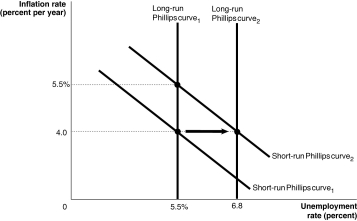 -Refer to Figure 28-3. The shifts shown in the short-run and long-run Phillips curves between period 1 and period 2 could be explained by
 (Multiple Choice)
4.9/5 (81)
(81) Figure 28-2
-Refer to Figure 28-2. Suppose the economy is at point A in the figure above. Which of the following is true?
-Refer to Figure 28-2. Suppose the economy is at point A in the figure above. Which of the following is true? (Multiple Choice)
4.7/5 (93)
(93) Figure 28-9  -Refer to Figure 28-9. Fed Chairman Paul Volcker's response to the ________ of the late 1970s is depicted in the figure above as a movement from C to D to A.
 (Multiple Choice)
4.8/5 (77)
(77) Figure 28-9
-Refer to Figure 28-9. A supply shock, such as rising oil prices, would be depicted as a movement from
-Refer to Figure 28-9. A supply shock, such as rising oil prices, would be depicted as a movement from (Multiple Choice)
4.7/5 (87)
(87) If workers and firms ignore inflation or form their inflation expectations adaptively, expansionary monetary policy will lower unemployment permanently.
(True/False)
4.7/5 (77)
(77) In the long run, the Federal Reserve can control which of the following?
(Multiple Choice)
4.8/5 (77)
(77) In face of a negative supply shock, the Fed may avoid a rise in unemployment only if it is willing to increase the rate of inflation.
(True/False)
4.7/5 (81)
(81) 
Filters
- Essay(0)
- Multiple Choice(0)
- Short Answer(0)
- True False(0)
- Matching(0)