



 Chat with AI
Exam 4: Economic Efficiency, Government Price Setting, and Taxes

Exam 1: Economics: Foundations and Models444 Questions
Exam 2: Trade-Offs, Comparative Advantage, and the Market System498 Questions
Exam 3: Where Prices Come From: the Interaction of Demand and Supply475 Questions
Exam 4: Economic Efficiency, Government Price Setting, and Taxes419 Questions
Exam 5: Externalities, Environmental Policy, and Public Goods266 Questions
Exam 6: Elasticity: the Responsiveness of Demand and Supply295 Questions
Exam 7: The Economics of Health Care334 Questions
Exam 8: Firms, the Stock Market, and Corporate Governance278 Questions
Exam 9: Comparative Advantage and the Gains From International Trade379 Questions
Exam 10: Consumer Choice and Behavioral Economics302 Questions
Exam 11: Technology, Production, and Costs330 Questions
Exam 12: Firms in Perfectly Competitive Markets298 Questions
Exam 13: Monopolistic Competition: the Competitive Model in a More Realistic Setting276 Questions
Exam 14: Oligopoly: Firms in Less Competitive Markets262 Questions
Exam 15: Monopoly and Antitrust Policy271 Questions
Exam 16: Pricing Strategy263 Questions
Exam 17: The Markets for Labor and Other Factors of Production286 Questions
Exam 18: Public Choice, Taxes, and the Distribution of Income258 Questions
Exam 19: GDP: Measuring Total Production and Income266 Questions
Exam 20: Unemployment and Inflation292 Questions
Exam 21: Economic Growth, the Financial System, and Business Cycles257 Questions
Exam 22: Long-Run Economic Growth: Sources and Policies268 Questions
Exam 23: Aggregate Expenditure and Output in the Short Run306 Questions
Exam 24: Aggregate Demand and Aggregate Supply Analysis284 Questions
Exam 25: Money, Banks, and the Federal Reserve System280 Questions
Exam 26: Monetary Policy277 Questions
Exam 27: Fiscal Policy303 Questions
Exam 28: Inflation, Unemployment, and Federal Reserve Policy257 Questions
Exam 29: Macroeconomics in an Open Economy278 Questions
Exam 30: The International Financial System262 Questions
Select questions type


Figure 4-18  Figure 4-18 shows the market for cigarettes. The government plans to impose a unit tax in this market.
-Refer to Figure 4-18. For each unit sold, the price sellers receive after the tax (net of tax) is
Figure 4-18 shows the market for cigarettes. The government plans to impose a unit tax in this market.
-Refer to Figure 4-18. For each unit sold, the price sellers receive after the tax (net of tax) is (Multiple Choice)
4.8/5  (77)
(77) Table 4-7
 Table 4-7 shows the demand and supply schedules for labor market in the city of Pixley.
-To affect the market outcome, a price ceiling
Table 4-7 shows the demand and supply schedules for labor market in the city of Pixley.
-To affect the market outcome, a price ceiling (Multiple Choice)
4.7/5 (82)
(82) Figure 4-11  Figure 4-11 shows the demand and supply curves for the coffee market. The government believes that the equilibrium price is too low and tries to help almond growers by setting a price floor at $7.00.
-Congress passed the Freedom to Farm Act in 1996. What was the purpose of this Act?
Figure 4-11 shows the demand and supply curves for the coffee market. The government believes that the equilibrium price is too low and tries to help almond growers by setting a price floor at $7.00.
-Congress passed the Freedom to Farm Act in 1996. What was the purpose of this Act? (Multiple Choice)
4.8/5 (72)
(72) Article Summary
In an attempt to discourage smoking, New York City Mayor Michael Bloomberg proposed a bill which would set a $10.50 minimum price for a pack of cigarettes. The bill would also prohibit retailers from offering any discounts such as 2-for-1 offers or accepting discount coupons. New York City already has the highest cigarette tax in the country, at $5.85 per pack, and the state of New York is one of many which already require cigarettes be marked up by a specified percentage. This bill is a companion to one which would require stores to keep tobacco products hidden from sight. Although the bills are expected to be challenged in court, a precedent has been set in Rhode Island, where a court upheld a ruling allowing the city of Providence to forbid retailers from accepting coupons and offering discounts on cigarettes.
Source: Vivian Yee, "Bloomberg Seeks End to Cheap Cigarettes," New York Times, March 26, 2013.
-Refer to the Article Summary. The minimum price of $10.50 per pack of cigarettes being proposed by mayor Bloomberg would have which of the following effects on the market for cigarettes?
(Multiple Choice)
4.9/5 (67)
(67) If the price of chewing gum is represented by equation P = 25 - 0.5 QD, then the corresponding quantity of chewing gum demanded is represented by the equation
(Multiple Choice)
4.9/5 (72)
(72) Table 4-12
 -Refer to Table 4-12. The equations above describe the demand and supply for Bubba's Fried Jellybeans. The equilibrium price and quantity for Bubba's Fried Jellybeans are $40 and 5 thousand units. What is the value of economic surplus in this market?
 (Multiple Choice)
4.8/5 (81)
(81) Table 4-9
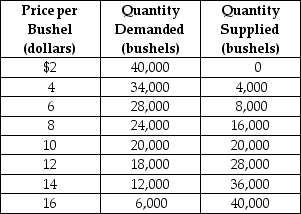 Table 4-9 above contains information about the corn market. Answer the following questions based on this table.
-Refer to Table 4-9. An agricultural price floor is a price that the government guarantees farmers will receive for a particular crop. Suppose the federal government sets a price floor for corn at $12 per bushel.
a. What is the amount of shortage or surplus in the corn market as result of the price floor?
b. If the government agrees to purchase any surplus output at $12, how much will it cost the government?
c. If the government buys all of the farmers' output at the floor price, how many bushels of corn will it have to purchase and how much will it cost the government?
d. Suppose the government buys up all of the farmers' output at the floor price and then sells the output to consumers at whatever price it can get. Under this scheme, what is the price at which the government will be able to sell off all of the output it had purchased from farmers? What is the revenue received from the government's sale?
e. In this problem we have considered two government schemes: (1) a price floor is established and the government purchases any excess output and (2) the government buys all the farmers' output at the floor price and resells at whatever price it can get. Which scheme will taxpayers prefer?
f. Consider again the two schemes. Which scheme will the farmers prefer?
g. Consider again the two schemes. Which scheme will corn buyers prefer?
Table 4-9 above contains information about the corn market. Answer the following questions based on this table.
-Refer to Table 4-9. An agricultural price floor is a price that the government guarantees farmers will receive for a particular crop. Suppose the federal government sets a price floor for corn at $12 per bushel.
a. What is the amount of shortage or surplus in the corn market as result of the price floor?
b. If the government agrees to purchase any surplus output at $12, how much will it cost the government?
c. If the government buys all of the farmers' output at the floor price, how many bushels of corn will it have to purchase and how much will it cost the government?
d. Suppose the government buys up all of the farmers' output at the floor price and then sells the output to consumers at whatever price it can get. Under this scheme, what is the price at which the government will be able to sell off all of the output it had purchased from farmers? What is the revenue received from the government's sale?
e. In this problem we have considered two government schemes: (1) a price floor is established and the government purchases any excess output and (2) the government buys all the farmers' output at the floor price and resells at whatever price it can get. Which scheme will taxpayers prefer?
f. Consider again the two schemes. Which scheme will the farmers prefer?
g. Consider again the two schemes. Which scheme will corn buyers prefer? (Essay)
4.8/5 (72)
(72) Economic surplus is maximized in a competitive market when
(Multiple Choice)
4.8/5 (78)
(78) Table 4-8
 Table 4-8 shows the demand and supply schedules for the low-skilled labor market in the city of Westover.
-Refer to Table 4-8. Suppose that the quantity of labor demanded decreases by 40,000 at each wage level. What are the new free market equilibrium hourly wage and the new equilibrium quantity of labor?
Table 4-8 shows the demand and supply schedules for the low-skilled labor market in the city of Westover.
-Refer to Table 4-8. Suppose that the quantity of labor demanded decreases by 40,000 at each wage level. What are the new free market equilibrium hourly wage and the new equilibrium quantity of labor? (Multiple Choice)
4.8/5 (69)
(69) Figure 4-14 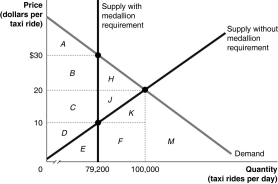 Figure 4-14 shows the market for taxi rides. The following question(s) are based on this figure.
-Refer to Figure 4-14. To legally drive a taxicab in New York City, you must have a medallion issued by the city government. Assume that only 13,200 medallions have been issued. Let's also assume this puts an absolute limit on the number of taxi rides that can be supplied in New York City on any day, because no one breaks the law by driving a taxi without a medallion. Assume as well that each taxi provides 6 trips per day. In that case, the quantity supplied of taxi rides is 79,200 (or 6 rides per taxi × 13,200 taxis). This is shown in the diagram with a vertical line at this quantity. Assume that there are no government controls on the prices that drivers can charge for rides.
a. What would the equilibrium price and quantity be in this market if there were no medallion requirement?
b. If there were no medallion requirement, indicate the area that represents consumer surplus.
c. If there were no medallion requirement, indicate the area that represents producer surplus.
d. If there were no medallion requirement, indicate the area that represents economic surplus.
e. What are the price and quantity with the medallion requirement?
f. With a medallion requirement in place, what area represents consumer surplus?
g. With a medallion requirement in place, what area represents producer surplus?
h. With a medallion requirement in place, what area represents the deadweight loss?
i. Based on your answers to parts (c) and (g), are taxicab drivers better off with the medallion requirement for taxicabs than without?
j. Are consumers better off with or without the medallion requirement for taxicabs?
Figure 4-14 shows the market for taxi rides. The following question(s) are based on this figure.
-Refer to Figure 4-14. To legally drive a taxicab in New York City, you must have a medallion issued by the city government. Assume that only 13,200 medallions have been issued. Let's also assume this puts an absolute limit on the number of taxi rides that can be supplied in New York City on any day, because no one breaks the law by driving a taxi without a medallion. Assume as well that each taxi provides 6 trips per day. In that case, the quantity supplied of taxi rides is 79,200 (or 6 rides per taxi × 13,200 taxis). This is shown in the diagram with a vertical line at this quantity. Assume that there are no government controls on the prices that drivers can charge for rides.
a. What would the equilibrium price and quantity be in this market if there were no medallion requirement?
b. If there were no medallion requirement, indicate the area that represents consumer surplus.
c. If there were no medallion requirement, indicate the area that represents producer surplus.
d. If there were no medallion requirement, indicate the area that represents economic surplus.
e. What are the price and quantity with the medallion requirement?
f. With a medallion requirement in place, what area represents consumer surplus?
g. With a medallion requirement in place, what area represents producer surplus?
h. With a medallion requirement in place, what area represents the deadweight loss?
i. Based on your answers to parts (c) and (g), are taxicab drivers better off with the medallion requirement for taxicabs than without?
j. Are consumers better off with or without the medallion requirement for taxicabs? (Essay)
4.9/5 (72)
(72) Table 4-6
 -Refer to Table 4-6. The table above lists the marginal cost of polo shirts by Marko's, a firm that specializes in producing men's clothing. If the price of polo shirts increases from $15 to $20,
 (Multiple Choice)
4.7/5 (66)
(66) Which of the following is not a result of government price controls?
(Multiple Choice)
4.9/5 (87)
(87) If, in a competitive market, marginal benefit is less than marginal cost,
(Multiple Choice)
4.8/5 (78)
(78) Figure 4-15  Figure 4-15 shows the market for beer. The government plans to impose a unit tax in this market.
-Refer to Figure 4-15. For each unit sold, the price sellers receive after the tax (net of tax) is
Figure 4-15 shows the market for beer. The government plans to impose a unit tax in this market.
-Refer to Figure 4-15. For each unit sold, the price sellers receive after the tax (net of tax) is (Multiple Choice)
4.8/5 (78)
(78) The following equations represent the demand and supply for bird feeders. QD = 35 - P
QS = -5 + 3P
What is the equilibrium price (P) and quantity (Q - in thousands) of bird feeders?
(Multiple Choice)
4.8/5 (91)
(91) If a tax is imposed on a product, the buyer will always bear the entire burden of the tax.
(True/False)
5.0/5 (69)
(69) Figure 4-8  Figure 4-8 shows the market for apartments in Springfield. Recently, the government imposed a rent ceiling of $1,000 per month.
-Refer to Figure 4-8. What is the value of producer surplus after the imposition of the ceiling?
Figure 4-8 shows the market for apartments in Springfield. Recently, the government imposed a rent ceiling of $1,000 per month.
-Refer to Figure 4-8. What is the value of producer surplus after the imposition of the ceiling? (Multiple Choice)
5.0/5 (81)
(81) 
Filters
- Essay(0)
- Multiple Choice(0)
- Short Answer(0)
- True False(0)
- Matching(0)