



 Chat with AI
Exam 4: Economic Efficiency, Government Price Setting, and Taxes

Exam 1: Economics: Foundations and Models444 Questions
Exam 2: Trade-Offs, Comparative Advantage, and the Market System498 Questions
Exam 3: Where Prices Come From: the Interaction of Demand and Supply475 Questions
Exam 4: Economic Efficiency, Government Price Setting, and Taxes419 Questions
Exam 5: Externalities, Environmental Policy, and Public Goods266 Questions
Exam 6: Elasticity: the Responsiveness of Demand and Supply295 Questions
Exam 7: The Economics of Health Care334 Questions
Exam 8: Firms, the Stock Market, and Corporate Governance278 Questions
Exam 9: Comparative Advantage and the Gains From International Trade379 Questions
Exam 10: Consumer Choice and Behavioral Economics302 Questions
Exam 11: Technology, Production, and Costs330 Questions
Exam 12: Firms in Perfectly Competitive Markets298 Questions
Exam 13: Monopolistic Competition: the Competitive Model in a More Realistic Setting276 Questions
Exam 14: Oligopoly: Firms in Less Competitive Markets262 Questions
Exam 15: Monopoly and Antitrust Policy271 Questions
Exam 16: Pricing Strategy263 Questions
Exam 17: The Markets for Labor and Other Factors of Production286 Questions
Exam 18: Public Choice, Taxes, and the Distribution of Income258 Questions
Exam 19: GDP: Measuring Total Production and Income266 Questions
Exam 20: Unemployment and Inflation292 Questions
Exam 21: Economic Growth, the Financial System, and Business Cycles257 Questions
Exam 22: Long-Run Economic Growth: Sources and Policies268 Questions
Exam 23: Aggregate Expenditure and Output in the Short Run306 Questions
Exam 24: Aggregate Demand and Aggregate Supply Analysis284 Questions
Exam 25: Money, Banks, and the Federal Reserve System280 Questions
Exam 26: Monetary Policy277 Questions
Exam 27: Fiscal Policy303 Questions
Exam 28: Inflation, Unemployment, and Federal Reserve Policy257 Questions
Exam 29: Macroeconomics in an Open Economy278 Questions
Exam 30: The International Financial System262 Questions
Select questions type


Employers withhold several taxes from employees' paychecks, one of which is FICA. Congress requires employers to pay half of the FICA tax and workers to pay the other half. Does this mean that the burden of the FICA tax falls evenly on employers and employees? Briefly explain.
(Essay)
4.8/5  (84)
(84) Table 4-14
 -Refer to Table 4-14. The equations above describe the demand and supply for Pauline's Pickled Pomegranates. The equilibrium price and quantity for Pauline's Pickled Pomegranates are $30 and 15 thousand units. What is the value of economic surplus in this market?
 (Multiple Choice)
4.9/5 (82)
(82) Figure 4-16  -Refer to Figure 4-16. Suppose the market is initially in equilibrium at price P1 and now the government imposes a tax on every unit sold. Which of the following statements best describes the impact of the tax? For demand curve D1,
 (Multiple Choice)
4.9/5 (78)
(78) Which of the following statements best describes the concept of consumer surplus?
(Multiple Choice)
4.9/5 (90)
(90) Figure 4-3  Figure 4-3 shows Kendra's demand curve for ice-cream cones.
-Two economists from Northwestern University estimated the benefit households received from subscribing to broadband Internet service. They found that in the year they analyzed, 47 million consumers paid an average of $36 per month to subscribe to a broadband Internet service, and estimated the value of total consumer surplus for these subscribers was equal to $890.5 million. Based on these numbers, what was the average monthly consumer surplus per subscriber for broadband Internet service?
Figure 4-3 shows Kendra's demand curve for ice-cream cones.
-Two economists from Northwestern University estimated the benefit households received from subscribing to broadband Internet service. They found that in the year they analyzed, 47 million consumers paid an average of $36 per month to subscribe to a broadband Internet service, and estimated the value of total consumer surplus for these subscribers was equal to $890.5 million. Based on these numbers, what was the average monthly consumer surplus per subscriber for broadband Internet service? (Multiple Choice)
4.7/5 (80)
(80) Article Summary
In an attempt to discourage smoking, New York City Mayor Michael Bloomberg proposed a bill which would set a $10.50 minimum price for a pack of cigarettes. The bill would also prohibit retailers from offering any discounts such as 2-for-1 offers or accepting discount coupons. New York City already has the highest cigarette tax in the country, at $5.85 per pack, and the state of New York is one of many which already require cigarettes be marked up by a specified percentage. This bill is a companion to one which would require stores to keep tobacco products hidden from sight. Although the bills are expected to be challenged in court, a precedent has been set in Rhode Island, where a court upheld a ruling allowing the city of Providence to forbid retailers from accepting coupons and offering discounts on cigarettes.
Source: Vivian Yee, "Bloomberg Seeks End to Cheap Cigarettes," New York Times, March 26, 2013.
-Refer to the Article Summary. The minimum price of $10.50 per pack of cigarettes being proposed by Mayor Bloomberg is an example of
(Multiple Choice)
4.8/5 (65)
(65) Figure 4-6  Figure 4-6 shows the market for granola. The market is initially in equilibrium at a price of P1 and a quantity of Q1. Now suppose producers decide to cut output to Q2 in order to raise the price to P2.
-Refer to Figure 4-6. What area represents producer surplus at the equilibrium price of P1?
Figure 4-6 shows the market for granola. The market is initially in equilibrium at a price of P1 and a quantity of Q1. Now suppose producers decide to cut output to Q2 in order to raise the price to P2.
-Refer to Figure 4-6. What area represents producer surplus at the equilibrium price of P1? (Multiple Choice)
4.9/5 (92)
(92) Figure 4-2  -The difference between the ________ for a good and the ________ is called consumer surplus.
 (Multiple Choice)
4.8/5 (78)
(78) Figure 4-18  Figure 4-18 shows the market for cigarettes. The government plans to impose a unit tax in this market.
-Refer to Figure 4-18. The price buyers pay after the tax is
Figure 4-18 shows the market for cigarettes. The government plans to impose a unit tax in this market.
-Refer to Figure 4-18. The price buyers pay after the tax is (Multiple Choice)
4.9/5 (81)
(81) The graph below represents the market for walnuts. Identify the values of the marginal benefit and the marginal cost at the output levels of 2,000 pounds, 4,000 pounds and 6,000 pounds. At each of these output levels, state whether output is inefficiently high, inefficiently low, or economically efficient. 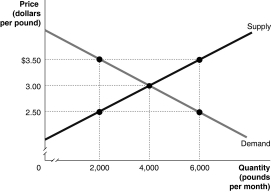
(Essay)
4.9/5 (71)
(71) If the market price is at equilibrium, the deadweight loss is maximized.
(True/False)
4.9/5 (84)
(84) Table 4-3
 -The total amount of producer surplus in a market is equal to
 (Multiple Choice)
4.9/5 (75)
(75) The maximum price that a buyer is willing to pay for a good measures his
(Multiple Choice)
4.8/5 (69)
(69) When ________ in a market, the total net benefit to society is maximized.
(Multiple Choice)
5.0/5 (77)
(77) Monique buys a new television for $795. She receives consumer surplus of $355 from the purchase. How much does Monique value her television?
(Multiple Choice)
4.9/5 (73)
(73) Figure 4-6 Figure 4-6 shows the market for granola. The market is initially in equilibrium at a price of P1 and a quantity of Q1. Now suppose producers decide to cut output to Q2 in order to raise the price to P2.
-Refer to Figure 4-6. What area represents the deadweight loss at the equilibrium price of P1?
Figure 4-6 shows the market for granola. The market is initially in equilibrium at a price of P1 and a quantity of Q1. Now suppose producers decide to cut output to Q2 in order to raise the price to P2.
-Refer to Figure 4-6. What area represents the deadweight loss at the equilibrium price of P1? (Multiple Choice)
4.7/5 (79)
(79) Marco goes to the pet store to buy a dozen Koi fish for his new Koi pond. He is willing to pay $200 for the dozen fish, but buys them for a total of $140. Marco's consumer surplus from the purchase is
(Multiple Choice)
4.9/5 (92)
(92) Consumers are willing to purchase a product up to the point where
(Multiple Choice)
4.7/5 (81)
(81) Table 4-1
 -Refer to Table 4-1. The table above lists the highest prices three consumers, Tom, Dick and Harriet, are willing to pay for a short-sleeved polo shirt. If the price of one of the shirts is $28 dollars,
 (Multiple Choice)
4.8/5 (81)
(81) 
Filters
- Essay(0)
- Multiple Choice(0)
- Short Answer(0)
- True False(0)
- Matching(0)