



 Chat with AI
Exam 4: Economic Efficiency, Government Price Setting, and Taxes

Exam 1: Economics: Foundations and Models444 Questions
Exam 2: Trade-Offs, Comparative Advantage, and the Market System498 Questions
Exam 3: Where Prices Come From: the Interaction of Demand and Supply475 Questions
Exam 4: Economic Efficiency, Government Price Setting, and Taxes419 Questions
Exam 5: Externalities, Environmental Policy, and Public Goods266 Questions
Exam 6: Elasticity: the Responsiveness of Demand and Supply295 Questions
Exam 7: The Economics of Health Care334 Questions
Exam 8: Firms, the Stock Market, and Corporate Governance278 Questions
Exam 9: Comparative Advantage and the Gains From International Trade379 Questions
Exam 10: Consumer Choice and Behavioral Economics302 Questions
Exam 11: Technology, Production, and Costs330 Questions
Exam 12: Firms in Perfectly Competitive Markets298 Questions
Exam 13: Monopolistic Competition: the Competitive Model in a More Realistic Setting276 Questions
Exam 14: Oligopoly: Firms in Less Competitive Markets262 Questions
Exam 15: Monopoly and Antitrust Policy271 Questions
Exam 16: Pricing Strategy263 Questions
Exam 17: The Markets for Labor and Other Factors of Production286 Questions
Exam 18: Public Choice, Taxes, and the Distribution of Income258 Questions
Exam 19: GDP: Measuring Total Production and Income266 Questions
Exam 20: Unemployment and Inflation292 Questions
Exam 21: Economic Growth, the Financial System, and Business Cycles257 Questions
Exam 22: Long-Run Economic Growth: Sources and Policies268 Questions
Exam 23: Aggregate Expenditure and Output in the Short Run306 Questions
Exam 24: Aggregate Demand and Aggregate Supply Analysis284 Questions
Exam 25: Money, Banks, and the Federal Reserve System280 Questions
Exam 26: Monetary Policy277 Questions
Exam 27: Fiscal Policy303 Questions
Exam 28: Inflation, Unemployment, and Federal Reserve Policy257 Questions
Exam 29: Macroeconomics in an Open Economy278 Questions
Exam 30: The International Financial System262 Questions
Select questions type


Figure 4-3 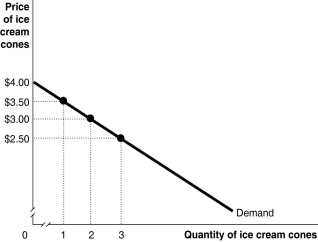 Figure 4-3 shows Kendra's demand curve for ice-cream cones.
-Refer to Figure 4-3. If the market price is $2.50, what is Kendra's consumer surplus?
Figure 4-3 shows Kendra's demand curve for ice-cream cones.
-Refer to Figure 4-3. If the market price is $2.50, what is Kendra's consumer surplus? (Multiple Choice)
5.0/5  (87)
(87) Figure 4-17 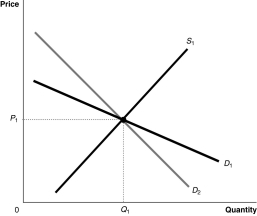 -The payroll tax is a tax imposed on ________ that is used to fund Social Security and Medicare.
 (Multiple Choice)
4.9/5 (85)
(85) Economic efficiency is defined as a market outcome in which the marginal benefit to consumers of the last unit produced is equal to the marginal cost of production, and in which
(Multiple Choice)
4.8/5 (94)
(94) Figure 4-2 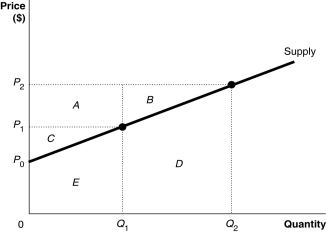 -In cities with rent control, people have an incentive to list their apartments on sites such as Airbnb at rents ________ the controlled rates, because rent control causes a ________ of apartments.
 (Multiple Choice)
4.8/5 (77)
(77) In a competitive market, when there is no deadweight loss,
(Multiple Choice)
4.8/5 (83)
(83) If the government implements a price ceiling on insulin, this will have all of the following effects on the market for insulin except
(Multiple Choice)
4.8/5 (82)
(82) Table 4-12
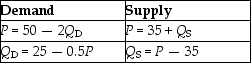 -Refer to Table 4-12. The equations above describe the demand and supply for Bubba's Fried Jellybeans. The equilibrium price and quantity for Bubba's Fried Jellybeans are $40 and 5 thousand units. What is the value of consumer surplus?
 (Multiple Choice)
4.8/5 (96)
(96) Figure 4-8  Figure 4-8 shows the market for apartments in Springfield. Recently, the government imposed a rent ceiling of $1,000 per month.
-Refer to Figure 4-8. Suppose that instead of a rent ceiling, the government imposed a price floor of $2,000 per month for apartments. What is the value of the deadweight loss after the imposition of the price floor?
Figure 4-8 shows the market for apartments in Springfield. Recently, the government imposed a rent ceiling of $1,000 per month.
-Refer to Figure 4-8. Suppose that instead of a rent ceiling, the government imposed a price floor of $2,000 per month for apartments. What is the value of the deadweight loss after the imposition of the price floor? (Multiple Choice)
4.8/5 (82)
(82) Figure 4-18  Figure 4-18 shows the market for cigarettes. The government plans to impose a unit tax in this market.
-Refer to Figure 4-18. As a result of the tax, is there a loss in producer surplus?
Figure 4-18 shows the market for cigarettes. The government plans to impose a unit tax in this market.
-Refer to Figure 4-18. As a result of the tax, is there a loss in producer surplus? (Multiple Choice)
4.7/5 (84)
(84) Figure 4-10  Figure 4-10 shows the market for apartments in Bay City. Recently, the government imposed a rent ceiling at R0.
-Refer to Figure 4-10. What is the area that represents the producer surplus after the imposition of the ceiling?
Figure 4-10 shows the market for apartments in Bay City. Recently, the government imposed a rent ceiling at R0.
-Refer to Figure 4-10. What is the area that represents the producer surplus after the imposition of the ceiling? (Multiple Choice)
4.8/5 (85)
(85) Table 4-7
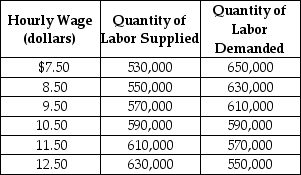 Table 4-7 shows the demand and supply schedules for labor market in the city of Pixley.
-Rent control is an example of
Table 4-7 shows the demand and supply schedules for labor market in the city of Pixley.
-Rent control is an example of (Multiple Choice)
5.0/5 (85)
(85) What is marginal benefit? Which curve is also referred to as a marginal benefit curve?
(Essay)
4.8/5 (69)
(69) Table 4-3
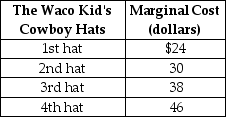 -Refer to Table 4-3. The table above lists the marginal cost of cowboy hats by The Waco Kid, a firm that specializes in producing western wear. If the market price of cowboy hats is $50, producer surplus is
 (Multiple Choice)
4.8/5 (79)
(79) Figure 4-3 Figure 4-3 shows Kendra's demand curve for ice-cream cones.
-Refer to Figure 4-3. If the market price is $3.50, what is the consumer surplus on the first ice cream cone?
Figure 4-3 shows Kendra's demand curve for ice-cream cones.
-Refer to Figure 4-3. If the market price is $3.50, what is the consumer surplus on the first ice cream cone? (Multiple Choice)
4.9/5 (76)
(76) Table 4-2
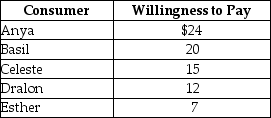 -Refer to Table 4-2. The table above lists the highest prices five consumers are willing to pay for a theater ticket. If the price of one ticket falls from $25 to $10,
 (Multiple Choice)
4.8/5 (74)
(74) Table 4-2
-Refer to Table 4-2. The table above lists the highest prices five consumers are willing to pay for a theater ticket. If the price of one ticket rises from $10 to $19,
-Refer to Table 4-2. The table above lists the highest prices five consumers are willing to pay for a theater ticket. If the price of one ticket rises from $10 to $19, (Multiple Choice)
4.8/5 (81)
(81) If the quantity of tacos demanded is represented by the equation QD = 20 - 0.5P then the corresponding price of tacos is represented by the equation
(Multiple Choice)
5.0/5 (88)
(88) Table 4-3
-Refer to Table 4-3. The table above lists the marginal cost of cowboy hats by The Waco Kid, a firm that specializes in producing western wear. If the price of cowboy hats decreases from $38 to $30,
-Refer to Table 4-3. The table above lists the marginal cost of cowboy hats by The Waco Kid, a firm that specializes in producing western wear. If the price of cowboy hats decreases from $38 to $30, (Multiple Choice)
4.9/5 (82)
(82) If, in a competitive market, marginal benefit is greater than marginal cost,
(Multiple Choice)
4.8/5 (75)
(75) Which term refers to a legally established maximum price that firms may charge?
(Multiple Choice)
4.8/5 (89)
(89) 
Filters
- Essay(0)
- Multiple Choice(0)
- Short Answer(0)
- True False(0)
- Matching(0)