



 Chat with AI
Exam 21: International Trade Restrictions

Exam 1: The Wealth of Nations: Ownership and Economic Freedom87 Questions
Exam 2: Scarcity and Opportunity Costs87 Questions
Exam 3: Markets and the Price System96 Questions
Exam 4: The Aggregate Economy61 Questions
Exam 5: Using Economics to Understand the World Around You68 Questions
Exam 6: Elasticity: Demand and Supply133 Questions
Exam 7: Demand: Consumer Choice142 Questions
Exam 8: Supply: the Costs of Doing Business105 Questions
Exam 9: Profit Maximization121 Questions
Exam 10: Perfect Competition135 Questions
Exam 11: Monopoly118 Questions
Exam 12: Monopolistic Competition and Oligopoly114 Questions
Exam 13: Markets and Government113 Questions
Exam 14: Antitrust and Regulation88 Questions
Exam 15: Resource Markets110 Questions
Exam 16: The Labor Market116 Questions
Exam 17: The Capital Market110 Questions
Exam 18: The Land Market and Natural Resources55 Questions
Exam 19: Current Issues: Income, Income Distribution, Poverty, and Government Policy85 Questions
Exam 20: World Trade Equilibrium112 Questions
Exam 21: International Trade Restrictions109 Questions
Exam 22: Exchange Rates and Financial Links Between Countries130 Questions
Select questions type


The figure below shows the demand (D) and supply (S) curves of a good produced domestically in an economy as well as traded in the international market.Figure 21.1
In the figure,
P1: Price of the good in the international market.P2: Price of the good in the domestic market after the imposition of tariff by the government.P3: No-trade price of the good in the domestic market.  -According to Figure 21.1, the domestic equilibrium quantity of the good is:
 (Multiple Choice)
4.8/5  (92)
(92) The figure below shows the demand (D) and supply (S) curves of cocoa in the U.S.Figure 21.4
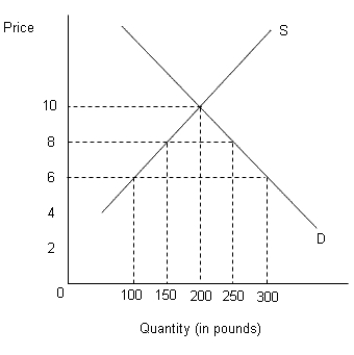 -Since individual consumers do not know how much of the price they pay for a commodity is due to trade protection, consumers rarely lobby their political representatives to eliminate protection and reduce prices.
 (True/False)
4.7/5 (89)
(89) The figure below shows the demand (D) and supply (S) curves of cocoa in the U.S.Figure 21.4
-International trade on the basis of comparative advantage maximizes world output and allows consumers to access better-quality products at lower prices than would be available in the domestic market alone.
-International trade on the basis of comparative advantage maximizes world output and allows consumers to access better-quality products at lower prices than would be available in the domestic market alone. (True/False)
4.7/5 (80)
(80) The table below shows the quantity demanded (in thousands) and quantity supplied (in thousands) of computers in the U.S. and Canada at different prices.Table 20.5
 -The notion of reciprocity means that one nation will impose import restrictions on another in order to:
 (Multiple Choice)
4.7/5 (73)
(73) The table below shows the quantity demanded (in thousands) and quantity supplied (in thousands) of computers in the U.S. and Canada at different prices.Table 20.5
-People who call for creating a "level playing field" believe that:
-People who call for creating a "level playing field" believe that: (Multiple Choice)
4.7/5 (83)
(83) The table below shows the quantity demanded (in thousands) and quantity supplied (in thousands) of computers in the U.S. and Canada at different prices.Table 20.5
-Which of the following statements about international trade restrictions is true?
-Which of the following statements about international trade restrictions is true? (Multiple Choice)
4.9/5 (76)
(76) The figure below shows the demand (D) and supply (S) curves of corn syrups.Figure 21.3
 -In Figure 21.3, what are the equilibrium price and quantity in the absence of trade?
 (Multiple Choice)
4.9/5 (79)
(79) The figure below shows the demand (D) and supply (S) curves of cocoa in the U.S.Figure 21.4
-The world output is higher if the countries follow restrictive trade policies rather than free trade.
-The world output is higher if the countries follow restrictive trade policies rather than free trade. (True/False)
4.9/5 (86)
(86) The figure given below depicts the negatively sloped demand and positively sloped supply curves of wheat in a country.Figure 21.2
 -Refer to Figure 21.2. In the absence of international trade, what are the domestic equilibrium price and quantity?
 (Multiple Choice)
4.8/5 (82)
(82) 
Filters
- Essay(0)
- Multiple Choice(0)
- Short Answer(0)
- True False(0)
- Matching(0)