



 Chat with AI
Exam 7: Demand: Consumer Choice

Exam 1: The Wealth of Nations: Ownership and Economic Freedom87 Questions
Exam 2: Scarcity and Opportunity Costs87 Questions
Exam 3: Markets and the Price System96 Questions
Exam 4: The Aggregate Economy61 Questions
Exam 5: Using Economics to Understand the World Around You68 Questions
Exam 6: Elasticity: Demand and Supply133 Questions
Exam 7: Demand: Consumer Choice142 Questions
Exam 8: Supply: the Costs of Doing Business105 Questions
Exam 9: Profit Maximization121 Questions
Exam 10: Perfect Competition135 Questions
Exam 11: Monopoly118 Questions
Exam 12: Monopolistic Competition and Oligopoly114 Questions
Exam 13: Markets and Government113 Questions
Exam 14: Antitrust and Regulation88 Questions
Exam 15: Resource Markets110 Questions
Exam 16: The Labor Market116 Questions
Exam 17: The Capital Market110 Questions
Exam 18: The Land Market and Natural Resources55 Questions
Exam 19: Current Issues: Income, Income Distribution, Poverty, and Government Policy85 Questions
Exam 20: World Trade Equilibrium112 Questions
Exam 21: International Trade Restrictions109 Questions
Exam 22: Exchange Rates and Financial Links Between Countries130 Questions
Select questions type


The table given below reports the total utility derived by an individual from the consumption of different units of goods A, B, and C.Table 7.4
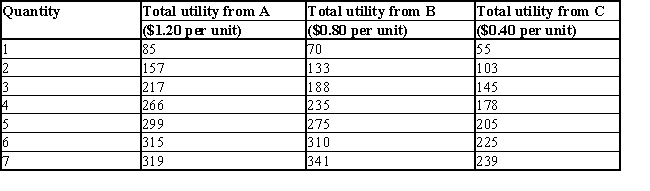 -Refer to Table 7.4. What is the highest possible total utility a consumer can attain given an income of $10?
 (Multiple Choice)
4.8/5  (86)
(86) The below figure shows the various combinations of the goods X and Y that yield different levels of utility.Figure 7.3
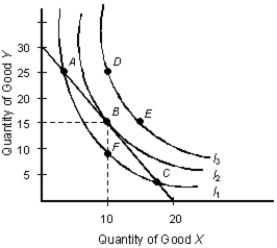 -If a consumer is buying only two goods, A and B, then he or she will be in equilibrium only when MUa = MUb.
 (True/False)
4.8/5 (72)
(72) The below figure shows the various combinations of the goods X and Y that yield different levels of utility.Figure 7.3
-According to neuroeconomists, our logical brain knows we should spend as much as possible when we have money.
-According to neuroeconomists, our logical brain knows we should spend as much as possible when we have money. (True/False)
4.9/5 (74)
(74) The below table shows the average utility (in utils) obtained from the consumption of goods A and B.Table 7.3
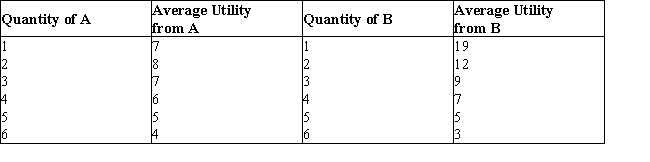 -As long as the marginal utilities per dollar obtained from the last unit of all products consumed are the same, _____.
 (Multiple Choice)
4.9/5 (65)
(65) The below table shows the average utility (in utils) obtained from the consumption of goods A and B.Table 7.3
-To decide which of the two goods is a better buy, a consumer should compare the products' _____.
-To decide which of the two goods is a better buy, a consumer should compare the products' _____. (Multiple Choice)
4.8/5 (85)
(85) The below table shows the average utility (in utils) obtained from the consumption of goods A and B.Table 7.3
-Suppose the prices of goods X, Y, and Z are $4, $1, and $5, respectively, and the last unit purchased of good X has a marginal utility MUx = 16 utils. At the point of equilibrium, the marginal utility of the last unit purchased of goods Y and Z will be:
-Suppose the prices of goods X, Y, and Z are $4, $1, and $5, respectively, and the last unit purchased of good X has a marginal utility MUx = 16 utils. At the point of equilibrium, the marginal utility of the last unit purchased of goods Y and Z will be: (Multiple Choice)
5.0/5 (75)
(75) The below table shows the average utility (in utils) obtained from the consumption of goods A and B.Table 7.3
-If a dinner guest was serious when she said that she could never get enough of your cooking, you would conclude that the marginal utility of your cooking for her was _____.
-If a dinner guest was serious when she said that she could never get enough of your cooking, you would conclude that the marginal utility of your cooking for her was _____. (Multiple Choice)
4.9/5 (79)
(79) The below figure shows the various combinations of the goods X and Y that yield different levels of utility.Figure 7.3
-Marginal utility is total utility divided by the number of units consumed.
-Marginal utility is total utility divided by the number of units consumed. (True/False)
4.8/5 (75)
(75) The below indifference map shows the various combinations of hours of music and apples that yield different levels of utility.Figure 7.1
 -Suppose a budget line is drawn with X on the horizontal axis and Y on the vertical axis. A decrease in the price of X will cause:
 (Multiple Choice)
4.8/5 (72)
(72) The below figure shows the various combinations of the goods X and Y that yield different levels of utility.Figure 7.3
-According to neuroeconomists, the limbic portion of the brain called the amygdala is more primitive and deals with emotion.
-According to neuroeconomists, the limbic portion of the brain called the amygdala is more primitive and deals with emotion. (True/False)
4.9/5 (77)
(77) The below figure shows the various combinations of the goods X and Y that yield different levels of utility.Figure 7.3
-If a consumer purchases only two goods, X and Y, and if (MUx / Px) = (MUy / Py), then the consumer cannot reallocate her expenditures on X and Y to increase her utility unless she has more money to spend.
-If a consumer purchases only two goods, X and Y, and if (MUx / Px) = (MUy / Py), then the consumer cannot reallocate her expenditures on X and Y to increase her utility unless she has more money to spend. (True/False)
4.7/5 (82)
(82) The table below shows the total utility associated with various units of goods X and Y.Table 7.5
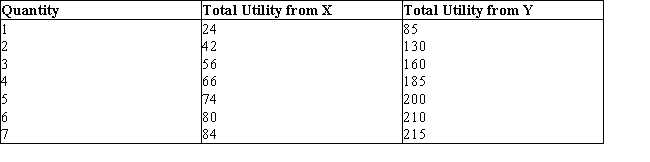 -As one moves downward on an indifference curve, the:
 (Multiple Choice)
4.7/5 (86)
(86) The table given below depicts the total utility derived from the consumption of a good.Table 7.1
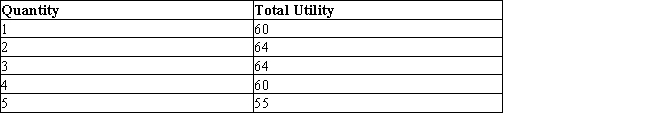 -According to Table 7.1, marginal utility _____.
 (Multiple Choice)
4.7/5 (67)
(67) The below table shows the average utility (in utils) obtained from the consumption of goods A and B.Table 7.3
-Refer to Table 7.3. Marginal utility diminishes for good A from the _____ unit.
-Refer to Table 7.3. Marginal utility diminishes for good A from the _____ unit. (Multiple Choice)
4.9/5 (77)
(77) The table given below records the total utility derived from the consumption of avocados.Table 7.2
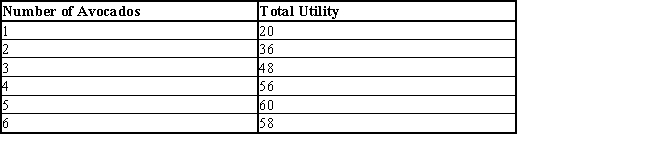 -According to Table 7.2, marginal utility is positive _____.
 (Multiple Choice)
4.8/5 (80)
(80) The table below shows the total utility associated with various units of goods X and Y.Table 7.5
-Refer to Table 7.5. Given that the price of good X is $2 per unit, the price of good Y is $5 per unit, and that the consumer spends a total of $14 on both goods, what is the total utility associated with the utility-maximizing combination?
-Refer to Table 7.5. Given that the price of good X is $2 per unit, the price of good Y is $5 per unit, and that the consumer spends a total of $14 on both goods, what is the total utility associated with the utility-maximizing combination? (Multiple Choice)
4.9/5 (73)
(73) Scenario 5.1
The demand for noodles is given by the following equation: Q = 20 - 4P + 0.2I - 2Px. Assume that P = $8, I = 200, and Px = $10.
-When economists describe the theory of consumer choice, they
(Multiple Choice)
4.9/5 (67)
(67) Scenario 5.1
The demand for noodles is given by the following equation: Q = 20 - 4P + 0.2I - 2Px. Assume that P = $8, I = 200, and Px = $10.
-Utility is most closely defined as _____.
(Multiple Choice)
4.7/5 (80)
(80) The below table shows the average utility (in utils) obtained from the consumption of goods A and B.Table 7.3
-In order to maximize utility, consumers _____.
-In order to maximize utility, consumers _____. (Multiple Choice)
4.8/5 (87)
(87) Scenario 5.1
The demand for noodles is given by the following equation: Q = 20 - 4P + 0.2I - 2Px. Assume that P = $8, I = 200, and Px = $10.
-If a consumer purchases more of a product, then most likely the marginal utility of _____.
(Multiple Choice)
4.8/5 (83)
(83) 
Filters
- Essay(0)
- Multiple Choice(0)
- Short Answer(0)
- True False(0)
- Matching(0)