



 Chat with AI
Exam 7: Demand: Consumer Choice

Exam 1: The Wealth of Nations: Ownership and Economic Freedom87 Questions
Exam 2: Scarcity and Opportunity Costs87 Questions
Exam 3: Markets and the Price System96 Questions
Exam 4: The Aggregate Economy61 Questions
Exam 5: Using Economics to Understand the World Around You68 Questions
Exam 6: Elasticity: Demand and Supply133 Questions
Exam 7: Demand: Consumer Choice142 Questions
Exam 8: Supply: the Costs of Doing Business105 Questions
Exam 9: Profit Maximization121 Questions
Exam 10: Perfect Competition135 Questions
Exam 11: Monopoly118 Questions
Exam 12: Monopolistic Competition and Oligopoly114 Questions
Exam 13: Markets and Government113 Questions
Exam 14: Antitrust and Regulation88 Questions
Exam 15: Resource Markets110 Questions
Exam 16: The Labor Market116 Questions
Exam 17: The Capital Market110 Questions
Exam 18: The Land Market and Natural Resources55 Questions
Exam 19: Current Issues: Income, Income Distribution, Poverty, and Government Policy85 Questions
Exam 20: World Trade Equilibrium112 Questions
Exam 21: International Trade Restrictions109 Questions
Exam 22: Exchange Rates and Financial Links Between Countries130 Questions
Select questions type


The below table shows the average utility (in utils) obtained from the consumption of goods A and B.Table 7.3
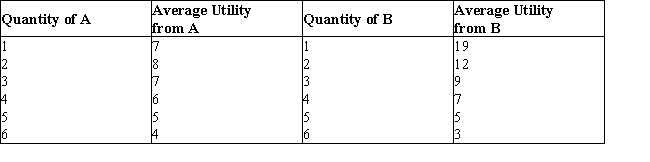 -Suppose a friend gives you two pieces of gum, and you decide to have one piece now and save the other for tomorrow. You do this because:
 (Multiple Choice)
4.8/5  (71)
(71) The table given below records the total utility derived from the consumption of avocados.Table 7.2
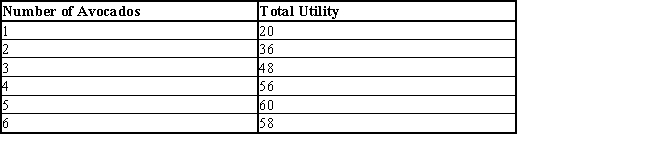 -According to Table 7.2, marginal utility is negative _____.
 (Multiple Choice)
4.8/5 (81)
(81) The below table shows the average utility (in utils) obtained from the consumption of goods A and B.Table 7.3
-If MUx / Px = MUY / PY, then _____.
-If MUx / Px = MUY / PY, then _____. (Multiple Choice)
4.8/5 (69)
(69) Scenario 5.1
The demand for noodles is given by the following equation: Q = 20 - 4P + 0.2I - 2Px. Assume that P = $8, I = 200, and Px = $10.
-The additional satisfaction that a consumer receives from one more unit of a good or service is known as _____.
(Multiple Choice)
4.9/5 (91)
(91) The below table shows the average utility (in utils) obtained from the consumption of goods A and B.Table 7.3
-Because incomes are limited, purchasing one thing means not being able to purchase other things. This indicates that:
-Because incomes are limited, purchasing one thing means not being able to purchase other things. This indicates that: (Multiple Choice)
4.8/5 (85)
(85) The table below shows the total utility associated with various units of goods X and Y.Table 7.5
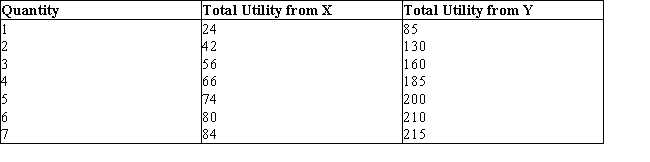 -Refer to Table 7.5. Given that the price of good X is $2 per unit, the price of good Y is $5 per unit, and that the consumer spends a total of $14 on both goods, what is the total utility associated with the utility-maximizing combination?
 (Multiple Choice)
4.9/5 (68)
(68) The below figure shows the various combinations of the goods X and Y that yield different levels of utility.Figure 7.3
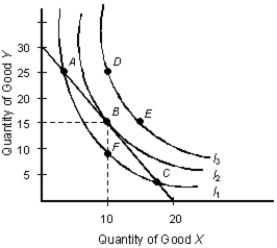 -Utility is easy to measure in the real world with recent advances in psychometric technology.
 (True/False)
4.8/5 (66)
(66) The below table shows the average utility (in utils) obtained from the consumption of goods A and B.Table 7.3
-If MUX / PX < MUY / PY then this consumer:
-If MUX / PX < MUY / PY then this consumer: (Multiple Choice)
4.9/5 (75)
(75) The table below shows the total utility associated with various units of goods X and Y.Table 7.5
-Which of the following statements concerning income and substitution effects is not true?
-Which of the following statements concerning income and substitution effects is not true? (Multiple Choice)
5.0/5 (91)
(91) Scenario 5.1
The demand for noodles is given by the following equation: Q = 20 - 4P + 0.2I - 2Px. Assume that P = $8, I = 200, and Px = $10.
-_____ is a measure of the total satisfaction derived from consuming a quantity of some good or service.
(Multiple Choice)
4.8/5 (78)
(78) The below indifference map shows the various combinations of hours of music and apples that yield different levels of utility.Figure 7.1
 -An increase in income _____.
 (Multiple Choice)
4.7/5 (87)
(87) The below table shows the average utility (in utils) obtained from the consumption of goods A and B.Table 7.3
-According to utility theory, a consumer is in equilibrium when:
-According to utility theory, a consumer is in equilibrium when: (Multiple Choice)
4.9/5 (69)
(69) The table given below reports the total utility derived by an individual from the consumption of different units of goods A, B, and C.Table 7.4
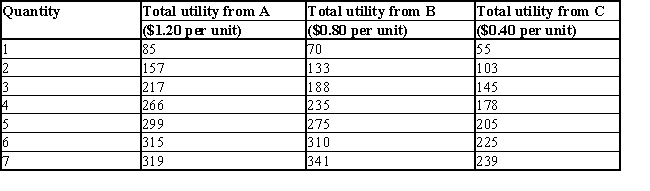 -Refer to Table 7.4. With an income of $10, the consumer would maximize utility by purchasing _____.
 (Multiple Choice)
4.8/5 (88)
(88) The below figure shows the various combinations of the goods X and Y that yield different levels of utility.Figure 7.3
-In Figure 7.3, the consumer is in equilibrium at point:
-In Figure 7.3, the consumer is in equilibrium at point: (Multiple Choice)
4.8/5 (79)
(79) The table given below depicts the total utility derived from the consumption of a good.Table 7.1
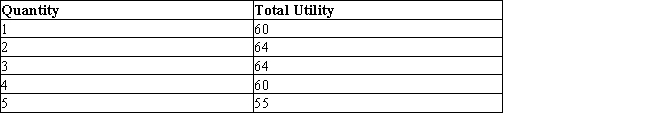 -When total utility is at a maximum, marginal utility is:
 (Multiple Choice)
4.8/5 (96)
(96) Scenario 5.1
The demand for noodles is given by the following equation: Q = 20 - 4P + 0.2I - 2Px. Assume that P = $8, I = 200, and Px = $10.
-Total utility is determined by:
(Multiple Choice)
4.9/5 (77)
(77) The below figure shows the various combinations of the goods X and Y that yield different levels of utility.Figure 7.3
-As you move along an indifference curve, your total utility increases or decreases depending on whether it's an upward or downward movement.
-As you move along an indifference curve, your total utility increases or decreases depending on whether it's an upward or downward movement. (True/False)
4.9/5 (92)
(92) The table below shows the total utility associated with various units of goods X and Y.Table 7.5
-If the price of videotapes decreases, then the _____.
-If the price of videotapes decreases, then the _____. (Multiple Choice)
4.7/5 (76)
(76) The below table shows the average utility (in utils) obtained from the consumption of goods A and B.Table 7.3
-Derek has $1 to spend at the grocery store. An apple, an orange, and a banana cost $0.50 each. If Derek's MUA/PA (ratio of marginal utility to price) of an apple is 45, MUO/PO of an orange is 38, and MUB/PB of a banana is 52, he will purchase a(n) _____ first and a(n) _____ second.
-Derek has $1 to spend at the grocery store. An apple, an orange, and a banana cost $0.50 each. If Derek's MUA/PA (ratio of marginal utility to price) of an apple is 45, MUO/PO of an orange is 38, and MUB/PB of a banana is 52, he will purchase a(n) _____ first and a(n) _____ second. (Multiple Choice)
4.8/5 (81)
(81) The below table shows the average utility (in utils) obtained from the consumption of goods A and B.Table 7.3
-It is often observed that, over the same period of time and for the same good, marginal utility declines rapidly for some consumers and very little for others. This observation illustrates:
-It is often observed that, over the same period of time and for the same good, marginal utility declines rapidly for some consumers and very little for others. This observation illustrates: (Multiple Choice)
4.8/5 (71)
(71) 
Filters
- Essay(0)
- Multiple Choice(0)
- Short Answer(0)
- True False(0)
- Matching(0)