



 Chat with AI
Exam 7: Asset Pricing Models

Exam 1: The Investment Setting72 Questions
Exam 1: The Investment Setting: Part A6 Questions
Exam 2: Asset Allocation and Security Selection77 Questions
Exam 2: Asset Allocation and Security Selection: Part A3 Questions
Exam 3: Organization and Functioning of Securities Markets87 Questions
Exam 4: Security Market Indexes and Index Funds89 Questions
Exam 5: Efficient Capital Markets, Behavioral Finance, and Technical Analysis162 Questions
Exam 6: An Introduction to Portfolio Management114 Questions
Exam 6: An Introduction to Portfolio Management: Part A2 Questions
Exam 6: An Introduction to Portfolio Management: Part B2 Questions
Exam 7: Asset Pricing Models152 Questions
Exam 8: Equity Valuation83 Questions
Exam 9: The Top-Down Approach to Market, Industry, and Company Analysis216 Questions
Exam 10: The Practice of Fundamental Investing60 Questions
Exam 11: Equity Portfolio Management Strategies65 Questions
Exam 12: Bond Fundamentals and Valuation138 Questions
Exam 13: Bond Analysis and Portfolio Management Strategies125 Questions
Exam 14: An Introduction to Derivative Markets and Securities102 Questions
Exam 15: Forward, Futures, and Swap Contracts148 Questions
Exam 16: Option Contracts122 Questions
Exam 17: Professional Money Management, Alternative Assets, and Industry Ethics109 Questions
Exam 18: Evaluation of Portfolio Performance111 Questions
Select questions type


In a microeconomic (or characteristic)-based risk factor model, the following factor would be one of many appropriate factors:
(Multiple Choice)
4.9/5  (77)
(77) Assume that as a portfolio manager the beta of your portfolio is 1.15 and that your performance is exactly on target with the SML data under condition 1. If the true SML data is given by condition 2, how much does your performance differ from the true SML? 
(Multiple Choice)
4.9/5 (78)
(78) The variance of returns for a risky asset is 25 percent. The variance of the error term, Var(e), is 8 percent. What portion of the total risk of the asset, as measured by variance, is systematic?
(Multiple Choice)
4.7/5 (85)
(85) The planning period for the CAPM is the same length of time for every investor.
(True/False)
4.7/5 (80)
(80) USE THE INFORMATION BELOW FOR THE FOLLOWING PROBLEM(S)
Consider the three stocks, stock X, stock Y, and stock Z, that have the following factor loadings (or factor betas).
 The zero-beta return ( 0) = 3 percent, and the risk premia are 1 = 10 percent and 2 = 8 percent. Assume that all three stocks are currently priced at $50.
-Refer to Exhibit 7.9. Assume that you wish to create a portfolio with no net wealth invested. The portfolio that achieves this has 50 percent in stock X, -100 percent in stock Y, and 50 percent in stock Z. The weighted exposure to risk factor 1 for stocks X, Y, and Z are
The zero-beta return ( 0) = 3 percent, and the risk premia are 1 = 10 percent and 2 = 8 percent. Assume that all three stocks are currently priced at $50.
-Refer to Exhibit 7.9. Assume that you wish to create a portfolio with no net wealth invested. The portfolio that achieves this has 50 percent in stock X, -100 percent in stock Y, and 50 percent in stock Z. The weighted exposure to risk factor 1 for stocks X, Y, and Z are (Multiple Choice)
4.9/5 (86)
(86) The expected return for a stock, calculated using the CAPM, is 25 percent. The risk-free rate is 7.5 percent, and the beta of the stock is 0.80. Calculate the implied return on the market.
(Multiple Choice)
4.8/5 (77)
(77) USE THE INFORMATION BELOW FOR THE FOLLOWING PROBLEM(S)
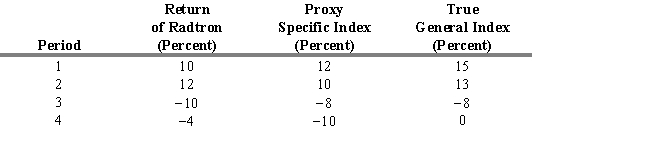 -Refer to Exhibit 7.3. The average return for Radtron is
 (Multiple Choice)
4.8/5 (74)
(74) USE THE INFORMATION BELOW FOR THE FOLLOWING PROBLEM(S)
Jonathan Crowley is a portfolio manager for a large pension fund. Last year his portfolio had an actual return of 12.6 percent with a standard deviation of 13 percent and a beta of 1.3. The market risk premium for this period of time was 6 percent, and the risk-free rate of return was 5 percent.
-Refer to Exhibit 7.6. How does Jonathan Crowley's portfolio compare to the market portfolio?
(Multiple Choice)
5.0/5 (66)
(66) Assume that as a portfolio manager the beta of your portfolio is 1.1 and that your performance is exactly on target with the SML data under condition 1. If the true SML data is given by condition 2, how much does your performance differ from the true SML? 
(Multiple Choice)
4.9/5 (92)
(92) USE THE INFORMATION BELOW FOR THE FOLLOWING PROBLEM(S)
 -Refer to Exhibit 7.4. If the expected return on the market is 11.5% and the risk-free rate of return is 4.5%, then what are the required rates of return for stocks X, Y, and Z based on the CAPM? X Y Z
 (Multiple Choice)
4.7/5 (76)
(76) The expected return for Zbrite stock calculated using the CAPM is 15.5 percent. The risk-free rate is 3.5 percent and the beta of the stock is 1.2. Calculate the implied market risk premium.
(Multiple Choice)
4.8/5 (75)
(75) USE THE INFORMATION BELOW FOR THE FOLLOWING PROBLEM(S)
Consider the three stocks, stock X, stock Y, and stock Z, that have the following factor loadings (or factor betas).
The zero-beta return ( 0) = 3 percent, and the risk premia are 1 = 10 percent and 2 = 8 percent. Assume that all three stocks are currently priced at $50.
-Refer to Exhibit 7.9. The new prices now for stocks X, Y, and Z that will not allow for arbitrage profits are
The zero-beta return ( 0) = 3 percent, and the risk premia are 1 = 10 percent and 2 = 8 percent. Assume that all three stocks are currently priced at $50.
-Refer to Exhibit 7.9. The new prices now for stocks X, Y, and Z that will not allow for arbitrage profits are (Multiple Choice)
4.8/5 (83)
(83) If an incorrect proxy market portfolio such as the S&P index is used when developing the security market line, the slope of the line will tend to be underestimated.
(True/False)
4.8/5 (83)
(83) Assume that as a portfolio manager the beta of your portfolio is 1.3 and that your performance is exactly on target with the SML data under condition 1. If the true SML data is given by condition 2, how much does your performance differ from the true SML? 
(Multiple Choice)
4.9/5 (78)
(78) USE THE INFORMATION BELOW FOR THE FOLLOWING PROBLEM(S)
Consider the three stocks, stock X, stock Y, and stock Z, that have the following factor loadings (or factor betas).
The zero-beta return ( 0) = 3 percent, and the risk premia are 1 = 10 percent and 2 = 8 percent. Assume that all three stocks are currently priced at $50.
-Refer to Exhibit 7.9. Assume that you wish to create a portfolio with no net wealth invested and the portfolio that achieves this has 50 percent in stock X, -100 percent in stock Y, and 50 percent in stock Z. The net arbitrage profit is
The zero-beta return ( 0) = 3 percent, and the risk premia are 1 = 10 percent and 2 = 8 percent. Assume that all three stocks are currently priced at $50.
-Refer to Exhibit 7.9. Assume that you wish to create a portfolio with no net wealth invested and the portfolio that achieves this has 50 percent in stock X, -100 percent in stock Y, and 50 percent in stock Z. The net arbitrage profit is (Multiple Choice)
4.9/5 (74)
(74) One approach for using multifactor models is to use factors that capture systematic risk. Which of the following is NOT a common factor used in this approach?
(Multiple Choice)
4.8/5 (73)
(73) Calculate the expected return for D Industries, which has a beta of 1.0 when the risk-free rate is 0.03 and you expect the market return to be 0.13.
(Multiple Choice)
4.8/5 (71)
(71) 
Filters
- Essay(0)
- Multiple Choice(0)
- Short Answer(0)
- True False(0)
- Matching(0)