



 Chat with AI
Exam 5: Efficient Capital Markets, Behavioral Finance, and Technical Analysis

Exam 1: The Investment Setting72 Questions
Exam 1: The Investment Setting: Part A6 Questions
Exam 2: Asset Allocation and Security Selection77 Questions
Exam 2: Asset Allocation and Security Selection: Part A3 Questions
Exam 3: Organization and Functioning of Securities Markets87 Questions
Exam 4: Security Market Indexes and Index Funds89 Questions
Exam 5: Efficient Capital Markets, Behavioral Finance, and Technical Analysis162 Questions
Exam 6: An Introduction to Portfolio Management114 Questions
Exam 6: An Introduction to Portfolio Management: Part A2 Questions
Exam 6: An Introduction to Portfolio Management: Part B2 Questions
Exam 7: Asset Pricing Models152 Questions
Exam 8: Equity Valuation83 Questions
Exam 9: The Top-Down Approach to Market, Industry, and Company Analysis216 Questions
Exam 10: The Practice of Fundamental Investing60 Questions
Exam 11: Equity Portfolio Management Strategies65 Questions
Exam 12: Bond Fundamentals and Valuation138 Questions
Exam 13: Bond Analysis and Portfolio Management Strategies125 Questions
Exam 14: An Introduction to Derivative Markets and Securities102 Questions
Exam 15: Forward, Futures, and Swap Contracts148 Questions
Exam 16: Option Contracts122 Questions
Exam 17: Professional Money Management, Alternative Assets, and Industry Ethics109 Questions
Exam 18: Evaluation of Portfolio Performance111 Questions
Select questions type


Analysts following what the smart, sophisticated investor is doing would examine

Free
(Multiple Choice)
4.9/5  (91)
(91) Correct Answer: Verified
B
Calculate the net advance-decline for day 5 using the trade data in the table below. 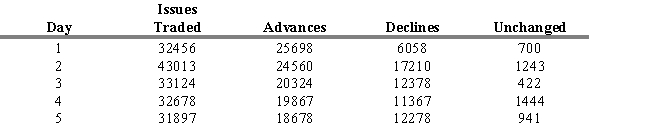
Free
(Multiple Choice)
4.9/5 (94)
(94) Correct Answer:Verified
VerifiedD
According to contrary opinion technicians, the ratio of mutual funds cash to total assets ____ near troughs in the market cycle and ____ near peaks.
Free
(Multiple Choice)
4.9/5 (83)
(83) Correct Answer:Verified
VerifiedD
A rise in the Confidence Index published by Barron's is an indication that investors will purchase more lower-quality bonds.
(True/False)
4.8/5 (85)
(85) Two major classes of technicians include the contrarians and those who "follow the smart money"
(True/False)
4.8/5 (84)
(84) There is empirical evidence that low P/E stocks have outperformed high P/E stocks for some historical time periods.
(True/False)
4.8/5 (87)
(87) A "runs test" on successive stock price changes which supports the efficient market hypothesis would show the actual number of runs
(Multiple Choice)
4.8/5 (75)
(75) Fama and French examined the relationship between the Book Value to Market Value ratio and average stock returns and found
(Multiple Choice)
4.7/5 (66)
(66) A contrary opinion technician would buy stock when mutual funds
(Multiple Choice)
4.8/5 (65)
(65) Studies concerning quarterly earnings reports indicate that information in quarterly statements is of value and can provide an above-average, risk-adjusted return.
(True/False)
4.9/5 (71)
(71) USE THE INFORMATION BELOW FOR THE FOLLOWING PROBLEM(S)
 Rit = return for stock i during period t
Rmt = return for the aggregate market during period t
-Refer to Exhibit 5.1. What is the abnormal rate of return for Stock C when you consider its systematic risk measure (beta)?
Rit = return for stock i during period t
Rmt = return for the aggregate market during period t
-Refer to Exhibit 5.1. What is the abnormal rate of return for Stock C when you consider its systematic risk measure (beta)? (Multiple Choice)
4.9/5 (68)
(68) Which of the following is NOT considered a contrary trading rule?
(Multiple Choice)
4.9/5 (84)
(84) USE THE INFORMATION BELOW FOR THE FOLLOWING PROBLEM(S)
 Rit = return for stock i during period t
Rmt = return for the aggregate market during period t
-Refer to Exhibit 5.2. What is the abnormal rate of return for Stock XYZ when you consider its systematic risk measure (beta)?
Rit = return for stock i during period t
Rmt = return for the aggregate market during period t
-Refer to Exhibit 5.2. What is the abnormal rate of return for Stock XYZ when you consider its systematic risk measure (beta)? (Multiple Choice)
4.8/5 (85)
(85) In tests of the semistrong-form EMH, it is not necessary to use risk-adjusted rates of return.
(True/False)
5.0/5 (73)
(73) USE THE INFORMATION BELOW FOR THE FOLLOWING PROBLEM(S)
 Rit = return for stock i during period t
Rmt = return for the aggregate market during period t
-Refer to Exhibit 5.6. What is the abnormal rate of return for Stock B when you consider its systematic risk measure (beta)?
Rit = return for stock i during period t
Rmt = return for the aggregate market during period t
-Refer to Exhibit 5.6. What is the abnormal rate of return for Stock B when you consider its systematic risk measure (beta)? (Multiple Choice)
4.9/5 (66)
(66) An increase in debit balances in brokerage accounts is viewed by technicians as a bullish sign.
(True/False)
4.7/5 (78)
(78) Which of the following ratios is the most commonly used ratio for predicting the performance of a growth company?
(Multiple Choice)
4.9/5 (84)
(84) Based on Stock Z's beta of 0.9 the normal return is 9 percent. However, the actual return for Stock Z was 8 percent. What is Stock Z's abnormal rate of return?
(Multiple Choice)
4.9/5 (76)
(76) 
Filters
- Essay(0)
- Multiple Choice(0)
- Short Answer(0)
- True False(0)
- Matching(0)