



 Chat with AI
Exam 6: Energy Balance and Body Composition

Exam 1: Overview of Nutrition and Health78 Questions
Exam 2: Digestion and Absorption71 Questions
Exam 3: Carbohydrates74 Questions
Exam 4: Lipids82 Questions
Exam 5: Protein78 Questions
Exam 6: Energy Balance and Body Composition69 Questions
Exam 7: Weight Management70 Questions
Exam 8: The Vitamins85 Questions
Exam 9: Water and the Minerals80 Questions
Exam 10: Nutrition Through the Life Span: Pregnancy and Infancy95 Questions
Exam 11: Nutrition Through the Life Span: Childhood and Adolescence85 Questions
Exam 12: Nutrition Through the Life Span: Later Adulthood67 Questions
Exam 13: Nutrition Care and Assessment82 Questions
Exam 14: Nutrition Intervention and Diet-Drug Interactions89 Questions
Exam 15: Enteral and Parenteral Nutrition Support127 Questions
Exam 16: Nutrition in Metabolic and Respiratory Stress70 Questions
Exam 17: Nutrition and Upper Gastrointestinal Disorders83 Questions
Exam 18: Nutrition and Lower Gastrointestinal Disorders110 Questions
Exam 19: Nutrition and Liver Diseases95 Questions
Exam 20: Nutrition and Diabetes Mellitus108 Questions
Exam 21: Nutrition and Disorders of the Heart and Blood Vessels94 Questions
Exam 22: Nutrition and Renal Diseases95 Questions
Exam 23: Nutrition, Cancer, and Hiv Infection88 Questions
Select questions type


Skinfold measurements provide an inaccurate estimate of total body fat.
(True/False)
4.8/5  (71)
(71) The energy needed to maintain life when a person is at complete digestive, physical, and emotional rest is termed:
(Multiple Choice)
4.8/5 (78)
(78) Calculate the BMI of a male who is 5'11" tall and weighs 210 pounds.
(Multiple Choice)
4.9/5 (79)
(79) Define the thermic effect of food and explain its effect on energy expenditure.
(Not Answered)
This question doesn't have any answer yet
The basal metabolic rate slows with increasing age because:
(Multiple Choice)
4.8/5 (73)
(73) When protein consumption exceeds body needs and energy needs are met, the excess amino acids are metabolized and:
(Multiple Choice)
5.0/5 (62)
(62) Which of the following statements is true regarding fad diets?
(Multiple Choice)
4.9/5 (94)
(94) Given that EER for women = [354 - (6.91 * age)] + PA * [(9.36 * wt) + (726 * ht)], estimate the energy requirements for Anne, an active 27 year old (PA = 1.27) who is 5 feet 4 inches tall and weighs 130 pounds.
(Multiple Choice)
4.8/5 (81)
(81) Which of the following are acidic, water-soluble compounds formed from the incomplete breakdown of fat when carbohydrate is not available?
(Multiple Choice)
4.8/5 (90)
(90) The health risk associated with central obesity has to do with:
(Multiple Choice)
4.8/5 (86)
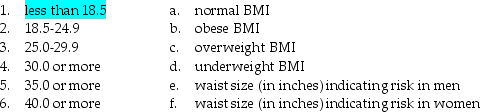
(86) Matching
Match each range to the appropriate health indicator.
(Short Answer)
4.8/5 (77)
(77) In the body, no metabolic difference exists between fasting and starving.
(True/False)
4.8/5 (75)
(75) An individual can most easily alter his/her energy output by altering:
(Multiple Choice)
4.9/5 (77)
(77) Basal metabolic needs are large compared to energy needs for activities.
(True/False)
4.9/5 (87)
(87) The body's adaptations to fasting are sufficient to maintain life for a long period.
(True/False)
4.9/5 (86)
(86) 
Filters
- Essay(0)
- Multiple Choice(0)
- Short Answer(0)
- True False(0)
- Matching(0)