



 Chat with AI
Exam 23: Exempt Entities

Exam 1: An Introduction to Taxation and Understanding the Federal Tax Law159 Questions
Exam 2: Working With the Tax Law85 Questions
Exam 3: Computing the Tax150 Questions
Exam 4: Gross Income: Concepts and Inclusions125 Questions
Exam 5: Gross Income: Exclusions116 Questions
Exam 6: Deductions and Losses: in General153 Questions
Exam 7: Deductions and Losses: Certain Business Expenses and Losses97 Questions
Exam 8: Depreciation, Cost Recovery, Amortization, and Depletion116 Questions
Exam 9: Deductions: Employee and Self-Employed Related Expenses166 Questions
Exam 10: Deductions and Losses: Certain Itemized Deductions106 Questions
Exam 11: Investor Losses103 Questions
Exam 12: Tax Credits and Payments109 Questions
Exam 13: A: Property Transactions: Determination of Gain or Loss, Basis Considerations, and Nontaxable Exchanges-Part 1200 Questions
Exam 13: Property Transactions: Determination of Gain or Loss, Basis Considerations, and Nontaxable Exchanges-Part 292 Questions
Exam 14: Property Transactions: Capital Gains and Losses, 1231, Recapture Provisions144 Questions
Exam 15: Alternative Minimum Tax125 Questions
Exam 16: Accounting Periods and Methods87 Questions
Exam 17: Corporations: Introduction and Operating Rules109 Questions
Exam 18: Corporations: Organization and Capital Structure93 Questions
Exam 19: Corporations: Distributions Not in Complete Liquidation145 Questions
Exam 20: Corporations: Distributions in Complete Liquidation and an Overview of Reorganizations70 Questions
Exam 21: Partnerships159 Questions
Exam 22: S: Corporations159 Questions
Exam 23: Exempt Entities151 Questions
Exam 24: Multistate Corporate Taxation145 Questions
Exam 25: Taxation of International Transactions148 Questions
Exam 26: Tax Practice and Ethics147 Questions
Exam 28: Income Taxation of Trusts and Estates145 Questions
Select questions type


The income from a bingo game or a casino game conducted by an exempt organization may be unrelated business income.
(True/False)
4.8/5  (79)
(79) Which of the following exempt organizations are required to file Form 990 (Return of Organization Exempt from Income Tax)?
(Multiple Choice)
4.9/5 (70)
(70) Engaging in a prohibited transaction can result in an exempt organization being subject to Federal income tax, but cannot cause it to lose its exempt status unless the exempt organization repeats the prohibited transaction.
(True/False)
4.8/5 (75)
(75) 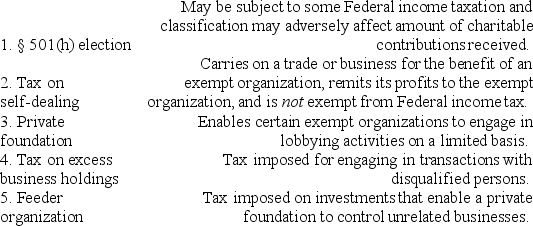
While the major objective of the Federal income tax law is to raise revenue, social considerations and economic objectives also affect the tax law.
(True/False)
4.8/5 (78)
(78) To satisfy the broadly supported provision to avoid classification as a private foundation, the exempt organization must satisfy both an external support test and an internal support test.Under the internal support test, more than one-third of the exempt organization's support for the taxable year must come from gross investment income and unrelated business taxable income.
(True/False)
4.9/5 (86)
(86) Arbor, Inc., an exempt organization, leases land, building, and machinery to a tenant for a 5-year period.The rent income for the land and building is $600,000 per year and that from the related machinery is $90,000 per year.Expenses incurred by Arbor for the land and building during the year are $65,000 and those for the machinery are $38,000.Net unrelated business income, which includes the above rental income and expenses, is $850,000.Calculate Arbor's unrelated business taxable income.
(Essay)
4.8/5 (75)
(75) 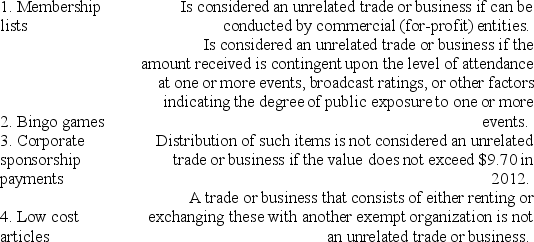
The purpose of the excise tax imposed on a private foundation for failure to distribute sufficient levels of income is to motivate the foundation to distribute more of its income for application to exempt purposes and thus be classified as a feeder organization.
(True/False)
4.8/5 (85)
(85) If an exempt organization owns a feeder organization, the exempt organization is taxed on the profits of the feeder organization under the unrelated business income tax (UBIT) rules.
(True/False)
4.8/5 (79)
(79) Lemon, Inc., a private foundation, engages in a transaction with a disqualified person in the amount of $300,000.Calculate the tax on self-dealing.Assume that corrective action is taken so that the additional tax does not apply.
(Essay)
4.8/5 (79)
(79) Which of the following statements regarding intermediate sanctions is correct?
(Multiple Choice)
4.9/5 (76)
(76) The excise tax imposed on private foundations for excess business holdings is imposed on investments that enable the private foundation to control publicly-held rather than privately-held businesses.
(True/False)
4.9/5 (69)
(69) Tan, Inc., a tax-exempt organization, has $65,000 of net unrelated business income.Total charitable contributions (all associated with the unrelated trade or business) are $7,500.Assuming that the $7,500 was deducted in calculating net unrelated business income, what is Tan's unrelated business taxable income?
(Multiple Choice)
4.9/5 (76)
(76) Nice, Inc., a § 501(c)(3) organization, inherited 100% of the stock of Aggressive, Inc., a for-profit entity, at the beginning of the year.Although Nice plans on selling the stock of Aggressive, a buyer has not yet been located.Aggressive's taxable income for the year is $600,000.Aggressive distributed a dividend of $450,000 to Nice at the beginning of December.Determine the tax consequences for the taxable income and the dividend payment to Aggressive, Inc.
(Essay)
4.8/5 (77)
(77) An entity satisfies the "not-for-profit" requirement for exempt status if its total expenses for the year exceed its gross income.
(True/False)
4.9/5 (77)
(77) All organizations that are exempt from Federal income tax are exempt under § 501(c)(3).
(True/False)
4.9/5 (70)
(70) For purposes of the unrelated business income tax, debt-financed property is all property of the exempt organization that is held to produce income and on which there is acquisition indebtedness.
(True/False)
4.8/5 (72)
(72) 
Filters
- Essay(0)
- Multiple Choice(0)
- Short Answer(0)
- True False(0)
- Matching(0)