



 Chat with AI
Exam 11: Risk and Return in Capital Markets

Exam 1: Corporate Finance and the Financial Manager86 Questions
Exam 2: Introduction to Financial Statement Analysis95 Questions
Exam 3: Time Value of Money: an Introduction112 Questions
Exam 4: Time Value of Money: Valuing Cash Flow Streams62 Questions
Exam 5: Interest Rates110 Questions
Exam 6: Bonds109 Questions
Exam 7: Stock Valuation64 Questions
Exam 8: Investment Decision Rules123 Questions
Exam 9: Fundamentals of Capital Budgeting113 Questions
Exam 10: Stock Valuation: a Second Look46 Questions
Exam 11: Risk and Return in Capital Markets110 Questions
Exam 12: Systematic Risk and the Equity Risk Premium104 Questions
Exam 13: The Cost of Capital107 Questions
Exam 14: Raising Equity Capital107 Questions
Exam 15: Debt Financing101 Questions
Exam 16: Capital Structure109 Questions
Exam 17: Payout Policy110 Questions
Exam 18: Financial Modeling and Pro Forma Analysis95 Questions
Exam 19: Working Capital Management107 Questions
Exam 20: Short-Term Financial Planning104 Questions
Exam 21: Option Applications and Corporate Finance102 Questions
Exam 22: Mergers and Acquisitions47 Questions
Exam 23: International Corporate Finance108 Questions
Exam 24: Leasing46 Questions
Exam 25: Insurance and Risk Management38 Questions
Exam 26: Corporate Governance45 Questions
Select questions type


Consider an economy with two types of firms, S and I. S firms always move together, but I firms move independently of each other. For both types of firms there is a 40% probability that the firm will have a 20% return and a 60% probability that the firm will have a -30% return. The standard deviation for the return on an individual firm is closest to ________.
(Multiple Choice)
4.8/5  (79)
(79) Consider the following realized annual returns: 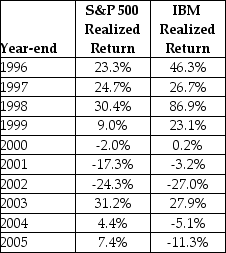 The average annual return on the S&P 500 from 1996 to 2005 is closest to ________.
 (Multiple Choice)
4.8/5 (94)
(94) When looking at investment portfolios historically, was there a pattern between returns and volatility?
(Essay)
4.9/5 (73)
(73) Amazon.com stock prices gave a realized return of 15%, 15%, 15%, and 10% over four successive quarters. What is the annual realized return for Amazon.com for the year?
(Multiple Choice)
4.9/5 (71)
(71) You purchase a 30-year, zero-coupon bond for a price of $25. The bond will pay back $100 after 30 years and make no interim payments. The annual compounded return (geometric average return) on this investment is ________.
(Multiple Choice)
4.9/5 (79)
(79) Big Cure and Little Cure are both pharmaceutical companies. Big Cure presently has a potential "blockbuster" drug before the Food and Drug Administration (FDA) waiting for approval. If approved, Big Cure's blockbuster drug will produce $1 billion in net income for Big Cure. Little Cure has ten separate, less important drugs before the FDA waiting for approval. If approved, each of Little Cure's drugs would produce $50 million in net income. The probability of the FDA approving a drug is 50%. What is the expected payoff for Little Cure's ten drugs?
(Multiple Choice)
4.8/5 (91)
(91) The average annual return for the S&P 500 from 1886 to 2006 is 15%, with a standard deviation of 25%. Based on these numbers, what is a 95% confidence interval for 2007's returns?
(Multiple Choice)
4.9/5 (82)
(82) The S&P 500 index delivered a return of 25%, 15%, -35%, and -5% over four successive years. What is the arithmetic average annual return for four years?
(Multiple Choice)
4.8/5 (88)
(88) The average annual return over the period 1926-2009 for the S&P 500 is 12.8%, and the standard deviation of returns is 21.4%. Based on these numbers, what is a 67% confidence interval for 2010 returns?
(Multiple Choice)
4.9/5 (76)
(76) Fluctuations of a stock's return that are due to market-wide news representing common risk is the ________.
(Multiple Choice)
4.7/5 (86)
(86) A portfolio of stocks can achieve diversification benefits if the stocks that comprise the portfolio are ________.
(Multiple Choice)
4.9/5 (87)
(87) Your investment over one year yielded a capital gains yield of 5% and no dividend yield. If the sale price was $114 per share, what was the cost of the investment?
(Multiple Choice)
4.8/5 (76)
(76) Which type of investment has historically had the highest volatility?
(Essay)
4.7/5 (77)
(77) Bear Stearns' stock price closed at $98, $103, $58, $29, $4 over five successive weeks. The weekly standard deviation of the stock price calculated from this sample is ________.
(Multiple Choice)
4.9/5 (90)
(90) Suppose you invested $100 in the Ishares High Yield Fund (HYG) a month ago. It paid a dividend of $2 today and then you sold it for $95. What was your dividend yield and capital gains yield on the investment?
(Multiple Choice)
4.8/5 (69)
(69) In the United States over the long term, small stocks have provided the highest return followed by the large stocks in the S&P 500.
(True/False)
5.0/5 (82)
(82) Suppose that a stock gave a realized return of 20% over a two-year time period and a 10% return over the third year. The geometric average annual return is ________.
(Multiple Choice)
4.8/5 (88)
(88) Consider an economy with two types of firms, S and I. S firms always move together, but I firms move independently of each other. For both types of firms there is a 70% probability that the firm will have a 20% return and a 30% probability that the firm will have a -30% return. The standard deviation for the return on an portfolio of 20 type S firms is closest to ________.
(Multiple Choice)
4.9/5 (82)
(82) What is the diversification achieved by an investor if he invests in Exxon Mobil, Dell, and Bank of America?
(Essay)
4.8/5 (75)
(75) 
Filters
- Essay(0)
- Multiple Choice(0)
- Short Answer(0)
- True False(0)
- Matching(0)