



 Chat with AI
Exam 11: Risk and Return in Capital Markets

Exam 1: Corporate Finance and the Financial Manager86 Questions
Exam 2: Introduction to Financial Statement Analysis95 Questions
Exam 3: Time Value of Money: an Introduction112 Questions
Exam 4: Time Value of Money: Valuing Cash Flow Streams62 Questions
Exam 5: Interest Rates110 Questions
Exam 6: Bonds109 Questions
Exam 7: Stock Valuation64 Questions
Exam 8: Investment Decision Rules123 Questions
Exam 9: Fundamentals of Capital Budgeting113 Questions
Exam 10: Stock Valuation: a Second Look46 Questions
Exam 11: Risk and Return in Capital Markets110 Questions
Exam 12: Systematic Risk and the Equity Risk Premium104 Questions
Exam 13: The Cost of Capital107 Questions
Exam 14: Raising Equity Capital107 Questions
Exam 15: Debt Financing101 Questions
Exam 16: Capital Structure109 Questions
Exam 17: Payout Policy110 Questions
Exam 18: Financial Modeling and Pro Forma Analysis95 Questions
Exam 19: Working Capital Management107 Questions
Exam 20: Short-Term Financial Planning104 Questions
Exam 21: Option Applications and Corporate Finance102 Questions
Exam 22: Mergers and Acquisitions47 Questions
Exam 23: International Corporate Finance108 Questions
Exam 24: Leasing46 Questions
Exam 25: Insurance and Risk Management38 Questions
Exam 26: Corporate Governance45 Questions
Select questions type


Consider an economy with two types of firms, S and I. S firms always move together, but I firms move independently of each other. For both types of firms there is a 60% probability that the firm will have a 20% return and a 40% probability that the firm will have a -30% return. The standard deviation for the return on a portfolio of 20 type I firms is closest to ________.
(Multiple Choice)
4.8/5  (77)
(77) The risk premium of a stock is NOT affected by its ________.
(Multiple Choice)
4.9/5 (87)
(87) Consider the following realized annual returns: 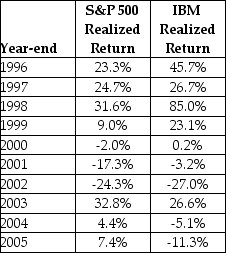 The average annual return on IBM from 1996 to 2005 is closest to ________.
 (Multiple Choice)
4.8/5 (86)
(86) A stock whose return does not depend on overall economic conditions has a high systematic risk.
(True/False)
4.9/5 (81)
(81) Consider the following average annual returns: 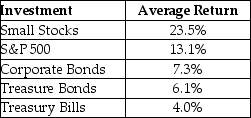 What is the excess return for the portfolio of small stocks?
 (Multiple Choice)
4.8/5 (84)
(84) Ford Motor Company had realized returns of 20%, 30%, 30%, and 20% over four quarters. What is the quarterly standard deviation of returns for Ford calculated from this sample?
(Multiple Choice)
4.9/5 (90)
(90) Consider the following price and dividend data for Quicksilver Inc.: 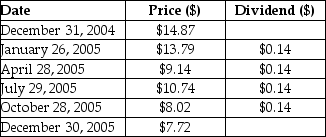 Assume that you purchased Quicksilver's stock at the closing price on December 31, 2004 and sold it at the closing price on December 30, 2005. Your realized annual return for the year 2005 is closest to ________.
 (Multiple Choice)
4.9/5 (61)
(61) The Ishares Bond Index fund (TLT) has a mean and annual standard deviation of returns of 5% and 10%, respectively. What is the 66% confidence interval for the returns on TLT?
(Multiple Choice)
5.0/5 (85)
(85) A portfolio of stocks where each stock has a large component of independent risk benefits when such stocks are held in a portfolio, because the independent risks are averaged out. This is also referred to as diversification of risks.
(True/False)
4.9/5 (78)
(78) What is the diversification achieved by an investor if he invests in Dell, IBM, and Microsoft?
(Essay)
4.7/5 (75)
(75) Ford Motor Company had realized returns of 10%, 20%, -10%, and -10% over four quarters. What is the quarterly standard deviation of returns for Ford?
(Multiple Choice)
4.9/5 (68)
(68) The risk that inflation rates are likely to increase in the next year is an example of common risk.
(True/False)
4.7/5 (84)
(84) Suppose you invested $79 in the Ishares Dividend Stock Fund (DVY) a month ago. It paid a dividend of $0.41 today and then you sold it for $66. What was your return on the investment?
(Multiple Choice)
4.7/5 (84)
(84) IGM Realty had stock prices of $33, $33, $38, $36, and $28 at the end of the last five quarters. If IGM pays a dividend of $1 at the end of each quarter, what is the annual realized return on IGM?
(Multiple Choice)
4.8/5 (75)
(75) As we increase the number of stocks in a portfolio, the standard deviation of returns of the portfolio ________.
(Multiple Choice)
4.8/5 (71)
(71) If returns on stock A are more volatile than the returns on stock B, the geometric average return of stock A will be ________ the geometric average return of stock B when their arithmetic average returns are same.
(Multiple Choice)
4.8/5 (70)
(70) Two slot machines offer to double your money 3 times out of 5. Machine A takes $10 bets and Machine B takes $100 bets on each occasion. A risk-averse investor prefers to bet on ________.
(Multiple Choice)
4.9/5 (78)
(78) 
Filters
- Essay(0)
- Multiple Choice(0)
- Short Answer(0)
- True False(0)
- Matching(0)