



 Chat with AI
Exam 11: Risk and Return in Capital Markets

Exam 1: Corporate Finance and the Financial Manager86 Questions
Exam 2: Introduction to Financial Statement Analysis95 Questions
Exam 3: Time Value of Money: an Introduction112 Questions
Exam 4: Time Value of Money: Valuing Cash Flow Streams62 Questions
Exam 5: Interest Rates110 Questions
Exam 6: Bonds109 Questions
Exam 7: Stock Valuation64 Questions
Exam 8: Investment Decision Rules123 Questions
Exam 9: Fundamentals of Capital Budgeting113 Questions
Exam 10: Stock Valuation: a Second Look46 Questions
Exam 11: Risk and Return in Capital Markets110 Questions
Exam 12: Systematic Risk and the Equity Risk Premium104 Questions
Exam 13: The Cost of Capital107 Questions
Exam 14: Raising Equity Capital107 Questions
Exam 15: Debt Financing101 Questions
Exam 16: Capital Structure109 Questions
Exam 17: Payout Policy110 Questions
Exam 18: Financial Modeling and Pro Forma Analysis95 Questions
Exam 19: Working Capital Management107 Questions
Exam 20: Short-Term Financial Planning104 Questions
Exam 21: Option Applications and Corporate Finance102 Questions
Exam 22: Mergers and Acquisitions47 Questions
Exam 23: International Corporate Finance108 Questions
Exam 24: Leasing46 Questions
Exam 25: Insurance and Risk Management38 Questions
Exam 26: Corporate Governance45 Questions
Select questions type


Investors should earn a risk premium for bearing unsystematic risk.

Free
(True/False)
5.0/5  (78)
(78) Correct Answer: Verified
False
Suppose you invested $100 in the Ishares High Yield Fund (HYG) a month ago. It paid a dividend of $2 today and then you sold it for $100. What was your dividend yield and capital gains yield on the investment?
Free
(Multiple Choice)
4.8/5 (95)
(95) Correct Answer:Verified
VerifiedD
Amazon.com stock prices gave a realized return of 15%, 15%, -15%, and -15% over four successive quarters. What is the annual realized return for Amazon.com for the year?
Free
(Multiple Choice)
5.0/5 (85)
(85) Correct Answer:Verified
VerifiedA
Which of the following investments had the largest fluctuations overall return over the past eighty years?
(Multiple Choice)
4.9/5 (68)
(68) The standard deviation of returns of ________. I. small stocks is higher than that of large stocks
 Which statement is true?
 (Multiple Choice)
4.8/5 (83)
(83) The probability mass between two standard deviations around the mean for a normal distribution is ________.
(Multiple Choice)
4.9/5 (69)
(69) The S&P 500 index delivered a return of 10%, 15%, 15%, and -30% over four successive years. What is the arithmetic average annual return for four years?
(Multiple Choice)
4.9/5 (74)
(74) A company's stock price dropped when it announced that its revenue had decreased because of the quality issues of its products. This is an example of ________.
(Multiple Choice)
4.8/5 (78)
(78) Many former employees at AlphaEnergy, an energy trading and supply company, had a large part of their portfolio invested in AlphaEnergy's stock. These employees were bearing a high degree of ________ risk.
(Multiple Choice)
4.8/5 (69)
(69) The average annual return over the period 1926-2009 for the S&P 500 is 12.0%, and the standard deviation of returns is 21.3%. Based on these numbers, what is a 95% confidence interval for 2010 returns?
(Multiple Choice)
4.8/5 (69)
(69) When investing for a long term, investors care about the volatility of ________ returns and not the volatility of ________ returns.
(Multiple Choice)
4.9/5 (77)
(77) Comment on the accuracy of the statement that as we put more stocks in a portfolio, its risk gets eliminated to zero.
(Essay)
4.8/5 (79)
(79) Consider the following price and dividend data for Quicksilver Inc.: 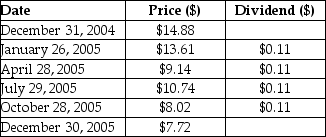 Assume that you purchased Quicksilver's stock at the closing price on December 31, 2004 and sold it after the dividend had been paid at the closing price on January 26, 2005. Your dividend yield for this period is closest to ________.
 (Multiple Choice)
4.9/5 (68)
(68) Consider the following average annual returns: 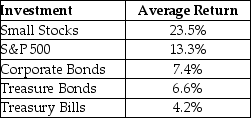 What is the excess return for Treasury bills?
 (Multiple Choice)
4.9/5 (77)
(77) Treasury bill returns are 4%, 3%, 2%, and 5% over four years. The standard deviation of returns of Treasury bills is ________.
(Multiple Choice)
4.7/5 (84)
(84) Rational investors ________ fluctuations in the value of their investments.
(Multiple Choice)
4.8/5 (85)
(85) Suppose you invested $93 in the Ishares High Yield Fund (HYG) a month ago. It paid a dividend of $0.53 today and then you sold it for $94. What was your dividend yield and capital gains yield on the investment?
(Multiple Choice)
4.8/5 (89)
(89) The average annual return for the S&P 500 from 1886 to 2006 is 9.5%, with a standard deviation of 18%. Based on these numbers, what is a 95% confidence interval for 2007's returns?
(Multiple Choice)
4.7/5 (76)
(76) 
Filters
- Essay(0)
- Multiple Choice(0)
- Short Answer(0)
- True False(0)
- Matching(0)