



 Chat with AI
Exam 14: Raising Equity Capital

Exam 1: Corporate Finance and the Financial Manager86 Questions
Exam 2: Introduction to Financial Statement Analysis95 Questions
Exam 3: Time Value of Money: an Introduction112 Questions
Exam 4: Time Value of Money: Valuing Cash Flow Streams62 Questions
Exam 5: Interest Rates110 Questions
Exam 6: Bonds109 Questions
Exam 7: Stock Valuation64 Questions
Exam 8: Investment Decision Rules123 Questions
Exam 9: Fundamentals of Capital Budgeting113 Questions
Exam 10: Stock Valuation: a Second Look46 Questions
Exam 11: Risk and Return in Capital Markets110 Questions
Exam 12: Systematic Risk and the Equity Risk Premium104 Questions
Exam 13: The Cost of Capital107 Questions
Exam 14: Raising Equity Capital107 Questions
Exam 15: Debt Financing101 Questions
Exam 16: Capital Structure109 Questions
Exam 17: Payout Policy110 Questions
Exam 18: Financial Modeling and Pro Forma Analysis95 Questions
Exam 19: Working Capital Management107 Questions
Exam 20: Short-Term Financial Planning104 Questions
Exam 21: Option Applications and Corporate Finance102 Questions
Exam 22: Mergers and Acquisitions47 Questions
Exam 23: International Corporate Finance108 Questions
Exam 24: Leasing46 Questions
Exam 25: Insurance and Risk Management38 Questions
Exam 26: Corporate Governance45 Questions
Select questions type


At what stage of the IPO process do senior management and the lead underwriters travel to promote the company and explain their rationale for the offer price to the underwriters' largest customers?
(Multiple Choice)
4.9/5  (73)
(73) You founded your own firm three years ago. You initially contributed $200,000 of your own money and in return you received 3 million shares of stock. Since then, you have sold an additional 2 million shares of stock to angel investors. You are now considering raising capital from a venture capital firm. This venture capital firm would invest $5 million and would receive 4 million newly issued shares in return. Suppose you sold the 2 million shares to the angel investor for $500,000. What was your percentage ownership in the company immediately following the angel investor's investment?
(Multiple Choice)
4.8/5 (73)
(73) Parafoil Avionics sells 50 million shares of stock in an SEO-20 million being primary shares issued by the company and 30 million being secondary shares sold by investors in the company. At the time of the sale, Parafoil's stock was selling at $13.00 per share. If the underwriter charges 7% of the gross proceeds as a fee, how much money was raised in the sale?
(Multiple Choice)
4.7/5 (72)
(72) Which of the following is NOT a reason why an investor would choose to invest in new and growing firms as a limited partner in a venture capital firm rather than making those investments directly by themselves?
(Multiple Choice)
4.8/5 (84)
(84) Luther Industries is in the process of selling shares of stock in an auction IPO. At the end of the bidding period, Luther's investment bank has received the following bids: 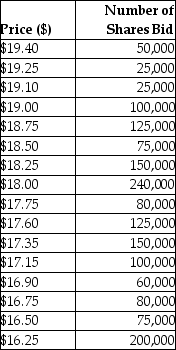 What will the offer price of these shares be if Luther is selling 1 million shares?
 (Multiple Choice)
4.7/5 (74)
(74) The main advantages for a firm in going public are greater liquidity and better access to capital.
(True/False)
4.8/5 (79)
(79) Parafoil Avionics sells 50 million shares of stock in an SEO-30 million being primary shares issued by the company and 20 million being secondary shares sold by investors in the company. At the time of the sale, Parafoil's stock was selling at $11.50 per share. If the underwriter charges 7% of the gross proceeds as a fee, how much money did existing investors in the company raise in the sale?
(Multiple Choice)
4.9/5 (76)
(76) You founded your own firm three years ago. You initially contributed $200,000 of your own money and in return you received 2 million shares of stock. Since then, you have sold an additional 1 million shares of stock to angel investors. You are now considering raising capital from a venture capital firm. This venture capital firm would invest $5 million and would receive 4 million newly issued shares in return. After the venture capitalist's investment, the post-money valuation of your shares is closest to ________.
(Multiple Choice)
4.8/5 (88)
(88) The founder of a company issues 200,000 shares of stock of series A stock for his own $250,000 investment. He then goes through three further rounds of investment, as shown below: 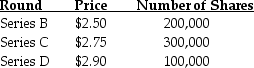 Which of the following is closest to the percentage of the company owned by the founder of the company?
 (Multiple Choice)
4.7/5 (88)
(88) You founded your own firm three years ago. You initially contributed $200,000 of your own money and in return you received 3 million shares of stock. Since then, you have sold an additional 2 million shares of stock to angel investors. You are now considering raising capital from a venture capital firm. This venture capital firm would invest $5 million and would receive 4 million newly issued shares in return. Suppose you sold the 2 million shares to the angel investor for $500,000. What was the post-money valuation of your shares immediately following the angel investor's investment?
(Multiple Choice)
4.7/5 (85)
(85) Which of the following statements regarding best efforts IPOs is FALSE?
(Multiple Choice)
5.0/5 (78)
(78) You founded your own firm three years ago. You initially contributed $200,000 of your own money and in return you received 3 million shares of stock. Since then, you have sold an additional 2 million shares of stock to angel investors. You are now considering raising capital from a venture capital firm. This venture capital firm would invest $4 million and would receive 2 million newly issued shares in return. Assuming that this is the venture capitalist's first investment in your firm, what percentage of the firm will the venture capitalist own?
(Multiple Choice)
4.9/5 (80)
(80) A cash offer differs from a rights offer in that in the latter shares are offered to both existing shareholders and investors at large.
(True/False)
4.8/5 (74)
(74) Which of the following statements is NOT true regarding angel investors?
(Multiple Choice)
4.8/5 (83)
(83) Equity investors in a private company usually plan to realize a return on their investment by selling their stock when that company is acquired by another firm or sold to the public in a public offering.
(True/False)
4.8/5 (83)
(83) Jeremy founded a company. He issues 100,000 shares of series A stock for his own $100,000 investment. He then goes through three further rounds of investment, as shown below:  Which of the following is closest to the percentage of the company owned by the series D investors?
 (Multiple Choice)
4.9/5 (80)
(80) Which of the following is an activity typically taken by an underwriter during an IPO of a company?
(Multiple Choice)
4.8/5 (73)
(73) 
Filters
- Essay(0)
- Multiple Choice(0)
- Short Answer(0)
- True False(0)
- Matching(0)