



 Chat with AI
Exam 14: Raising Equity Capital

Exam 1: Corporate Finance and the Financial Manager86 Questions
Exam 2: Introduction to Financial Statement Analysis95 Questions
Exam 3: Time Value of Money: an Introduction112 Questions
Exam 4: Time Value of Money: Valuing Cash Flow Streams62 Questions
Exam 5: Interest Rates110 Questions
Exam 6: Bonds109 Questions
Exam 7: Stock Valuation64 Questions
Exam 8: Investment Decision Rules123 Questions
Exam 9: Fundamentals of Capital Budgeting113 Questions
Exam 10: Stock Valuation: a Second Look46 Questions
Exam 11: Risk and Return in Capital Markets110 Questions
Exam 12: Systematic Risk and the Equity Risk Premium104 Questions
Exam 13: The Cost of Capital107 Questions
Exam 14: Raising Equity Capital107 Questions
Exam 15: Debt Financing101 Questions
Exam 16: Capital Structure109 Questions
Exam 17: Payout Policy110 Questions
Exam 18: Financial Modeling and Pro Forma Analysis95 Questions
Exam 19: Working Capital Management107 Questions
Exam 20: Short-Term Financial Planning104 Questions
Exam 21: Option Applications and Corporate Finance102 Questions
Exam 22: Mergers and Acquisitions47 Questions
Exam 23: International Corporate Finance108 Questions
Exam 24: Leasing46 Questions
Exam 25: Insurance and Risk Management38 Questions
Exam 26: Corporate Governance45 Questions
Select questions type


Which of the following is LEAST likely to be a possible source of funds to finance a growing business?
(Multiple Choice)
4.8/5  (79)
(79) Luther Industries currently has 100 million shares of stock outstanding at a price of $25 per share. The company would like to raise money and has announced a rights issue. Every existing shareholder will be sent one right per share of stock that he or she owns. The company plans to require twenty rights to purchase one share at a price of $30 per share. The amount of money that Luther will raise through its rights offering is closest to ________.
(Multiple Choice)
4.9/5 (84)
(84) Managers will try to protect their existing shareholders by selling new shares at a price that correctly values or overvalues their firm, leading investors to reason that the announcement of an SEO indicates that a company is over-valued.
(True/False)
4.9/5 (78)
(78) A large publishing firm specializing in college textbooks wishes to expand into online delivery of its materials. In order to facilitate this, it invests in a number of small start-up companies that deliver college courses online and uses these companies to start diversifying the delivery of its content. Which of the following best describes the role of the publishing firm as described above?
(Multiple Choice)
4.8/5 (71)
(71) The founder of a company currently holds 12 million of the 15 million shares in that company. She considers an IPO where she sells a mix of primary shares and 2 million of her own secondary shares for $16 per share. If she wants to retain a 70% ownership of the company, how much money can she raise in this IPO?
(Multiple Choice)
4.8/5 (79)
(79) When a company founder sells stock to outside investors in order to raise capital, the share of the company owned by the founder and the founder's control over the company will be reduced.
(True/False)
4.9/5 (74)
(74) Chambers Industries has a market capitalization of $800 million and 250 million shares outstanding. The management of this firm plans to raise further capital through a rights issue. Which of the following rights schemes will raise the most money, if all shareholders exercise their rights?
(Multiple Choice)
4.8/5 (81)
(81) Highlander Homes stock trades at $35 per share and there are 50 million shares outstanding. The management would like to raise $300 million in an SEO. If the underwriter charges 5% of gross proceeds, and all the shares are primary shares sold to new investors, what percentage of the company will be owned by the new investors?
(Multiple Choice)
4.7/5 (76)
(76) Which of the following is NOT one of the four characteristics of IPOs that puzzle financial economists?
(Multiple Choice)
4.9/5 (76)
(76) Criswell Mining stock trades at $19 per share, and there are 200 million shares outstanding. The management would like to raise $100 million in an SEO. If the underwriter charges 5% of gross proceeds, how many shares must it sell?
(Multiple Choice)
4.9/5 (69)
(69) Stock issued in an IPO usually trades significantly higher at the end of the first day of trading than the original IPO price.
(True/False)
4.7/5 (65)
(65) Jeremy founded a company. He issues 100,000 shares of series A stock for his own $100,000 investment. He then goes through three further rounds of investment, as shown below: 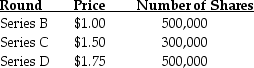 What is the post-money valuation for the series D funding round?
 (Multiple Choice)
4.9/5 (83)
(83) In its IPO, Jillian's Imprints, a small publishing house, offered stock at a price of $10.00 per share. The underwriters of this IPO had a spread of 6.5% per share. If 2 million shares were sold, what funds did Jillian's receive from the IPO?
(Multiple Choice)
4.9/5 (82)
(82) Newly listed firms tend to perform relatively poorly in the three to five years after their IPOs.
(True/False)
4.9/5 (83)
(83) Moon Company plans to issue 10 million shares in a seasoned equity offering. The owner, Ken Moon, plans to sell 4 million shares as part of the offering. Which of the following is true regarding the seasoned equity issue?
(Multiple Choice)
4.9/5 (82)
(82) A firm's founder sells equity to outside investors for the first time in the form of preferred stock. In what way is this preferred stock most likely to differ from the preferred stock issued by an established public firm?
(Multiple Choice)
4.9/5 (81)
(81) 
Filters
- Essay(0)
- Multiple Choice(0)
- Short Answer(0)
- True False(0)
- Matching(0)