



 Chat with AI
Exam 16: Capital Structure

Exam 1: Corporate Finance and the Financial Manager86 Questions
Exam 2: Introduction to Financial Statement Analysis95 Questions
Exam 3: Time Value of Money: an Introduction112 Questions
Exam 4: Time Value of Money: Valuing Cash Flow Streams62 Questions
Exam 5: Interest Rates110 Questions
Exam 6: Bonds109 Questions
Exam 7: Stock Valuation64 Questions
Exam 8: Investment Decision Rules123 Questions
Exam 9: Fundamentals of Capital Budgeting113 Questions
Exam 10: Stock Valuation: a Second Look46 Questions
Exam 11: Risk and Return in Capital Markets110 Questions
Exam 12: Systematic Risk and the Equity Risk Premium104 Questions
Exam 13: The Cost of Capital107 Questions
Exam 14: Raising Equity Capital107 Questions
Exam 15: Debt Financing101 Questions
Exam 16: Capital Structure109 Questions
Exam 17: Payout Policy110 Questions
Exam 18: Financial Modeling and Pro Forma Analysis95 Questions
Exam 19: Working Capital Management107 Questions
Exam 20: Short-Term Financial Planning104 Questions
Exam 21: Option Applications and Corporate Finance102 Questions
Exam 22: Mergers and Acquisitions47 Questions
Exam 23: International Corporate Finance108 Questions
Exam 24: Leasing46 Questions
Exam 25: Insurance and Risk Management38 Questions
Exam 26: Corporate Governance45 Questions
Select questions type


Consider the following equation for the question(s) below.
 -The E in the equation above represents ________.
 (Multiple Choice)
4.8/5  (68)
(68) The pecking order hypothesis states that managers will have a preference to fund investment by using ________, followed by ________, and will issue ________ as a last resort.
(Multiple Choice)
4.8/5 (64)
(64) A firm that does not have trouble meeting its debt obligations is said to be in financial distress.
(True/False)
4.9/5 (77)
(77) A bankruptcy process is complex, time-consuming, and costly. The costs of bankruptcy include ________.
(Multiple Choice)
4.7/5 (85)
(85) Use the information for the question(s) below.
Consider two firms, Firm X and Firm Y, that have identical assets that generate identical cash flows. Firm Y is an all-equity firm, with 1 million shares outstanding that trade for a price of $24 per share. Firm X has 2 million shares outstanding and $12 million in debt at an interest rate of 5%.
-According to MM Proposition I, the stock price for Firm X is closest to ________.
(Multiple Choice)
4.8/5 (88)
(88) A firm requires an investment of $60,000 and borrows $20,000 at 8%. If the return on equity is 14% and the tax rate is 30%, what is the firm's WACC?
(Multiple Choice)
4.9/5 (82)
(82) Managers should not change the capital structure unless it departs significantly from the optimal level because such a change would ________.
(Multiple Choice)
4.8/5 (101)
(101) Asymmetric information implies that ________ may have better information about a firm's cash flows than other stakeholders.
(Multiple Choice)
4.9/5 (82)
(82) As the level of debt increases the tax benefits of debt increase until ________.
(Multiple Choice)
4.9/5 (88)
(88) Aside from direct costs of bankruptcy, a firm may also incur other indirect costs such as ________.
(Multiple Choice)
4.8/5 (80)
(80) Market timing means that managers may sell ________ when they believe the stock is over-valued and rely on ________ when the stock is undervalued.
(Multiple Choice)
4.8/5 (70)
(70) A firm has a market value of equity of $30,000. It borrows $7500 at 8%. If the unlevered cost of equity is 15%, what is the firm's cost of equity capital?
(Multiple Choice)
4.7/5 (78)
(78) The following equation: 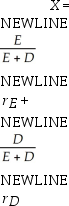 can be used to calculate all of the following EXCEPT ________.
 (Multiple Choice)
4.7/5 (69)
(69) Consider the following equation for the question(s) below.
-The U in the equation above represents ________.
-The U in the equation above represents ________. (Multiple Choice)
4.9/5 (70)
(70) Use the information for the question(s) below.
Luther is a successful logistical services firm that currently has $5 billion in cash. Luther has decided to use this cash to repurchase shares from its investors and has already announced the stock repurchase plan. Currently Luther is an all-equity firm with 1.25 billion shares outstanding. Luther's shares are currently trading at $20 per share.
-With perfect capital markets, what is the market price per share of Luther's stock after the share repurchase?
(Multiple Choice)
4.7/5 (68)
(68) Consider the following equation for the question(s) below.
-Which of the following statements is FALSE?
-Which of the following statements is FALSE? (Multiple Choice)
4.8/5 (75)
(75) A firm will give a one-time cash flow of $24,000 after one year. If the project risk requires a return of 10%, what is the levered value of the firm with perfect capital markets?
(Multiple Choice)
4.8/5 (76)
(76) A firm requires an investment of $20,000 and will return $26,500 after one year. If the firm borrows $6000 at 7%, what is the return on levered equity?
(Multiple Choice)
4.9/5 (69)
(69) 
Filters
- Essay(0)
- Multiple Choice(0)
- Short Answer(0)
- True False(0)
- Matching(0)