



 Chat with AI
Exam 16: Capital Structure

Exam 1: Corporate Finance and the Financial Manager86 Questions
Exam 2: Introduction to Financial Statement Analysis95 Questions
Exam 3: Time Value of Money: an Introduction112 Questions
Exam 4: Time Value of Money: Valuing Cash Flow Streams62 Questions
Exam 5: Interest Rates110 Questions
Exam 6: Bonds109 Questions
Exam 7: Stock Valuation64 Questions
Exam 8: Investment Decision Rules123 Questions
Exam 9: Fundamentals of Capital Budgeting113 Questions
Exam 10: Stock Valuation: a Second Look46 Questions
Exam 11: Risk and Return in Capital Markets110 Questions
Exam 12: Systematic Risk and the Equity Risk Premium104 Questions
Exam 13: The Cost of Capital107 Questions
Exam 14: Raising Equity Capital107 Questions
Exam 15: Debt Financing101 Questions
Exam 16: Capital Structure109 Questions
Exam 17: Payout Policy110 Questions
Exam 18: Financial Modeling and Pro Forma Analysis95 Questions
Exam 19: Working Capital Management107 Questions
Exam 20: Short-Term Financial Planning104 Questions
Exam 21: Option Applications and Corporate Finance102 Questions
Exam 22: Mergers and Acquisitions47 Questions
Exam 23: International Corporate Finance108 Questions
Exam 24: Leasing46 Questions
Exam 25: Insurance and Risk Management38 Questions
Exam 26: Corporate Governance45 Questions
Select questions type


Use next year's Cash Flow Forecast for Blank Company to answer the question(s) below.
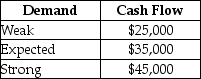 -Suppose Blank Company has only one project, as forecast above, and an unlevered cost of equity of 8%. What is the value of the company if the demand is as expected?
 (Multiple Choice)
5.0/5  (83)
(83) Use the information for the question(s) below.
Consider two firms, Firm X and Firm Y, that have identical assets that generate identical cash flows. Firm Y is an all-equity firm, with 1 million shares outstanding that trade for a price of $24 per share. Firm X has 2 million shares outstanding and $12 million in debt at an interest rate of 5%.
-Assume that MM's perfect capital markets conditions are met and that you can borrow and lend at the same 5% rate as Firm X. You have $5,000 of your own money to invest and you plan on buying Firm X stock. Using homemade (un)leverage, how much do you need to invest at the risk-free rate so that the payoff of your account will be the same as a $5,000 investment in Firm Y stock?
(Multiple Choice)
4.9/5 (79)
(79) What effect does debt have on a firm's weighted average cost of capital?
(Essay)
4.8/5 (76)
(76) A firm has a market value of equity of $30,000. It borrows $7500 at 8%. If the unlevered cost of equity is 16%, what is the firm's cost of equity capital?
(Multiple Choice)
4.9/5 (99)
(99) The optimal capital structure depends on ________ such as taxes, distress costs and agency costs.
(Multiple Choice)
4.7/5 (73)
(73) The use of leverage as a way to signal ________ information to investors is known as the signaling theory of debt.
(Multiple Choice)
4.7/5 (80)
(80) The relative proportions of debt, equity, and other securities that a firm has outstanding constitute its ________.
(Multiple Choice)
4.7/5 (75)
(75) Firms in industries such as real estate tend to have ________ distress costs because of a large proportion of tangible assets.
(Multiple Choice)
4.8/5 (71)
(71) Managerial entrenchment means that managers ________ and run the firm for their own best interests.
(Multiple Choice)
5.0/5 (85)
(85) Managers should consider ________ for external financing when agency costs are significant.
(Multiple Choice)
4.8/5 (78)
(78) In general, the gain to investors from the tax deductibility of interest payments is referred to as the interest rate tax shield.
(True/False)
4.8/5 (78)
(78) The probability of financial distress depends on the ________.
(Multiple Choice)
4.7/5 (85)
(85) A firm requires an investment of $30,000 and borrows $20,000 at 9%. If the return on equity is 15% and the tax rate is 30%, what is the firm's WACC?
(Multiple Choice)
5.0/5 (87)
(87) 
Filters
- Essay(0)
- Multiple Choice(0)
- Short Answer(0)
- True False(0)
- Matching(0)