



 Chat with AI
Exam 5: Economic Efficiency,government Price Setting and Taxes

Exam 1: Economics: Foundations and Models142 Questions
Exam 2: Choices and Trade-Offs in the Market192 Questions
Exam 3: Where Prices Come From: the Interaction of Demand and Supply241 Questions
Exam 4: Elasticity: The Responsiveness of Demand and Supply224 Questions
Exam 5: Economic Efficiency,government Price Setting and Taxes169 Questions
Exam 6: Technology,production and Costs255 Questions
Exam 7: Firms in Perfectly Competitive Markets269 Questions
Exam 8: Monopoly Markets187 Questions
Exam 9: Monopolistic Competition and Oligopoly350 Questions
Exam 10: The Markets for Labour and Other Factors of Production250 Questions
Exam 11: Government Intervention in the Market325 Questions
Exam 12: Social Policy and Inequality125 Questions
Exam 13: Gdp: Measuring Total Production, income and Economic Growth202 Questions
Exam 14: Unemployment and Inflation230 Questions
Exam 15: Aggregate Demand and Aggregate Supply Analysis166 Questions
Exam 16: Money,banks and the Reserve Bank of Australia110 Questions
Exam 17: Monetary Policy111 Questions
Exam 18: Fiscal Policy138 Questions
Exam 19: Comparative Advantage and the Gains From International Trade131 Questions
Exam 20: Macroeconomics in an Open Economy276 Questions
Select questions type


Suppose the demand curve for a product is vertical and the supply curve is upward sloping.If a unit tax is imposed in the market for this product,_________.
(Multiple Choice)
4.9/5  (63)
(63) Table 5.4
Hourly Wage (dollars) Quantity of Labour Supplied Quantity of Labour Demanded 7.50 530000 650000 8.50 550000 630000 9.50 570000 610000 10.50 590000 590000 11.50 610000 570000 12.50 630000 550000 Table 5-4 shows the demand and supply schedules for labour market in the city of Pixley.
-Refer to Table 5.4.Suppose that the quantity of labour demanded decreases by 80 000 at each wage level.What are the new free-market equilibrium hourly wage and the new equilibrium quantity of labour?
(Multiple Choice)
4.7/5 (71)
(71) Table 5.3
The Waco Kid's Cowboy Hats Marginal Cost (dollars) 1st hat 24 2nd hat 30 3rd hat 38 4th hat 46
-Refer to Table 5.3.The table above lists the marginal cost of cowboy hats by The Waco Kid,a firm that specialises in producing fancy dress costumes.If the market price of cowboy hats is $35,The Waco Kid will produce ________.
(Multiple Choice)
4.9/5 (88)
(88) What curve shows the marginal cost of producing one more unit of a good or service?
(Multiple Choice)
4.8/5 (76)
(76) The government proposes a tax on imported champagne.Buyers will bear the entire burden of the tax if the _________.
(Multiple Choice)
4.7/5 (78)
(78) Table 5.3
The Waco Kid's Cowboy Hats Marginal Cost (dollars) 1st hat 24 2nd hat 30 3rd hat 38 4th hat 46
-Refer to Table 5.3.The table above lists the marginal cost of cowboy hats by The Waco Kid,a firm that specialises in producing fancy dress costumes.If the market price of cowboy hats is $50,how many hats will be produced?
(Multiple Choice)
4.9/5 (75)
(75) In a city with rent-controlled apartments,all of the following are true except:
(Multiple Choice)
4.9/5 (77)
(77) Figure 5.1 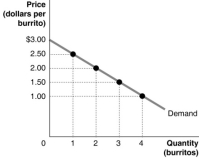 Figure 5.1 shows Arnold's demand curve for burritos.
-Refer to Figure 5.1.If the market price is $3.00,what is the maximum number of burritos that Arnold will buy?
Figure 5.1 shows Arnold's demand curve for burritos.
-Refer to Figure 5.1.If the market price is $3.00,what is the maximum number of burritos that Arnold will buy? (Multiple Choice)
4.9/5 (70)
(70) Figure 5.1 Figure 5.1 shows Arnold's demand curve for burritos.
-Refer to Figure 5.1.If the market price is $1.00,the consumer surplus on the third burrito is ________.
Figure 5.1 shows Arnold's demand curve for burritos.
-Refer to Figure 5.1.If the market price is $1.00,the consumer surplus on the third burrito is ________. (Multiple Choice)
4.9/5 (83)
(83) If equilibrium is achieved in a competitive market,_________.
(Multiple Choice)
4.9/5 (87)
(87) Companies in the sharing economy have the potential to lower the equilibrium price in their market,and by doing so increase efficiency.This would have a tendency to ________.
(Multiple Choice)
4.9/5 (73)
(73) The division of the burden of a tax between buyers and sellers in a market is called tax allocation.
(True/False)
4.7/5 (70)
(70) Figure 5.3 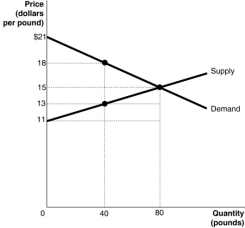 Figure 5.3 shows the market for tiger shrimp. The market is initially in equilibrium at a price of $15 and a quantity of 80. Now suppose producers decide to cut output to 40 in order to raise the price to $18.
-Refer to Figure 5.3.At the equilibrium price of $15,consumers are willing to buy 80 metrics of tiger shrimp.Is this an economically efficient quantity?
Figure 5.3 shows the market for tiger shrimp. The market is initially in equilibrium at a price of $15 and a quantity of 80. Now suppose producers decide to cut output to 40 in order to raise the price to $18.
-Refer to Figure 5.3.At the equilibrium price of $15,consumers are willing to buy 80 metrics of tiger shrimp.Is this an economically efficient quantity? (Multiple Choice)
4.9/5 (86)
(86) Table 5.1
Consumer Willingness to Pay (dollars) Tom 40 Dick 30 Harriet 25
-Refer to Table 5.1.The table above lists the highest prices three consumers,Tom,Dick,and Harriet,are willing to pay for a short-sleeved polo shirt.If the price of one of the shirts is $28 dollars,__________.
(Multiple Choice)
4.8/5 (80)
(80) What is producer surplus? What does producer surplus measure?
__________________________________________________________________________________________________________________________________________________________________________________________
(Essay)
4.7/5 (70)
(70) A price ceiling is a legally determined maximum price that sellers may charge.
(True/False)
4.8/5 (72)
(72) What is the difference between the highest price a consumer is willing to pay for a good and the price the consumer actually pays?
(Multiple Choice)
4.9/5 (69)
(69) Figure 5.3 Figure 5.3 shows the market for tiger shrimp. The market is initially in equilibrium at a price of $15 and a quantity of 80. Now suppose producers decide to cut output to 40 in order to raise the price to $18.
-Refer to Figure 5.3.The value of consumer surplus at the equilibrium price of $18 is _________.
Figure 5.3 shows the market for tiger shrimp. The market is initially in equilibrium at a price of $15 and a quantity of 80. Now suppose producers decide to cut output to 40 in order to raise the price to $18.
-Refer to Figure 5.3.The value of consumer surplus at the equilibrium price of $18 is _________. (Multiple Choice)
4.9/5 (67)
(67) Table 5.4
Hourly Wage (dollars) Quantity of Labour Supplied Quantity of Labour Demanded 7.50 530000 650000 8.50 550000 630000 9.50 570000 610000 10.50 590000 590000 11.50 610000 570000 12.50 630000 550000 Table 5-4 shows the demand and supply schedules for labour market in the city of Pixley.
-Refer to Table 5.4.Suppose that the quantity of labour supplied increases by 40 000 at each wage level.What are the new free-market equilibrium hourly wage and the new equilibrium quantity of labour?
(Multiple Choice)
4.8/5 (77)
(77) 
Filters
- Essay(0)
- Multiple Choice(0)
- Short Answer(0)
- True False(0)
- Matching(0)