



 Chat with AI
Exam 18: Ray Optics

Exam 1: Representing Motion113 Questions
Exam 2: Motion in One Dimension174 Questions
Exam 3: Vectors and Motion in Two Dimensions183 Questions
Exam 4: Forces and Newtons Laws of Motion64 Questions
Exam 5: Applying Newtons Laws82 Questions
Exam 6: Gravity96 Questions
Exam 7: Rotational Motion95 Questions
Exam 8: Equilibrium Ad Elasticity73 Questions
Exam 9: Momentum103 Questions
Exam 10: Energy and Work223 Questions
Exam 11: Using Energy106 Questions
Exam 12: Thermal Properties of Matter220 Questions
Exam 13: Fluids115 Questions
Exam 14: Oscillations105 Questions
Exam 15: Traveling Waves and Sound94 Questions
Exam 16: Superposition and Standing Waves66 Questions
Exam 17: Wave Optics129 Questions
Exam 18: Ray Optics155 Questions
Exam 19: Optical Instruments137 Questions
Exam 20: Electric Fields and Forces95 Questions
Exam 21: Electric Potential144 Questions
Exam 22: Current and Resistance125 Questions
Exam 23: Circuits157 Questions
Exam 24: Magnetic Fields and Forces168 Questions
Exam 25: EM Induction and Em Waves185 Questions
Exam 26: AC Electricity122 Questions
Exam 27: Relativity126 Questions
Exam 28: Quantum Physics86 Questions
Exam 29: Atoms and Molecules105 Questions
Exam 30: Nuclear Physics175 Questions
Select questions type


A beam of light in air enters a glass slab with an index of refraction of 1.40 at an angle of incidence of 30.0°. What is the angle of refraction?
(Multiple Choice)
5.0/5  (71)
(71) A certain slide projector has a lens of focal length 15.0 cm. This lens forms an image measuring 100 cm × 100 cm on the screen when a slide whose dimensions are 50.0 mm × 50.0 mm is being magnified. How far from the lens should the screen be placed?
(Short Answer)
4.9/5 (81)
(81) A beam of light traveling in air strikes a glass slab at an angle of incidence less than 90°. After entering the glass slab, what does the beam of light do? (There could be more than one correct choice.)
A) I follows the same path as before it struck the glass.
B) It follows the normal to the glass slab.
C) It bends away from the normal at the point of contact.
D) It bends closer to the normal at the point of contact.
E) It slows down.
(Short Answer)
4.9/5 (79)
(79) Two thin lenses, one a converging lens and the other a diverging lens, are separated by 1.00 m along the same principal axis, as shown in the figure. The magnitude of the focal length of the converging lens is 25 cm, while the magnitude of the focal length of the diverging lens is 40 cm. An object 8.25 cm tall is placed 35 cm to the left of the converging lens.
(a) Where is the final image produced by this combination of lenses? (Give your answer relative to the diverging lens.)
(b) Compared to the object, is the final image upright or inverted? Is it real or virtual? 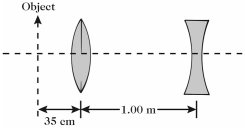
(Short Answer)
4.9/5 (85)
(85) A light ray in glass arrives at the glass-water interface an an angle of θ = 48° with the normal. The refracted ray in water makes an angle φ = 72° angle with the normal, as shown in the figure.The index of refraction of water is 1.33. The angle of incidence is now changed to θ = 37°. What is the new angle of refraction φ in the water? 
(Multiple Choice)
4.8/5 (88)
(88) An oil layer that is 5.0 cm thick is spread smoothly and evenly over the surface of water on a windless day. A light ray from the air above enters the oil at 45° with the normal and then goes into the water. What is the angle of refraction of this ray in the water? The index of refraction for the oil is 1.15, and for water it is 1.33.
(Multiple Choice)
4.8/5 (78)
(78) The focal length of a convex mirror is has a magnitude of 20 cm. What is its radius of curvature?
(Multiple Choice)
5.0/5 (85)
(85) A 4.0-cm tall object is placed 60 cm in front of a converging lens of focal length of magnitude 30 cm. What are the nature and location of the image?
(Multiple Choice)
4.9/5 (72)
(72) A seed is 15 mm in front of a converging lens, and the image of the seed is 4.0 mm behind the lens. What is the focal length of the lens?
(Multiple Choice)
4.7/5 (79)
(79) Which of the following terms describe lenses that are thicker at the center than at the edges? (There could be more than one correct choice.)
(Multiple Choice)
4.9/5 (73)
(73) An object is placed near a concave mirror having a radius of curvature of magnitude 60 cm. How far should you place the object from the mirror so that the lateral magnification produced by the mirror will be +2.5?
(Multiple Choice)
4.7/5 (80)
(80) If a spherical convex mirror has a radius of curvature R, the magnitude of its focal length is
(Multiple Choice)
4.8/5 (74)
(74) An object is placed 50 cm in front of a concave mirror with a focal length of 25 cm. What is the magnification produced by the mirror?
(Multiple Choice)
5.0/5 (89)
(89) Light in a transparent material that has an index of refraction of 1.333 strikes the boundary with another transparent material for which the index of refraction is 1.010. What is the critical angle for total internal reflection between these two materials?
(Short Answer)
4.8/5 (90)
(90) A thick slab of plastic lies at the bottom of a tank filled with water having an index of refraction of 1.33. A narrow laser beam is shone directly downward through the water on the plastic. You then gradually rotate the laser, thereby increasing the angle with respect to the normal that it strikes the plastic. You carefully note that at the instant the beam makes an angle of 66.5° with the normal in the water, no light enters the plastic, but it did enter for angles smaller than that. What is the speed of light in the plastic slab? (c = 3.00 × 10⁸ m/s)
(Short Answer)
4.9/5 (76)
(76) If you stand in front of a convex mirror, at the same distance from it as its focal length,
(Multiple Choice)
4.7/5 (68)
(68) A beam of light, traveling in air, strikes a plate of transparent material at an angle of incidence of 56.0°. It is observed that the reflected and refracted beams form an angle of 90.0°. What is the index of refraction of this material?
(Multiple Choice)
4.9/5 (75)
(75) A convex mirror has a focal length of magnitude f. An object is placed in front of this mirror at a point f from the face of the mirror. The image will appear
(Multiple Choice)
4.8/5 (87)
(87) An object is placed 15 cm to the left of a double-convex lens of focal length 20 cm. Where is the image of this object located?
(Multiple Choice)
4.8/5 (81)
(81) A thin lens projects an image of a man as shown in the figure. Rays marked A, B, and C travel to the lens from the man's ear. Draw the paths of these three rays after they have passed through the lens. Note that A is parallel to the principal axis, B goes through the center of the lens, C goes through the focal point on the left, and the point marked f is the focal point on the right of the lens. 
(Essay)
4.7/5 (78)
(78) 
Filters
- Essay(0)
- Multiple Choice(0)
- Short Answer(0)
- True False(0)
- Matching(0)