



 Chat with AI
Exam 18: Ray Optics

Exam 1: Representing Motion113 Questions
Exam 2: Motion in One Dimension174 Questions
Exam 3: Vectors and Motion in Two Dimensions183 Questions
Exam 4: Forces and Newtons Laws of Motion64 Questions
Exam 5: Applying Newtons Laws82 Questions
Exam 6: Gravity96 Questions
Exam 7: Rotational Motion95 Questions
Exam 8: Equilibrium Ad Elasticity73 Questions
Exam 9: Momentum103 Questions
Exam 10: Energy and Work223 Questions
Exam 11: Using Energy106 Questions
Exam 12: Thermal Properties of Matter220 Questions
Exam 13: Fluids115 Questions
Exam 14: Oscillations105 Questions
Exam 15: Traveling Waves and Sound94 Questions
Exam 16: Superposition and Standing Waves66 Questions
Exam 17: Wave Optics129 Questions
Exam 18: Ray Optics155 Questions
Exam 19: Optical Instruments137 Questions
Exam 20: Electric Fields and Forces95 Questions
Exam 21: Electric Potential144 Questions
Exam 22: Current and Resistance125 Questions
Exam 23: Circuits157 Questions
Exam 24: Magnetic Fields and Forces168 Questions
Exam 25: EM Induction and Em Waves185 Questions
Exam 26: AC Electricity122 Questions
Exam 27: Relativity126 Questions
Exam 28: Quantum Physics86 Questions
Exam 29: Atoms and Molecules105 Questions
Exam 30: Nuclear Physics175 Questions
Select questions type


A 4.0-cm tall apple is 20 cm in front of a plano-convex lens of focal length 75 cm.
(a) Find the location of the image of the apple. Is it a real or a virtual image?
(b) How tall is the image of the apple? Is it upright or inverted?
(Short Answer)
4.8/5  (83)
(83) A point source of light is positioned 20.0 m below the surface of a lake. What is the diameter of the largest circle on the surface of the water through which light can emerge into the air? The index of refraction of water is 1.33.
(Short Answer)
4.8/5 (72)
(72) If a spherical concave mirror has a radius of curvature R, its focal length is
(Multiple Choice)
5.0/5 (84)
(84) A concave spherical mirror with a radius of curvature of 20 cm creates a real image 30 cm from the mirror. How far is the object from the mirror?
(Multiple Choice)
4.9/5 (89)
(89) A tank holds a layer of oil, of thickness To = 1.43 m, that floats on a layer of syrup of thickness Ts = 0.640 m, as shown in the figure. Both liquids are clear and do not mix together. A light ray, originating at the bottom of the tank at point P, crosses the oil-syrup interface at a point 0.900 m from the axis. The ray continues and arrives at the oil-air interface, 2.00 m to the right of P and at the critical angle. What is the index of refraction of the oil? 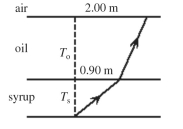
(Multiple Choice)
4.8/5 (76)
(76) As shown in the figure, a laser positioned on a ship is used to communicate with a small research submarine resting on the bottom of a lake. The laser is positioned 12 m above the surface of the water, and it strikes the water 20 m from the side of the ship. The water is 58 m deep and has an index of refraction of 1.33. How far horizontally is the submarine from the side of the ship? (Assume all numbers are accurate to three significant figures.) 
(Multiple Choice)
4.8/5 (81)
(81) Tan's face is 20 cm in front of a concave shaving mirror. If he observes his image to be twice as big and upright, what is the focal length of the mirror?
(Multiple Choice)
4.8/5 (87)
(87) A person jogs toward a plane mirror at a speed of 3 m/s. How fast is he approaching his image in the mirror?
(Multiple Choice)
4.8/5 (84)
(84) A beam of light that is parallel to the principal axis strikes a convex mirror. What happens to the reflected beam of light?
(Multiple Choice)
4.8/5 (89)
(89) An object that is 10.0 cm tall is placed 37.0 cm in front of a concave mirror of focal length 18.5 cm. How tall is the image?
(Multiple Choice)
4.9/5 (68)
(68) A drawing is placed 40 cm in front of a thin lens. If a virtual image forms at a distance of 50 cm from the lens, on the same side as the drawing, what is the focal length of the lens?
(Multiple Choice)
4.9/5 (76)
(76) An object is placed in front of a thin lens. Which statements are correct in describing the image formed by the lens? (There could be more than one correct choice.)
(Multiple Choice)
4.9/5 (75)
(75) A laser beam strikes a plane mirror's reflecting surface with an angle of incidence of 43°. What is the angle between the incident ray and the reflected ray?
(Multiple Choice)
4.8/5 (70)
(70) A glass plate having an index of refraction is 1.66 is immersed in a certain alcohol. The surface of the glass is inclined at an angle of 44° with the vertical. When a horizontal ray in the glass strikes the interface, you observe that it is at the critical angle. What is the index of refraction of the alcohol?
(Multiple Choice)
4.8/5 (72)
(72) Light goes from material having a refractive index of n1 into a material with refractive index n2. If the refracted light is bent away from the normal, what can you conclude about the indices of refraction?
(Multiple Choice)
4.9/5 (72)
(72) A lab specimen is 15.2 mm from a converging lens. The image is 4.0 mm tall and 9.0 cm from the lens. How tall is the specimen?
(Multiple Choice)
4.9/5 (76)
(76) Which of the following terms describe lenses that are thinner at the center than at the edges? (There could be more than one correct choice.)
(Multiple Choice)
4.8/5 (75)
(75) A narrow light beam in vacuum contains light of two wavelengths, 480 nm and 700 nm. It strikes a flat piece of glass at an angle of incidence of 60.000°. The index of refraction of the glass is 1.4830 at 480 nm and 1.4760 at 700 nm. Determine the angle between the two wavelengths as the light travels in the glass.
(Short Answer)
4.7/5 (94)
(94) A plant that is 4.1 cm tall is 10.3 cm from a converging lens. You observe that the image of this plant is virtual and 6.2 cm tall. What is the focal length of the lens?
(Multiple Choice)
4.7/5 (94)
(94) A coin is 12 cm in front of a converging lens with focal length of magnitude 4.0 cm. Where is the image?
(Multiple Choice)
4.8/5 (74)
(74) 
Filters
- Essay(0)
- Multiple Choice(0)
- Short Answer(0)
- True False(0)
- Matching(0)