



 Chat with AI
Exam 18: Ray Optics

Exam 1: Representing Motion113 Questions
Exam 2: Motion in One Dimension174 Questions
Exam 3: Vectors and Motion in Two Dimensions183 Questions
Exam 4: Forces and Newtons Laws of Motion64 Questions
Exam 5: Applying Newtons Laws82 Questions
Exam 6: Gravity96 Questions
Exam 7: Rotational Motion95 Questions
Exam 8: Equilibrium Ad Elasticity73 Questions
Exam 9: Momentum103 Questions
Exam 10: Energy and Work223 Questions
Exam 11: Using Energy106 Questions
Exam 12: Thermal Properties of Matter220 Questions
Exam 13: Fluids115 Questions
Exam 14: Oscillations105 Questions
Exam 15: Traveling Waves and Sound94 Questions
Exam 16: Superposition and Standing Waves66 Questions
Exam 17: Wave Optics129 Questions
Exam 18: Ray Optics155 Questions
Exam 19: Optical Instruments137 Questions
Exam 20: Electric Fields and Forces95 Questions
Exam 21: Electric Potential144 Questions
Exam 22: Current and Resistance125 Questions
Exam 23: Circuits157 Questions
Exam 24: Magnetic Fields and Forces168 Questions
Exam 25: EM Induction and Em Waves185 Questions
Exam 26: AC Electricity122 Questions
Exam 27: Relativity126 Questions
Exam 28: Quantum Physics86 Questions
Exam 29: Atoms and Molecules105 Questions
Exam 30: Nuclear Physics175 Questions
Select questions type


An object 2.0 cm tall is placed 24 cm in front of a convex mirror having a focal length of magnitude 30 cm.
(a) Where is the image formed and how far is it from the mirror?
(b) How tall is the image?
(Short Answer)
4.9/5  (62)
(62) A concave spherical mirror has a focal length of magnitude 20 cm. An object is placed 30 cm in front of the mirror on the mirror's axis. Where is the image located?
(Multiple Choice)
4.9/5 (77)
(77) A stature that is 3.0 cm tall statue is 24 cm in front of a concave mirror. The magnitude of the radius of curvature of the mirror is 20 cm.
(a) Is the image real or virtual?
(b) How far is the image from the mirror?
(c) Is the image upright or inverted?
(d) How tall is the image?
(Short Answer)
4.8/5 (82)
(82) A light ray in air strikes a glass plate whose index of refraction is 1.42. Some of the light reflects off the surface of the plate, but most of it enters the glass. If the angle of refraction is one-half the angle of reflection, the angle of refraction is closest to which one of the following angles?
(Multiple Choice)
5.0/5 (71)
(71) An object is placed in front of a convex mirror at a distance larger than twice the magnitude of the focal length of the mirror. The image will appear
(Multiple Choice)
4.8/5 (78)
(78) How far from a +50-mm focal length lens, such as is used in many 35-mm cameras, must an object be placed so it will form a real image that is 3.0 times the size of the object?
(Multiple Choice)
4.8/5 (74)
(74) Which one of the following sets of characteristics describes the image formed by a plane mirror?
(Multiple Choice)
5.0/5 (86)
(86) A light ray in glass arrives at the glass-water interface at an angle of θ = 48° with the normal. The refracted ray in water makes an angle θ = 61° with the normal, as shown in the figure. The index of refraction of water is 1.33. The angle of incidence is now changed to θ = 25°. What is the new angle of refraction φ in the water? 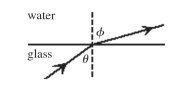
(Multiple Choice)
4.8/5 (77)
(77) How far from a converging lens of focal length 30 cm must an object be placed so the image will be virtual and 3.0 times as large as the object?
(Short Answer)
4.8/5 (80)
(80) As you walk away from a plane mirror on a wall, the height of your image
(Multiple Choice)
4.9/5 (95)
(95) Which of following statements about the image formed by a single diverging lens are true? (There could be more than one correct choice.)
(Multiple Choice)
4.9/5 (75)
(75) A scuba diver is 1.2 m beneath the surface of a still pond of water. At what angle relative to the normal at the surface must the diver shine a beam of light toward the surface in order for a person on a distant bank to be able to see it? The index of refraction for water is 1.33.
(Multiple Choice)
4.9/5 (76)
(76) A toy is 14 cm in front of a convex spherical mirror. If the image of the toy is 5.8 cm behind the mirror, what is the focal length of the mirror?
(Multiple Choice)
4.7/5 (69)
(69) Suppose you place an object in front of a concave mirror. Which of the following statements must be true? (There could be more than one correct choice.)
(Multiple Choice)
4.8/5 (88)
(88) Light enters air from water. The angle of refraction will be
(Multiple Choice)
5.0/5 (91)
(91) You may have seen ambulances on the street with the letters of the word AMBULANCE written on the front of them, in such a way as to appear correctly when viewed in your car's rear-view mirror. (See the figure.) How do the letters appear when you look directly at the ambulance (not through the mirror)? 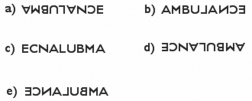
(Multiple Choice)
4.9/5 (82)
(82) A convex lens has focal length f. If an object is placed at a distance between f and 2f from the lens on the principal axis, the image is located at a distance from the lens
(Multiple Choice)
4.9/5 (71)
(71) An object is in front of a concave spherical mirror, and its image is 4.0 cm behind the mirror. If the focal length of the mirror has a magnitude of 5.0 cm, where is the object?
(Multiple Choice)
4.8/5 (75)
(75) 
Filters
- Essay(0)
- Multiple Choice(0)
- Short Answer(0)
- True False(0)
- Matching(0)