



 Chat with AI
Exam 18: Ray Optics

Exam 1: Representing Motion113 Questions
Exam 2: Motion in One Dimension174 Questions
Exam 3: Vectors and Motion in Two Dimensions183 Questions
Exam 4: Forces and Newtons Laws of Motion64 Questions
Exam 5: Applying Newtons Laws82 Questions
Exam 6: Gravity96 Questions
Exam 7: Rotational Motion95 Questions
Exam 8: Equilibrium Ad Elasticity73 Questions
Exam 9: Momentum103 Questions
Exam 10: Energy and Work223 Questions
Exam 11: Using Energy106 Questions
Exam 12: Thermal Properties of Matter220 Questions
Exam 13: Fluids115 Questions
Exam 14: Oscillations105 Questions
Exam 15: Traveling Waves and Sound94 Questions
Exam 16: Superposition and Standing Waves66 Questions
Exam 17: Wave Optics129 Questions
Exam 18: Ray Optics155 Questions
Exam 19: Optical Instruments137 Questions
Exam 20: Electric Fields and Forces95 Questions
Exam 21: Electric Potential144 Questions
Exam 22: Current and Resistance125 Questions
Exam 23: Circuits157 Questions
Exam 24: Magnetic Fields and Forces168 Questions
Exam 25: EM Induction and Em Waves185 Questions
Exam 26: AC Electricity122 Questions
Exam 27: Relativity126 Questions
Exam 28: Quantum Physics86 Questions
Exam 29: Atoms and Molecules105 Questions
Exam 30: Nuclear Physics175 Questions
Select questions type


Sometimes when you look into a curved mirror you see a magnified image (a great big you) and sometimes you see a diminished image (a little you). If you look at the bottom (convex) side of a shiny spoon, what will you see?
(Multiple Choice)
4.7/5  (84)
(84) An object that is 4.0 cm tall is placed 15 cm in front of a concave mirror of focal length 20 cm.
(a) Where is the image formed and how far is it from the mirror?
(b) How tall is the image?
(Short Answer)
4.8/5 (80)
(80) Which of the following statements about spherical mirrors is correct? (There could be more than one correct choice.)
(Multiple Choice)
4.9/5 (81)
(81) An object that is 47.5 cm tall forms an image that is 38.6 cm tall and 14.8 cm from a spherical mirror. How far is the object from the mirror?
(Multiple Choice)
4.9/5 (79)
(79) A thin flashlight beam traveling in air strikes a glass plate at an angle of 52° with the plane of the surface of the plate. If the index of refraction of the glass is 1.4, what angle will the beam make with the normal in the glass?
(Multiple Choice)
4.8/5 (69)
(69) Starting from very far away, an object is moved closer and closer to a diverging lens, eventually reaching the lens. What happens to its image formed by that lens? (There could be more than one correct choice.)
(Multiple Choice)
4.7/5 (85)
(85) Starting from very far away, an object is moved closer and closer to a converging lens, eventually reaching the lens. What happens to its image formed by that lens? (There could be more than one correct choice.)
(Multiple Choice)
4.7/5 (83)
(83) Two plane mirrors make an angle of with each other. A light ray enters the system and is reflected once off of each mirror. Through what angle is the ray turned?
(Multiple Choice)
4.8/5 (90)
(90) Light travels from crown glass, with a refractive index of 1.52, into water, having a refractive index of 1.33? The critical angle for this interface is closest to which one of the following angles?
(Multiple Choice)
4.8/5 (83)
(83) If a object is placed between a convex lens and its focal point, the image formed is
(Multiple Choice)
4.7/5 (77)
(77) The speed of light in a material is What is the critical angle of a light ray at the interface between the material and a vacuum?
(Multiple Choice)
4.9/5 (80)
(80) A light ray enters a glass enclosed fish tank. From air it enters the glass at 20° with respect to the plane of the surface and then emerges into the water. The index for the glass is 1.50 and for water 1.33.
(a) What is the angle of refraction in the glass?
(b) What is the angle of refraction in the water?
(c) Is there any incident angle in air for which the ray will not enter the water due to total internal reflection? If so, find it.
(Short Answer)
5.0/5 (97)
(97) A glass plate with an index of refraction is 1.57 is immersed in an oil having a refractive index of 1.40. The surface of the glass is inclined at an angle of 54° with the vertical. A horizontal light ray in the glass strikes the interface. What is the angle that the refracted ray, in the oil, makes with the horizontal?
(Multiple Choice)
4.7/5 (88)
(88) A tank holds a layer of oil, of thickness To = 1.65 m, that floats on a layer of syrup of thickness Ts = 0.830 m, as shown in the figure. Both liquids are clear and do not mix together. A light ray, originating at the bottom of the tank at point P, crosses the oil-syrup interface at a point 0.900 m from the axis. The ray continues and arrives at the oil-air interface, 2.00 m to the right of P and at the critical angle. What is the index of refraction of the syrup? 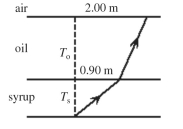
(Multiple Choice)
4.9/5 (79)
(79) David stands 2.5 m in front of a plane mirror.
(a) How far from David is his image in the mirror?
(b) If David moves away from the mirror at 1.5 m/s, how fast are David and his image moving apart from each other?
(c) If David is 180 cm tall, how tall is his image in the mirror?
(Short Answer)
4.9/5 (90)
(90) When a flower petal is 4.0 cm in front of a converging lens, the inverted image is half the height of the petal. What is the focal length of this lens?
(Multiple Choice)
4.9/5 (76)
(76) A convex lens has focal length f. If an object is located at "infinity" (very far away), the image formed is located at a distance from the lens
(Multiple Choice)
4.8/5 (75)
(75) 
Filters
- Essay(0)
- Multiple Choice(0)
- Short Answer(0)
- True False(0)
- Matching(0)