



 Chat with AI
Exam 18: Ray Optics

Exam 1: Representing Motion113 Questions
Exam 2: Motion in One Dimension174 Questions
Exam 3: Vectors and Motion in Two Dimensions183 Questions
Exam 4: Forces and Newtons Laws of Motion64 Questions
Exam 5: Applying Newtons Laws82 Questions
Exam 6: Gravity96 Questions
Exam 7: Rotational Motion95 Questions
Exam 8: Equilibrium Ad Elasticity73 Questions
Exam 9: Momentum103 Questions
Exam 10: Energy and Work223 Questions
Exam 11: Using Energy106 Questions
Exam 12: Thermal Properties of Matter220 Questions
Exam 13: Fluids115 Questions
Exam 14: Oscillations105 Questions
Exam 15: Traveling Waves and Sound94 Questions
Exam 16: Superposition and Standing Waves66 Questions
Exam 17: Wave Optics129 Questions
Exam 18: Ray Optics155 Questions
Exam 19: Optical Instruments137 Questions
Exam 20: Electric Fields and Forces95 Questions
Exam 21: Electric Potential144 Questions
Exam 22: Current and Resistance125 Questions
Exam 23: Circuits157 Questions
Exam 24: Magnetic Fields and Forces168 Questions
Exam 25: EM Induction and Em Waves185 Questions
Exam 26: AC Electricity122 Questions
Exam 27: Relativity126 Questions
Exam 28: Quantum Physics86 Questions
Exam 29: Atoms and Molecules105 Questions
Exam 30: Nuclear Physics175 Questions
Select questions type


When an object is 12 cm in front of a concave mirror, the image is 3.0 cm in front of the mirror? What is the focal length of the mirror?
(Multiple Choice)
4.9/5  (72)
(72) Lucite has an index of refraction of 1.50. What is its critical angle if it is in air?
(Multiple Choice)
4.8/5 (80)
(80) An object is 10 cm in front of a concave spherical mirror with a focal length of magnitude 3.0 cm. Where is the image?
(Multiple Choice)
4.9/5 (78)
(78) An object is 50 cm from a concave mirror with radius of curvature of magnitude 60 cm. What is the lateral magnification produced by the mirror?
(Multiple Choice)
4.9/5 (87)
(87) An object is 5.7 cm from a spherical concave mirror. If the image is 4.7 cm tall and 10 cm from the mirror, how tall is the object?
(Multiple Choice)
4.7/5 (80)
(80) The critical angle for a beam of light passing from water into air is 48.8°. This means that all light rays with an angle of incidence in the water that is greater than 48.8° will be
(Multiple Choice)
4.9/5 (92)
(92) An optic fiber is made of clear plastic with an index of refraction of 1.50. For what range of angles of incidence θ with the lateral surface of the fiber will light remain inside the plastic "guide" if it is surrounded by air?
(Multiple Choice)
4.8/5 (80)
(80) A ray of light (ray a) in air strikes a flat piece of glass at an angle of φ0 = 84° with respect to the normal, as shown in the figure. The index of refraction of the glass is 1.5. What is the angle θ between the reflected ray (ray b) and refracted ray (ray c) rays? 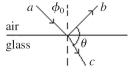
(Short Answer)
4.8/5 (80)
(80) A 3.0-cm tall statue is 48 cm in front of a convex lens having a focal length of magnitude 20 cm.
(a) Is the image of the statue real or virtual?
(b) How far is the image from the lens?
(c) Is the image upright or inverted?
(d) How tall is the image?
(Short Answer)
4.9/5 (83)
(83) A 14-mm tall postage stamp is 4.0 mm from a converging lens. If the image of the stamp is 4.0 mm tall, how far is it from the lens?
(Multiple Choice)
4.9/5 (77)
(77) Which of following statements about the image formed by a single converging lens are true? (There could be more than one correct choice.)
(Multiple Choice)
4.9/5 (77)
(77) A plant that is 4.0 cm tall is placed 15 cm from a concave spherical mirror having a focal length of magnitude 20 cm. Where is the image located?
(Multiple Choice)
4.9/5 (72)
(72) A flashlight beam makes an angle of 60° with the plane of the surface of a calm lake before it enters the water. In the water what angle does the beam make with the plane of the surface? The index of refraction of water is 1.33.
(Multiple Choice)
4.7/5 (97)
(97) An object is placed 21 cm from a concave lens having a focal length of magnitude 25 cm. What is the magnification?
(Multiple Choice)
4.9/5 (85)
(85) When an object is placed 118 cm from a thin diverging lens, its image is found to be 59 cm from the lens. The lens is removed, and replaced by a thin converging lens whose focal length has the same magnitude as the diverging lens. This second lens is at the original position of the first lens. Where is the image of the object now?
(Short Answer)
4.7/5 (61)
(61) An object is placed on the left side of a thin lens, and the image of this object is formed on the left side of the lens. Which of the following statements must be true? (There could be more than one correct choice.)
(Multiple Choice)
4.9/5 (73)
(73) A cell phone that is 8.90 cm tall is placed in front of a convex mirror. The image of the phone is 7.80 cm tall and is located 14.8 cm from a mirror. What is the mirror's focal length?
(Multiple Choice)
4.9/5 (83)
(83) A light beam is traveling inside a glass block that has an index of refraction of 1.46. As this light arrives at the surface of the block, it makes an angle of 53.0° with the normal. At what angle with the normal in the air will it leave the block?
(Multiple Choice)
4.8/5 (60)
(60) A light beam having a wavelength of 470 nm in air is directed into glycerine at an angle of 75.0° with the normal in air. Glycerine has a refractive index of 1.47. (c = 3.0 × 10⁸ m/s)
(a) What are the frequency and wavelength of the light in the glycerine?
(b) What angle does the light beam make with the normal in the glycerine?
(Short Answer)
4.9/5 (81)
(81) If the magnification of a mirror or lens is negative, it means that
(Multiple Choice)
4.9/5 (88)
(88) 
Filters
- Essay(0)
- Multiple Choice(0)
- Short Answer(0)
- True False(0)
- Matching(0)